
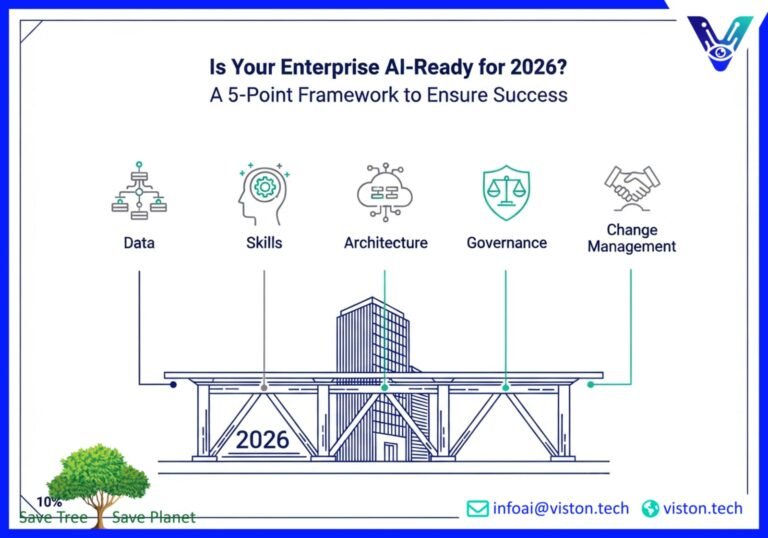
Enterprise AI Readiness: A 5-Point Assessment Framework for 2026
Artificial Intelligence is no longer a futuristic concept; it’s a present-day reality reshaping industries. Yet, for many enterprises, the promise of AI remains just out of reach. Industry reports paint a stark picture: a staggering 70-80% of AI initiatives are stuck in pilot phases, and a mere 23% of organizations successfully scale their AI projects. The primary culprit? A fundamental lack of AI readiness. This blog post introduces a practical 5-point assessment framework to ensure your enterprise is poised for AI success in 2026. #AIreadiness #enterpriseAI #digitaltransformation
Why AI Readiness is Non-Negotiable in 2026
In today’s competitive landscape, AI is the new frontier of business innovation. From optimizing supply chains to personalizing customer experiences, AI-powered solutions are unlocking unprecedented efficiency and growth. However, diving into AI without a solid foundation is like building a skyscraper on sand. An AI readiness assessment acts as your blueprint, identifying potential roadblocks before they derail your projects. By proactively addressing these gaps, you can prevent costly failures and position your organization to harness the full transformative power of AI.
The 5-Point Enterprise AI Readiness Framework
Our framework provides a holistic view of your organization’s AI preparedness, focusing on five critical pillars: data, skills, architecture, governance, and change management. Let’s delve into each of these areas and the key questions you need to ask.
1. Data: The Lifeblood of AI
Data is the fuel that powers every AI algorithm. Without high-quality, accessible data, even the most sophisticated AI models will falter. A comprehensive data readiness assessment is the first step towards building a robust AI strategy.
Key Assessment Questions:
- Data Quality and Availability: Is your data accurate, complete, and consistent? Do you have robust data collection and storage mechanisms in place?
- Data Accessibility: Can your data scientists and AI teams easily access the data they need? Are there data silos hindering collaboration?
- Data Governance: Do you have clear policies for data ownership, usage, and security? Is your data compliant with relevant regulations like GDPR?
- Data Diversity: Does your data accurately represent the real-world scenarios you want your AI to address? Are you actively working to mitigate biases in your datasets?
For more insights into building a modern data foundation, explore this comprehensive guide on building a modern data foundation for AI.
2. Skills: Bridging the Talent Gap
The demand for AI talent far outstrips the current supply. A successful AI adoption strategy requires a proactive approach to building and acquiring the necessary skills within your organization.
Key Assessment Questions:
- Technical Expertise: Do you have employees with skills in machine learning, data science, and AI engineering? If not, do you have a plan to hire or upskill?
- Domain Knowledge: Do your AI teams have a deep understanding of the business problems they are trying to solve?
- AI Literacy: Are your business leaders and employees equipped with a basic understanding of AI concepts and their implications?
- Culture of Learning: Does your organization foster a culture of continuous learning and experimentation?
3. Architecture: The Foundation for Scalability
Your IT architecture must be agile and scalable to support the demands of AI workloads. Legacy systems can often be a significant bottleneck in AI implementation.
Key Assessment Questions:
- Scalability and Performance: Can your current infrastructure handle the large-scale data processing and computational power required for AI?
- Flexibility and Agility: Is your architecture flexible enough to integrate new AI technologies and tools as they emerge?
- Data Integration: Can your architecture seamlessly integrate data from various sources, both internal and external?
- Security: Is your architecture secure enough to protect sensitive data and AI models from cyber threats?
4. Governance: Ensuring Responsible AI
As AI becomes more powerful, the need for robust governance frameworks becomes paramount. Responsible AI is not just a matter of compliance; it’s about building trust with your customers and stakeholders.
Key Assessment Questions:
- Ethical Guidelines: Have you established clear ethical principles for the development and deployment of AI?
- Transparency and Explainability: Can you explain how your AI models make decisions? Are your AI systems transparent to users?
- Accountability and Oversight: Who is responsible for the outcomes of your AI systems? Do you have clear lines of accountability?
- Risk Management: Have you identified and assessed the potential risks associated with your AI initiatives, including bias, fairness, and privacy?
To learn more about establishing a robust AI governance framework, read this insightful article on the importance of AI governance from the World Economic Forum.
5. Change Management: Fostering a Culture of Adoption
Technology is only half the battle. Successful AI adoption requires a concerted effort to manage the cultural and organizational changes that come with it. #AIadoption #changemanagement
Key Assessment Questions:
- Leadership Alignment: Are your leaders aligned on the strategic vision and goals for AI? Are they actively championing the change?
- Employee Engagement: Are you communicating the benefits of AI to your employees and addressing their concerns?
- Workflow Integration: How will AI be integrated into existing workflows and processes? Have you identified opportunities for automation and augmentation?
- Training and Support: Are you providing your employees with the training and support they need to adapt to new ways of working with AI?
The AI Maturity Model: Where Do You Stand?
The AI maturity model helps you benchmark your current capabilities and chart a course for future growth. It typically consists of several stages:
- Level 1: Initial/Ad Hoc: AI initiatives are siloed and experimental, with no clear strategy or governance.
- Level 2: Repeatable: Pockets of AI success exist, but there is no enterprise-wide coordination or standardization.
- Level 3: Defined: An enterprise-wide AI strategy and governance framework are in place, with defined processes and roles.
- Level 4: Managed: AI is integrated into core business processes, with a focus on continuous improvement and optimization.
- Level 5: Optimized: AI is a core driver of business innovation and competitive advantage, with a culture of continuous learning and adaptation.
Industry Benchmarks: Learning from the Leaders
Leading organizations across industries are already reaping the rewards of their AI investments. For instance, in finance, AI is being used for fraud detection and algorithmic trading. In healthcare, it’s powering personalized medicine and drug discovery. By studying these industry benchmarks, you can gain valuable insights into best practices and potential use cases for your own organization.
Take Action: Your Path to AI Readiness
Don’t let your AI initiatives become another statistic of stalled projects. By systematically assessing your enterprise’s AI readiness across these five key pillars, you can build a solid foundation for success. An honest and thorough assessment will illuminate your strengths and weaknesses, enabling you to develop a targeted action plan to bridge the gaps.
Ready to embark on your AI journey with confidence? The path to becoming an AI-driven enterprise begins with a clear understanding of where you stand today. Use this framework to start the conversation within your organization and pave the way for a future of innovation and growth.
Ready to accelerate your AI adoption and unlock true business value? Contact Viston AI today to learn how our AI-powered solutions can help you navigate your transformation journey.
Frequently Asked Questions (FAQs)
1. What is an enterprise AI readiness assessment?
An enterprise AI readiness assessment is a comprehensive evaluation of an organization’s preparedness to successfully adopt and scale artificial intelligence. It examines key areas such as data infrastructure, technical skills, IT architecture, governance policies, and change management capabilities to identify strengths, weaknesses, and potential roadblocks to AI implementation.
2. Why is AI readiness crucial for successful AI adoption?
AI readiness is crucial because it helps organizations avoid the common pitfalls that lead to the failure of AI projects. By proactively identifying and addressing gaps in data, skills, and governance, companies can mitigate risks, ensure alignment with business goals, and build a solid foundation for scaling AI initiatives beyond the pilot stage, ultimately leading to a higher return on investment.
3. What are the key components of an AI readiness framework?
A comprehensive AI readiness framework typically includes five key components:
- Data: Assessing the quality, accessibility, and governance of data.
- Skills: Evaluating the technical and business skills of the workforce.
- Architecture: Analyzing the scalability and flexibility of the IT infrastructure.
- Governance: Establishing ethical guidelines and accountability for AI systems.
- Change Management: Preparing the organization for the cultural and process changes that AI will bring.
4. How can we measure our organization’s AI maturity?
You can measure your organization’s AI maturity using an AI maturity model. This model typically outlines several stages of AI adoption, from initial ad-hoc experimentation to a fully optimized and AI-driven enterprise. By benchmarking your current capabilities against this model, you can identify areas for improvement and develop a roadmap for advancing to higher levels of maturity.
5. What are the first steps to take after conducting an AI readiness assessment?
After conducting an AI readiness assessment, the first steps should be to analyze the findings and prioritize the identified gaps. Develop a detailed action plan with clear timelines and responsibilities for addressing each weakness. This may involve investing in data infrastructure, launching upskilling programs, updating IT architecture, or establishing an AI governance committee. Secure buy-in from leadership to ensure the necessary resources are allocated to execute the plan.
6. How can we build an AI-ready workforce?
Building an AI-ready workforce involves a multi-pronged approach. Start by assessing your current skills and identifying gaps. Then, develop a comprehensive training and development program that includes both technical and non-technical skills. Foster a culture of continuous learning and provide opportunities for employees to experiment with AI tools. Consider a mix of hiring external talent and upskilling your existing employees to build a well-rounded team.
7. What is the role of governance in enterprise AI?
Governance plays a critical role in enterprise AI by ensuring that AI systems are developed and used responsibly and ethically. A strong governance framework helps to mitigate risks such as bias, privacy violations, and lack of transparency. It also establishes clear lines of accountability and ensures that AI initiatives are aligned with the organization’s values and legal obligations, thereby building trust with customers and stakeholders.
8. How can we ensure our AI initiatives deliver a positive ROI?
To ensure a positive ROI, it’s essential to align your AI initiatives with clear business objectives and key performance indicators (KPIs). Start with small, well-defined projects that have a clear business case and can deliver quick wins. Continuously monitor the performance of your AI models and measure their impact on your KPIs. A thorough AI readiness assessment will also help to ensure that you have the necessary foundations in place to support successful and profitable AI projects.
