
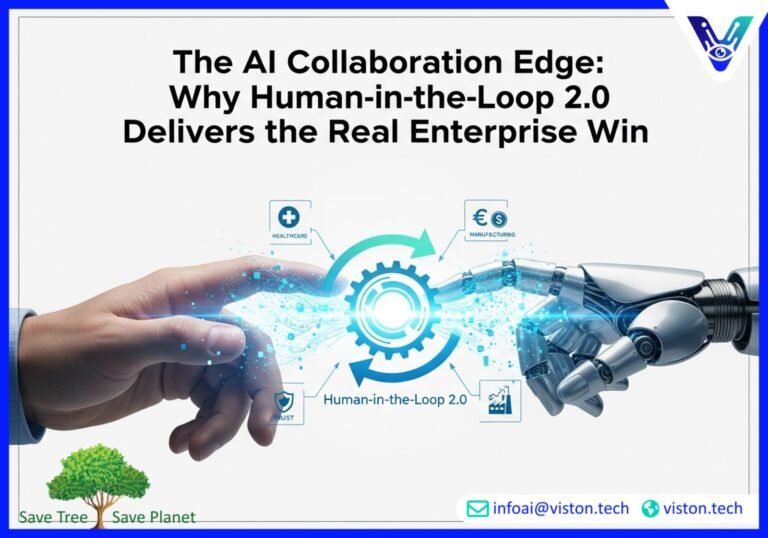
Hybrid Workflows: Why Human-in-the-Loop 2.0 Is the Real Enterprise Win
The conversation around Artificial Intelligence in the enterprise is undergoing a radical transformation. For years, the narrative was dominated by a single, formidable theme: replacement. The idea that AI would systematically replace human workers sent ripples of apprehension through boardrooms and breakrooms alike. But as we move further into 2025, a more nuanced and powerful reality is taking shape. The focus is no longer on replacement but on augmentation. This is the era of Human-AI collaboration, a symbiotic relationship that is unlocking unprecedented levels of productivity and innovation. At the heart of this evolution are hybrid workflows, powered by a concept we’re calling Human-in-the-Loop 2.0.
Recent studies reveal a fascinating trend: a significant portion of the workforce is already engaged in this collaborative model. While specific figures vary, the underlying truth is that employees are increasingly reviewing and refining AI-generated outputs. This constant human oversight is not a sign of AI’s failure, but rather a testament to a sophisticated and mature approach to its implementation. This collaborative process is crucial for enhancing the safety, reliability, and overall quality of AI-powered solutions. It’s a clear indication that the most successful enterprises are not just adopting AI, but are thoughtfully integrating it into the very fabric of their operations, with human expertise as the critical guiding force.
The Genesis of Human-in-the-Loop 2.0: From Correction to Collaboration
The initial concept of Human-in-the-Loop (HITL) was primarily about quality control. Humans were brought in to label data for training machine learning models or to correct errors in AI output. While valuable, this was a largely reactive role. Human-in-the-Loop 2.0, however, is a proactive and collaborative paradigm. It’s about creating a continuous feedback loop where human insights and expertise are used to not only correct but also to guide, refine, and improve AI systems in real-time. This evolution is pivotal for building trust in AI and establishing robust governance frameworks.
In this new model, AI handles the heavy lifting of data processing, pattern recognition, and initial analysis, while humans provide the contextual understanding, critical thinking, and ethical considerations that machines currently lack. This partnership allows organizations to tackle complex challenges with a level of precision and creativity that was previously unimaginable.
Case Studies in Human-AI Collaboration: Real-World Wins
The theoretical benefits of hybrid workflows are compelling, but their true value is demonstrated in their real-world applications. Here are three case studies that highlight the power of Human-in-the-Loop 2.0 across different industries:
1. Healthcare: Enhancing Diagnostic Accuracy and Patient Care
In the high-stakes world of medical diagnostics, accuracy is paramount. AI algorithms are now capable of analyzing medical images, such as X-rays and MRIs, with remarkable speed and precision, often identifying subtle anomalies that the human eye might miss. However, the final diagnosis is never left to the machine alone.
- The Hybrid Workflow: An AI system first scans and flags potential areas of concern in a patient’s medical images. This initial analysis is then presented to a radiologist, along with a confidence score for each finding.
- The Human-in-the-Loop 2.0 Advantage: The radiologist, armed with their extensive medical knowledge and understanding of the patient’s history, reviews the AI’s findings. They can then confirm, reject, or modify the AI’s conclusions. This collaborative process not only improves diagnostic accuracy but also accelerates the entire workflow, allowing doctors to see more patients and reduce waiting times. Furthermore, the radiologist’s feedback is fed back into the AI system, continually refining its algorithms and improving its future performance. This creates a virtuous cycle of learning and improvement, ultimately leading to better patient outcomes.
2. Finance: Augmenting Fraud Detection and Risk Management
The financial services industry is constantly battling sophisticated fraud schemes. AI-powered systems are instrumental in analyzing vast amounts of transactional data in real-time to identify suspicious activities. However, the nuances of financial transactions often require human judgment to avoid false positives and ensure legitimate customers are not inconvenienced.
- The Hybrid Workflow: An AI model continuously monitors transactions, flagging those that deviate from established patterns or exhibit characteristics of known fraud tactics.
- The Human-in-the-Loop 2.0 Advantage: Instead of automatically blocking a flagged transaction, the system escalates it to a human fraud analyst. The analyst can then investigate the transaction in greater detail, considering factors that the AI might not have access to, such as recent customer communications or known life events. This human oversight prevents the system from being overly zealous and blocking legitimate transactions, which can be a major source of customer frustration. The analyst’s decision is then used to retrain the AI model, making it smarter and more discerning over time. This approach not only strengthens fraud prevention but also enhances the customer experience and builds trust. For more on the evolution of AI in business, AI Business provides cutting-edge news and analysis.
3. Manufacturing: Optimizing Supply Chains and Quality Control
In the manufacturing sector, efficiency and quality are key drivers of success. AI is being used to optimize everything from supply chain logistics to production line quality control. Human expertise remains indispensable for navigating the complexities and unexpected challenges of the real world.
- The Hybrid Workflow: An AI-powered system analyzes data from various sources, including supplier delivery times, production line sensors, and quality control cameras, to predict potential disruptions and identify defects.
- The Human-in-the-Loop 2.0 Advantage: When the AI identifies a potential supply chain bottleneck or a quality control issue, it alerts a human manager. The manager can then use their experience and problem-solving skills to address the issue. For example, they might contact an alternative supplier or adjust the production line to correct a recurring defect. This hybrid approach allows manufacturers to proactively address problems before they escalate, minimizing downtime and ensuring product quality. The insights gained from these human interventions are then used to improve the AI’s predictive models, making the entire manufacturing process more resilient and efficient. A deeper dive into how AI is reshaping industries can be found in the comprehensive reports by McKinsey & Company.
The Importance of Escalation Frameworks in Hybrid Workflows
A crucial component of successful Human-in-the-Loop 2.0 implementation is the development of robust escalation frameworks. These are predefined pathways that determine when and how an AI system should escalate a decision to a human. A well-designed escalation framework ensures that human intervention is sought in situations where it is most needed, such as:
- High-stakes decisions: When the potential impact of an incorrect decision is significant, human oversight is essential.
- Low-confidence predictions: If the AI is not confident in its own output, it should automatically escalate the decision to a human.
- Novel or unusual situations: When the AI encounters a situation that it has not been trained on, it should defer to human judgment.
By establishing clear escalation protocols, organizations can strike the right balance between automation and human oversight, maximizing the benefits of AI while minimizing its risks.
Decision Quality Improvements: The Ultimate ROI of Human-AI Collaboration
The ultimate measure of success for any enterprise technology is its impact on the bottom line. Human-AI collaboration delivers a significant return on investment by dramatically improving the quality of decision-making across the organization. By combining the speed and analytical power of AI with the wisdom and experience of human experts, organizations can make decisions that are:
- More accurate: AI can uncover insights from data that humans might miss, while humans can provide the context and common sense that AI lacks.
- More consistent: AI can help to reduce the impact of human biases on decision-making, leading to more consistent and equitable outcomes.
- More agile: Hybrid workflows allow organizations to respond more quickly to changing market conditions and emerging opportunities.
The result is a more intelligent, adaptable, and competitive enterprise, poised to thrive in the age of AI.
Your Partner in the Hybrid Future: Viston AI
The journey to embracing Human-in-the-Loop 2.0 and building effective hybrid workflows requires a deep understanding of both AI technology and business processes. At Viston AI, we specialize in developing AI-powered solutions that are designed from the ground up to augment human capabilities and drive real business value. Our team of experts can help you to identify the right opportunities for Human-AI collaboration within your organization and to design and implement solutions that are tailored to your specific needs.
Don’t just adopt AI; empower your people with it. Contact Viston AI today to learn more about how our AI-powered solutions can help you to unlock the full potential of your enterprise.
#HumanAICollaboration #HybridWorkflows #HumanInTheLoop #EnterpriseAI #FutureOfWork #DigitalTransformation #AIGovernance #TrustInAI
Frequently Asked Questions (FAQs)
1. What is Human-in-the-Loop 2.0?
Human-in-the-Loop 2.0 is an evolution of the traditional HITL concept. It moves beyond simple data labeling and error correction to a more collaborative model where humans actively guide, refine, and improve AI systems in real-time. It emphasizes a continuous feedback loop that enhances the AI’s performance and builds trust.
2. How do hybrid workflows benefit enterprises?
Hybrid workflows combine the strengths of both humans and AI. AI handles large-scale data processing and analysis, while humans provide critical thinking, contextual understanding, and ethical oversight. This collaboration leads to improved decision quality, increased efficiency, enhanced safety and reliability, and a better final product or service.
3. Why is human oversight still necessary with advanced AI?
Despite the advancements in AI, it still lacks the nuanced understanding, common sense, and ethical judgment of humans. Human oversight is crucial for handling complex, ambiguous, or high-stakes situations that require a level of reasoning that AI has not yet achieved. It also helps to mitigate biases that may be present in the AI’s training data.
4. What are escalation frameworks in the context of AI?
Escalation frameworks are structured protocols that define when an AI system should hand over a task or decision to a human. These are typically triggered by factors such as the AI’s confidence level in its own output, the complexity of the task, or the potential impact of the decision. They are essential for ensuring that human expertise is applied where it is most needed.
5. How does Human-AI collaboration improve decision quality?
Human-AI collaboration improves decision quality by combining the analytical power of AI with the contextual intelligence of humans. AI can process vast amounts of data to identify patterns and insights that humans might miss, while humans can interpret these findings in the context of the real world and make more informed and strategic decisions.
6. What are some industries that are benefiting from hybrid workflows?
A wide range of industries are already benefiting from hybrid workflows, including healthcare (for diagnostics and treatment planning), finance (for fraud detection and risk management), manufacturing (for supply chain optimization and quality control), and customer service (for handling complex inquiries). The applications of Human-AI collaboration are continually expanding as the technology matures.
7. How does reviewing AI output improve the AI system itself?
When humans review and correct AI-generated output, this feedback can be used to retrain and refine the AI model. This process, known as reinforcement learning from human feedback (RLHF), helps the AI to learn from its mistakes and improve its performance over time, creating a virtuous cycle of continuous improvement.
8. What is the role of trust and governance in Human-AI collaboration?
Trust and governance are foundational to successful Human-AI collaboration. Employees need to trust that the AI systems they are working with are reliable and accurate. Organizations need to establish clear governance frameworks to ensure that AI is used responsibly and ethically. Human oversight is a key component of building both trust and effective governance.
