
The Agentic Operating System: How Enterprises Standardize AI in 2026
The year is 2026. Your enterprise is no longer just using AI; it’s deploying armies of AI agents. These autonomous workers operate 24/7 across your organization. They manage supply chains, serve customers, and detect fraud. But with thousands of these “agent swarms” running simultaneously, a new challenge has emerged: chaos. Without a central command center, these powerful tools can become inefficient, non-compliant, and risky. The era of isolated AI experiments is over. Welcome to the age of the Agentic Operating System (AOS), the essential framework for standardizing enterprise AI.
Industry leaders are unanimous: scaling AI requires a new approach. Ad-hoc deployments create silos and vulnerabilities. An AOS provides the governance, orchestration, and compliance needed to manage AI at scale. It’s the difference between a disorganized militia and a disciplined, effective digital workforce. This is how modern enterprises will compete and win in the new age of automation.
The Problem with Ad-Hoc AI: Why Your Current Strategy Won’t Scale
Many organizations fall into the “pilot project trap.” They see success with a few isolated AI agents but struggle to expand beyond these initial wins. Each department builds its own solutions on different platforms. This ad-hoc approach quickly leads to a fragmented and unmanageable AI landscape. The result is duplicated effort, inconsistent results, and escalating costs.
As enterprises deploy more autonomous agents, this lack of standardization becomes a critical business risk. How can you ensure hundreds of disconnected agents are complying with regulations like the EU AI Act? How do you track ROI when every team uses different metrics? The answer is, you can’t. This is where the Agentic Operating System becomes indispensable.
Ad-Hoc Experimentation vs. The Agentic Operating System (AOS)
The transition from scattered AI projects to a unified strategy is a matter of operational survival. Here’s a clear comparison of the two approaches:
| Feature | Ad-Hoc AI Approach (The Past) | AOS Approach (The Future) |
|---|---|---|
| Control | Fragmented and siloed. Each agent operates independently. | Centralized agent control planes for unified oversight. |
| Governance | Inconsistent or non-existent. Applied manually per project. | Embedded and automated. Policies are enforced across all agents. |
| Orchestration | Minimal to none. Agents cannot collaborate on complex tasks. | Dynamic multi-agent orchestration to manage complex workflows. |
| Compliance | Manual and difficult to audit. High risk of violations. | Automated monitoring and reporting for seamless compliance. |
| Scalability | Limited. Scaling increases complexity and risk exponentially. | Designed for scale. Easily manage thousands of agents. |
| Efficiency | Low. Redundant systems and wasted resources. | High. Shared memory, tools, and context reduce operational costs. |
What is an Agentic Operating System (AOS)?
Think of a traditional operating system like Windows or macOS. It manages all the hardware and software resources of a computer so that applications can run smoothly. An Agentic Operating System (AOS) does the same thing, but for your AI workforce. It is an intelligent software layer that coordinates models, workflows, and data across all your AI systems.
An AOS is not just another AI tool; it is the foundational platform that enables AI to function as a cohesive, enterprise-wide capability. It provides the core services that turn a collection of individual bots into a fully orchestrated digital workforce. According to thought leaders at IBM and other tech giants, this system is critical for any company serious about deploying autonomous AI.
Core Functions of an Agentic Operating System
- Orchestration: An AOS acts as an air traffic controller for your AI agents. It intelligently assigns tasks, manages handoffs between agents, and coordinates complex workflows that span multiple departments and software systems.
- Governance: The platform enforces the rules of the road. It ensures that every action taken by an AI agent aligns with your company’s ethical principles, operational policies, and risk tolerance. This is governance in action, not just on paper.
- Compliance: With an AOS, compliance is automated. The system maintains detailed logs of all agent activities, making audits straightforward. It continuously monitors for regulatory adherence, from data privacy laws to industry-specific mandates.
- Context and Memory: An AOS provides a shared memory for agents. This allows them to understand context from past interactions and collaborate effectively, preventing them from acting as isolated systems with no knowledge of the broader business process.
- Tool Integration: It provides a unified way for agents to access the tools they need to do their jobs, such as APIs, databases, and other software applications. This prevents redundant integrations and ensures secure access.
The Multi-Dashboard Dream: Agent Control Planes are Here
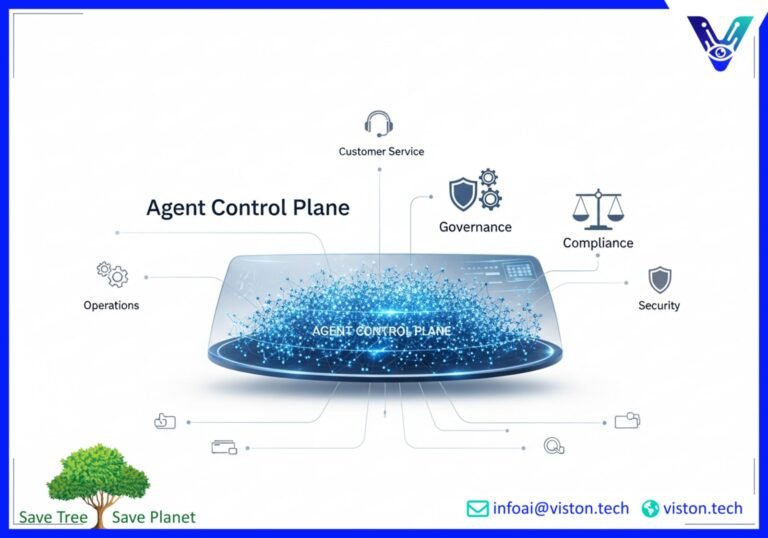
For years, executives have dreamed of a single pane of glass to view their entire operation. The AOS makes this a reality for AI. Through unified agent control planes, leaders can finally get a real-time, multi-dashboard view of their entire AI workforce.
Imagine a dashboard where a Chief Operating Officer can see the efficiency of supply chain agents in real-time. Picture a Chief Financial Officer monitoring financial reconciliation agents for accuracy and cost savings. Or a Chief Compliance Officer reviewing a log of all high-risk decisions escalated by AI agents. This is not science fiction; it is the practical application of an AOS. These control planes provide the visibility needed to manage, optimize, and trust an autonomous workforce. It transforms AI from a “black box” into a transparent and accountable business function.
Your Enterprise Governance Checklist for the Agentic Era
Effective governance is the bedrock of a successful AOS implementation. Without strong guardrails, the power of autonomous agents can create significant risks. As your organization prepares for this new reality, use this checklist to assess your readiness. This is your guide to building a responsible and defensible AI program for 2026.
- Establish a Complete AI Inventory: You cannot govern what you cannot see. Maintain a real-time inventory of all AI models and agents used across the organization, including those embedded in third-party vendor tools.
- Define Clear Ownership and Accountability: Assign a clear owner for every AI system. When an agent makes a mistake, there should be no ambiguity about who is responsible for addressing it.
- Implement Documented Decision Trails: Ensure your AOS logs not just what decisions were made by agents, but why. These audit trails are essential for debugging, performance tuning, and regulatory inquiries.
- Mandate Risk and Bias Assessments: All high-risk AI systems must undergo structured assessments before deployment. This includes documenting potential biases and implementing mitigation strategies to ensure fairness and equity.
- Enforce Vendor AI Transparency: Demand transparency from your software vendors. You need to understand how their embedded AI agents work, what data they use, and what governance controls they have in place.
- Automate Compliance Monitoring: Use the AOS to automate compliance checks. The system should be able to flag potential violations of GDPR, the EU AI Act, or other regulations in real time. For more on this, the Deloitte State of AI in the Enterprise report offers deep insights into rising compliance expectations.
- Develop a Human-in-the-Loop Protocol: Define clear rules for when an AI agent must escalate a decision to a human. This ensures that critical or sensitive tasks receive the necessary oversight.
The 2026 Vendor Landscape: Who is Building the AOS?
The market for Agentic Operating Systems is rapidly maturing. As enterprises shift from building individual models to orchestrating agent swarms, a new category of platforms is emerging. Understanding the vendor landscape is key to selecting the right partner for your AI standardization journey.
The Tech Giants
The world’s largest technology companies are heavily invested in building the foundational layers of the AOS. They are leveraging their vast cloud infrastructure and enterprise software ecosystems to offer powerful solutions.
- Microsoft: With its Copilot Studio and deep integration with Azure, Microsoft is enabling enterprises to build and orchestrate custom AI agents across their entire digital estate.
- Google: Through its Gemini models and Vertex AI platform, Google provides the tools for creating and managing sophisticated agentic workflows, backed by its world-class AI research.
- IBM: A strong proponent of enterprise AI, IBM’s watsonx Orchestrate is specifically designed to deploy and manage AI agents for business, with a heavy focus on governance and trust. You can learn more about their perspective on what agentic AI is and its implications.
- Amazon (AWS): Amazon Bedrock offers a comprehensive toolkit for building and scaling agentic applications, giving developers access to a wide range of foundation models on a secure and scalable platform.
Specialized Platforms
Alongside the tech giants, a new wave of vendors is focused exclusively on providing enterprise-grade agentic AI platforms. Companies like Kore.ai, Aisera, and aiXplain offer solutions that specialize in multi-agent orchestration, deep system integrations, and robust governance frameworks tailored for complex business environments.
The Path Forward: Make the AOS a Reality in Your Organization
Adopting an Agentic Operating System is not just a technology upgrade; it is a strategic business transformation. It requires a shift in mindset from building isolated AI tools to managing an integrated digital workforce. The journey begins with a clear vision and a deliberate, phased approach.
Start by identifying a high-impact business process that could be transformed by a team of collaborating AI agents. Use this initial project to build your governance framework and establish your agent control plane. Assemble a cross-functional team of IT, business, and compliance leaders to guide the implementation. By starting small and demonstrating value, you can build the momentum needed to scale the AOS across your entire enterprise.
The future of enterprise AI is not about having the most models. It’s about having the best-orchestrated system. The companies that thrive in 2026 will be those that master the science of standardizing AI. The Agentic Operating System is your command center for this new era.
Ready to harness the power of agent swarms with a robust Agentic Operating System? Contact the experts at Viston AI to explore our AI-powered solutions and build your enterprise AI strategy for 2026 and beyond.
Frequently Asked Questions (FAQs)
1. What is an Agentic Operating System (AOS)?
An Agentic Operating System (AOS) is a software platform that manages and orchestrates autonomous AI agents within an enterprise. It provides the necessary infrastructure for governance, compliance, and coordination, allowing “swarms” of agents to work together securely and efficiently to achieve complex business goals.
2. How is an AOS different from traditional AI or RPA?
Traditional AI and Robotic Process Automation (RPA) are typically reactive and task-based, following pre-defined rules or scripts. An AOS manages proactive, goal-driven AI agents that can plan, reason, and adapt their actions. It focuses on the high-level orchestration of many agents, not just the automation of a single task.
3. Why is AI governance so critical for agentic systems?
Because agentic systems are autonomous, they can make decisions and take actions without direct human input. Strong governance is essential to ensure these actions are safe, ethical, compliant, and aligned with business objectives. Without it, companies face significant operational, financial, and reputational risks.
4. What are AI “agent swarms”?
The term “agent swarms” refers to large numbers of AI agents working collaboratively to handle complex, interconnected tasks. For example, a swarm could manage an entire supply chain, with different agents handling procurement, logistics, inventory, and forecasting in a coordinated fashion.
5. What is an agent control plane?
An agent control plane is a centralized dashboard or interface within an AOS. It gives business and IT leaders a unified view of their entire AI agent workforce. From this control plane, they can monitor performance, manage risks, ensure compliance, and track the ROI of their AI initiatives.
6. How do I start implementing an AOS strategy?
Start with a strategic, high-value use case rather than a broad, enterprise-wide rollout. Form a cross-functional team including IT, compliance, and business leaders. Define your governance framework early and choose a platform that prioritizes a unified agent control plane and robust orchestration capabilities.
7. What are the main compliance risks with autonomous AI agents?
The primary compliance risks include data privacy violations (e.g., mishandling personal data), biased decision-making that leads to discrimination, lack of transparency and auditability for regulatory bodies (like those enforcing the EU AI Act), and actions that violate industry-specific regulations.
8. Can small and medium-sized businesses (SMBs) benefit from an AOS?
Yes. While the term sounds enterprise-focused, the core principles of standardization and governance are beneficial for any business deploying multiple AI agents. Cloud-based AOS platforms are making this technology more accessible, allowing SMBs to manage their digital workforces effectively without needing large internal teams.
#AgenticOS #AOS #AIGovernance #Orchestration #AICompliance #EnterpriseAI #FutureOfWork #DigitalTransformation #AgentControlPlanes #AIStrategy2026
