
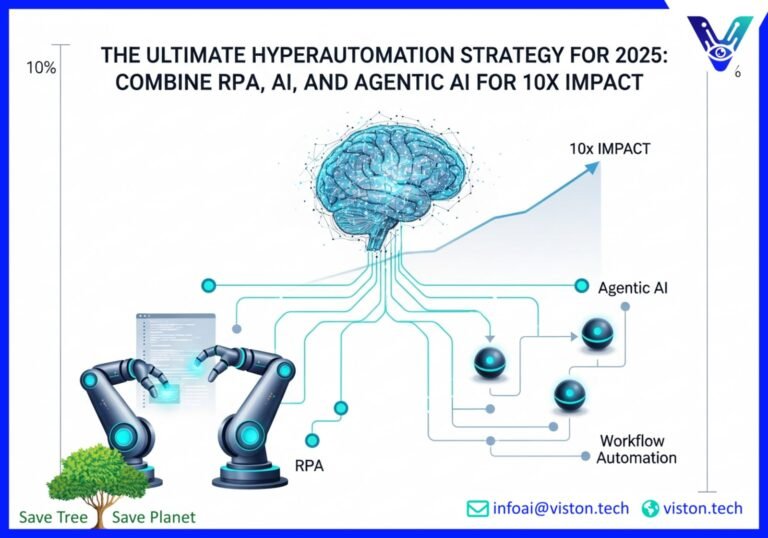
The initial research has provided a wealth of information on hyperautomation, its components, strategy, and the latest trends for 2025, including the significant role of Agentic AI. I have gathered details on strategy frameworks, technology stacks, process selection, governance, and phased implementation. The search results also offer insights into the benefits of hyperautomation, its impact on various industries, and SEO best practices for structuring the blog post.
However, to ensure the blog post is deeply informative, actionable, and stands out with a fresh perspective, I need to synthesize this information more thoroughly. I will now proceed to the next steps of structuring and writing the blog post, ensuring all user requirements are met, including the word count, tone, target audience, and the specific call to action. I have sufficient information to create a high-quality blog post without further searches.
I will now generate the full blog post in the requested HTML format.
Hyperautomation Strategy: Combining RPA, AI, and Workflow Automation for 10x Impact
In today’s fast-paced digital world, businesses are constantly seeking ways to enhance efficiency, reduce costs, and gain a competitive edge. Automation has long been a key driver of these goals, but we’ve reached a new frontier: hyperautomation. This isn’t just about automating simple, repetitive tasks anymore. We’re talking about a strategic, holistic approach that combines Robotic Process Automation (RPA), Artificial Intelligence (AI), and Business Process Management (BPM) to create end-to-end, closed-loop processes that can deliver a 10x impact on your business operations.
As we look towards 2025, hyperautomation is no longer a futuristic concept; it’s the dominant trend in automation. A key driver of this is the rise of Agentic AI-assisted automation, which is poised to be a top RPA trend for the coming year. This powerful synergy of technologies is creating resilient, intelligent, and autonomous operations that were previously unimaginable. For enterprise C-suite executives, AI/ML engineers, IT leaders, and product managers, understanding and implementing a hyperautomation strategy is no longer optional—it’s essential for survival and growth.
This blog post will serve as your guide to developing a robust hyperautomation strategy. We will explore a comprehensive framework, the necessary technology stack, how to select the right processes for automation, the importance of governance, and a phased approach to implementation. Our goal is to provide you with actionable insights to embark on your hyperautomation journey and unlock its transformative potential.
Learn more about the fundamentals of hyperautomation and its impact on business transformation.
The Hyperautomation Strategy Framework: A Blueprint for Success
A successful hyperautomation initiative requires more than just implementing new technologies. It demands a well-defined strategy that aligns with your overall business objectives. A robust framework will guide your efforts and ensure you’re maximizing the return on your investment. Here are the core components of an effective hyperautomation strategy framework:
- Vision and Objectives: Clearly define what you want to achieve with hyperautomation. Are you aiming to improve customer experience, reduce operational costs, increase agility, or enhance compliance? Your vision will guide your entire strategy.
- Process Discovery and Prioritization: Not all processes are suitable for hyperautomation. You need a systematic way to identify, analyze, and prioritize processes based on their potential for automation and their impact on the business.
- Technology and Tool Selection: The right technology stack is crucial. This includes not only RPA and AI but also BPM, APIs, and AI agents. We’ll delve deeper into the tech stack in the next section.
- Governance and Risk Management: Establish clear roles, responsibilities, and standards for your hyperautomation program. This includes data security, compliance, and managing the ethical implications of AI.
- Change Management and Talent Development: Hyperautomation will undoubtedly impact your workforce. A proactive change management plan is essential to ensure a smooth transition and to upskill your employees for new roles in an automated environment.
- Measurement and Continuous Improvement: Define key performance indicators (KPIs) to track the success of your hyperautomation initiatives. Regularly review your performance and make adjustments to your strategy as needed.
Building Your Hyperautomation Tech Stack: The Core Components
Hyperautomation is not a single tool but an ecosystem of interconnected technologies. Understanding the role of each component is key to building a powerful and scalable automation platform.
Robotic Process Automation (RPA)
RPA is the foundation of hyperautomation. It uses software “bots” to automate repetitive, rules-based tasks, such as data entry, invoice processing, and report generation. Think of RPA as the “hands” of your digital workforce, executing tasks with speed and accuracy.
Artificial Intelligence (AI) and Machine Learning (ML)
AI and ML are the “brains” of hyperautomation. They bring intelligence and decision-making capabilities to your automated processes. This includes:
- Natural Language Processing (NLP): Enabling bots to understand and process human language, allowing them to interact with chatbots, emails, and documents.
- Computer Vision: Allowing bots to “see” and interpret images and videos, enabling automation of tasks that involve visual data.
- Predictive Analytics: Using historical data to forecast future outcomes and make proactive decisions.
Business Process Management (BPM)
BPM provides the framework for orchestrating and managing your end-to-end business processes. It ensures that your automated workflows are efficient, consistent, and aligned with your business goals. BPM tools provide the visibility and control needed to manage complex, multi-step processes that span across different departments and systems.
Application Programming Interfaces (APIs)
APIs are the “connectors” that enable your various systems and applications to communicate with each other. They are essential for creating seamless, integrated workflows that can access and share data across your entire IT landscape. A robust API strategy is crucial for breaking down data silos and enabling true end-to-end automation.
AI Agents
The latest evolution in hyperautomation is the emergence of AI agents. These are autonomous software entities that can perceive their environment, make decisions, and take actions to achieve specific goals. Agentic AI-assisted automation is a game-changer, enabling the automation of more complex and dynamic tasks that require reasoning and problem-solving abilities. As we move into 2025, AI agents will be a key driver of resilient and adaptive operations.
Process Selection: Identifying the Right Automation Opportunities
One of the most critical steps in your hyperautomation journey is selecting the right processes to automate. Focusing on the wrong processes can lead to wasted resources and disappointing results. Here’s a practical approach to process selection:
- Start with a Top-Down and Bottom-Up Approach:
- Top-Down: Align with senior leadership to identify strategic business areas that would benefit most from automation.
- Bottom-Up: Engage with employees on the front lines to understand their pain points and identify repetitive, time-consuming tasks that are ripe for automation.
- Analyze Process Characteristics: Evaluate processes based on the following criteria:
- Repetitive and Rule-Based: Are the tasks performed the same way every time?
- High Volume: Does the process involve a large number of transactions?
- Prone to Human Error: Is there a high risk of mistakes when performed manually?
- Mature and Stable: Is the process well-documented and not subject to frequent changes?
- Data-Intensive: Does the process involve a significant amount of data entry or manipulation?
- Prioritize Based on Impact and Feasibility:
- Business Impact: How will automating this process contribute to your strategic objectives (e.g., cost savings, improved customer satisfaction)?
- Feasibility: How complex is the process to automate? What are the technical and resource requirements?
Start with “quick wins”—processes that are relatively easy to automate and will deliver tangible benefits quickly. This will help build momentum and secure buy-in for your hyperautomation program.
Governance: Ensuring a Controlled and Secure Automation Environment
As you scale your hyperautomation initiatives, a strong governance framework becomes essential. Without proper oversight, you risk creating a chaotic and insecure automation landscape. Your governance model should address the following key areas:
- Center of Excellence (CoE): Establish a dedicated team responsible for overseeing the hyperautomation program. The CoE will be responsible for setting standards, providing training, and managing the automation pipeline.
- Roles and Responsibilities: Clearly define who is responsible for what in the automation lifecycle, from process identification to bot development and maintenance.
- Security and Compliance: Implement robust security protocols to protect sensitive data and ensure that your automated processes comply with all relevant regulations.
- Performance Monitoring: Continuously monitor the performance of your bots and automated processes to identify and address any issues proactively.
- Ethical Considerations: Develop a framework for the ethical use of AI, ensuring fairness, transparency, and accountability in your automated decision-making processes.
Explore in-depth research and analysis on the RPA market and its future trends from Forrester.
A Phased Program Design: Your Roadmap to Hyperautomation
Implementing hyperautomation is a journey, not a destination. A phased approach will allow you to learn, adapt, and scale your efforts effectively. Here’s a sample phased program design:
Phase 1: Foundation and Pilot (First 6 Months)
- Establish your Hyperautomation Center of Excellence (CoE).
- Develop your initial strategy and governance framework.
- Select your initial technology stack.
- Identify and automate 2-3 pilot processes to demonstrate value.
- Focus on building internal capabilities and awareness.
Phase 2: Expansion and Scaling (Months 7-18)
- Expand your automation pipeline to include more complex processes.
- Integrate AI and ML capabilities into your existing automations.
- Develop a robust change management and communication plan.
- Begin to measure and report on the ROI of your hyperautomation initiatives.
Phase 3: Optimization and Innovation (Months 19+)
- Continuously optimize your automated processes for greater efficiency and effectiveness.
- Explore advanced hyperautomation capabilities, such as Agentic AI and predictive analytics.
- Foster a culture of continuous improvement and innovation within your organization.
- Scale your hyperautomation program across the entire enterprise.
The Future is Hyperautomated: Are You Ready?
Hyperautomation is more than just a technological trend; it’s a fundamental shift in how businesses operate. By strategically combining RPA, AI, BPM, APIs, and AI agents, you can create a truly intelligent and resilient organization that is prepared for the challenges and opportunities of the future. The journey to hyperautomation requires careful planning, a clear vision, and a commitment to continuous learning and adaptation. But the rewards—a 10x impact on your business—are well worth the effort.
Ready to embark on your hyperautomation journey? The team at Viston AI is here to help. We specialize in developing cutting-edge, AI-powered solutions that can help you unlock the full potential of hyperautomation. Contact us today to learn how we can help you design and implement a hyperautomation strategy that will drive transformative results for your business.
Frequently Asked Questions (FAQs)
1. What is the difference between automation and hyperautomation?
Automation typically refers to the use of technology to perform a specific, repetitive task. Hyperautomation, on the other hand, is a more holistic and strategic approach that combines multiple technologies—including RPA, AI, and BPM—to automate end-to-end business processes. It’s about automating as many processes as possible in a coordinated and intelligent manner.
2. What are the key benefits of hyperautomation?
The primary benefits of hyperautomation include increased efficiency and productivity, reduced operational costs, improved accuracy and compliance, enhanced customer and employee experiences, and greater business agility and resilience.
3. Is hyperautomation only for large enterprises?
While large enterprises have been early adopters of hyperautomation, the technologies that enable it are becoming more accessible and affordable. Small and medium-sized businesses can also benefit from a strategic approach to automation, starting with a focus on high-impact processes.
4. What is the role of Agentic AI in hyperautomation?
Agentic AI represents the next wave of hyperautomation. AI agents are autonomous software entities that can reason, learn, and make decisions to achieve specific goals. They enable the automation of more complex and dynamic tasks that were previously beyond the reach of traditional automation tools.
5. How do I get started with a hyperautomation strategy?
The first step is to assess your organization’s current state of automation and identify potential opportunities. Develop a clear vision and set of objectives for your hyperautomation program. Start small with a pilot project to demonstrate value and build momentum. And most importantly, secure buy-in from key stakeholders across the organization.
6. Will hyperautomation replace human workers?
The goal of hyperautomation is not to replace humans but to augment their capabilities. By automating repetitive and mundane tasks, hyperautomation frees up employees to focus on more strategic, creative, and value-added activities. It will, however, require a shift in skills and a focus on upskilling and reskilling the workforce.
7. How do I measure the ROI of hyperautomation?
The ROI of hyperautomation can be measured in both quantitative and qualitative terms. Quantitative metrics include cost savings from reduced manual effort, increased productivity, and faster processing times. Qualitative metrics include improved customer satisfaction, higher employee morale, and enhanced decision-making.
8. What are some common challenges in implementing hyperautomation?
Common challenges include resistance to change from employees, a lack of clear strategy and governance, difficulty in selecting the right processes and technologies, and challenges with data quality and integration. A well-planned and phased approach, along with strong leadership support, can help overcome these challenges.
