
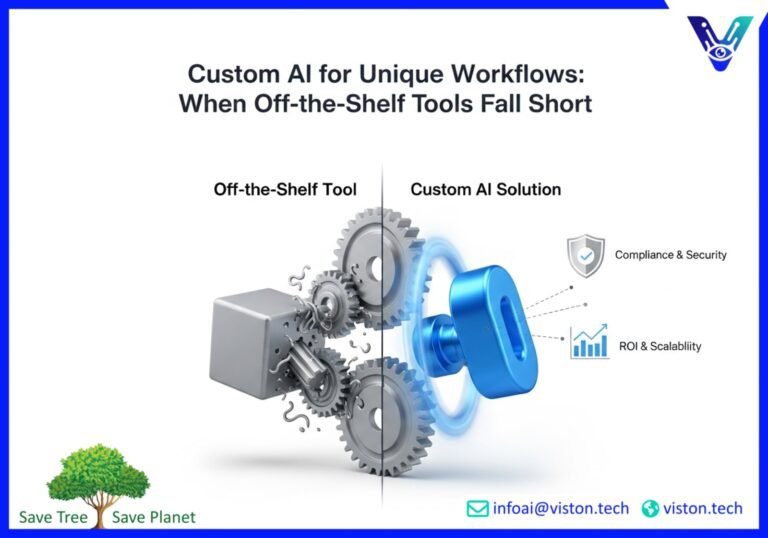
Custom AI Solutions for Unique Workflows: When Off-the-Shelf Tools Fall Short
The promise of artificial intelligence is immense, but the path to realizing its full potential is often challenging. While off-the-shelf AI tools offer a tempting quick fix, many organizations discover they are not enough. Shockingly, recent studies reveal that a staggering 75-95% of DIY AI projects fail to deliver a meaningful business impact. For businesses with complex operations or those in highly regulated industries, the one-size-fits-all approach of generic tools often leads to wasted resources and stalled progress.
This is where custom AI solutions, developed in partnership with experts, make a critical difference. Tailored AI not only addresses unique workflows but also unlocks significantly higher ROI and accelerates time-to-production. For enterprises navigating intricate compliance landscapes or dealing with specialized data, a bespoke solution is not a luxury—it’s a necessity for competitive advantage and sustainable growth.
When to Go Custom: Recognizing the Limits of Off-the-Shelf AI
Generic AI tools are designed for common, widespread use cases. They can be excellent for standard tasks, but their limitations quickly become apparent when faced with specialized business needs. If your organization is experiencing any of the following, it’s a strong indicator that a custom AI solution is the right path forward.
Your Workflows are Complex and Unique
Standard AI tools are built on generalized models. They often struggle to understand the specific nuances of your business processes, proprietary data, and industry-specific terminology. A custom solution, however, is built from the ground up to align perfectly with your operational reality. It learns from your data and is designed to handle the specific complexities of your workflows, leading to greater accuracy and efficiency.
You Operate in a Heavily Regulated Industry
For sectors like finance, healthcare, and pharmaceuticals, compliance is non-negotiable. Regulations such as GDPR, HIPAA, and financial services mandates require strict data governance, transparency, and model explainability. Off-the-shelf solutions often operate as “black boxes,” making it difficult to meet these stringent requirements. Custom AI provides full control over data handling, security protocols, and algorithmic transparency, ensuring your solutions are not only powerful but also fully compliant.
You Need a Sustainable Competitive Advantage
Using the same tools as your competitors will only yield the same results. A custom AI solution is a strategic asset that can set your business apart. By developing proprietary AI capabilities, you can create unique customer experiences, optimize operations in ways your rivals cannot, and unlock new revenue streams. This tailored approach transforms AI from a simple tool into a core driver of your long-term business strategy.
Scalability and Long-Term Costs are a Concern
While off-the-shelf tools may have a lower initial cost, their subscription and usage-based pricing models can become prohibitively expensive as your business scales. Custom AI solutions, though requiring a larger upfront investment, offer a more predictable and often lower total cost of ownership over time. You have complete control over the system’s evolution, allowing you to scale and adapt it as your business grows without being locked into a vendor’s pricing structure. For more on this topic, IBM offers valuable insights into the total cost of ownership for AI.
The Blueprint for Success: A Phased Approach to Custom AI
Embarking on a custom AI project can seem daunting, but a structured and collaborative approach ensures a successful outcome. By partnering with AI experts like Viston AI, you can navigate each phase with clarity and confidence, transforming a complex challenge into a strategic advantage.
Phase 1: Scoping and Discovery
This initial phase is the foundation of the entire project. It’s about moving beyond the technology to deeply understand the business problem you are trying to solve. The discovery process involves:
- Stakeholder Workshops: Bringing together business leaders, IT teams, and subject matter experts to align on objectives and define what success looks like.
- Problem Definition: Clearly articulating the specific pain points and opportunities that the AI solution will address.
- Feasibility Assessment: Evaluating the available data, technical infrastructure, and potential roadblocks to ensure the project is viable.
- ROI Projections: Defining key performance indicators (KPIs) and estimating the potential business impact to build a strong business case.
A thorough discovery phase prevents scope creep, aligns expectations, and ensures the final solution delivers tangible value.
Phase 2: Architecture and Design
With a clear understanding of the project’s goals, the next step is to design the technical blueprint. This phase is crucial for building a solution that is robust, scalable, and secure. Key activities include:
- Data Strategy: Identifying and preparing the necessary data, which may involve cleaning, labeling, and augmenting datasets to train the AI models effectively.
- Model Selection: Choosing the right AI and machine learning models that are best suited to the specific problem.
- System Architecture: Designing the end-to-end system, including how the AI model will integrate with existing software, data sources, and user interfaces.
- Compliance by Design: For regulated industries, embedding security and compliance considerations directly into the architecture to meet all necessary standards.
Phase 3: Build vs. Extend vs. Compose
Not every custom solution needs to be built entirely from scratch. A strategic decision must be made on the best development approach:
- Build: Creating a completely new, bespoke AI model and application. This offers the highest degree of customization and is ideal for highly specialized, core business functions.
- Extend: Taking a powerful, pre-trained foundation model and fine-tuning it with your proprietary data. This approach can significantly accelerate development time while still delivering a highly tailored solution.
- Compose: Integrating multiple existing AI services and APIs to create a new, composite application. This is often the fastest approach and works well for less complex workflows that can be addressed by combining specialized, best-in-class tools.
An experienced AI partner can help you evaluate the trade-offs between speed, cost, and control to select the approach that best fits your needs and resources.
Phase 4: Delivery and Integration
This is where the vision becomes a reality. The development team builds, tests, and deploys the AI solution. A successful delivery phase includes:
- Agile Development: Building the solution in iterative sprints, allowing for continuous feedback and adjustments.
- Rigorous Testing: Ensuring the model performs accurately and reliably with real-world data.
- Seamless Integration: Deploying the solution into your existing technology stack with minimal disruption to your operations.
- Change Management: Training your team and preparing the organization for the new AI-powered workflows to ensure smooth adoption.
Framing Timelines and Costs
The timeline and cost of a custom AI solution can vary significantly based on the complexity of the project. However, a transparent framework can provide clarity.
Timelines:
- Proof of Concept (PoC): A small-scale pilot to validate the approach can often be completed in 4-8 weeks.
- Minimum Viable Product (MVP): A functional, core version of the solution is typically ready in 3-6 months.
- Full-Scale Production System: A comprehensive, enterprise-grade solution may take 6-12 months or more to develop and deploy.
Cost Framing:
Initial investments for custom AI development can range from $50,000 for a focused MVP to several hundred thousand dollars for a complex, enterprise-wide platform. While this may seem substantial, it’s crucial to consider the long-term ROI. Custom solutions often deliver returns of 1.7x to 10x the initial investment by driving significant operational efficiencies, reducing compliance risks, and creating new revenue opportunities. Explore this in-depth analysis of AI workflow automation to understand its growing impact.
The Viston AI Advantage: Your Partner in Custom AI
Navigating the complexities of custom AI development requires more than just technical expertise; it demands a strategic partner who understands your business. At Viston AI, we specialize in building bespoke AI solutions that are tailored to the unique workflows and regulatory demands of your industry. Our end-to-end approach, from discovery and strategy to deployment and scaling, ensures your AI initiatives deliver measurable business impact.
Don’t let your AI projects become another statistic. Partner with Viston AI to build custom solutions that drive efficiency, ensure compliance, and unlock a true competitive edge.
Ready to move beyond off-the-shelf tools? Contact Viston AI today to schedule a consultation and discover how a custom AI solution can transform your business.
#CustomAI #AISolutions #AIConsulting #DigitalTransformation #EnterpriseAI #WorkflowAutomation #AIIntegration #FutureOfWork
Frequently Asked Questions (FAQs)
1. What is a custom AI solution?
A custom AI solution is an artificial intelligence system designed and built to address the specific needs, workflows, and data of a particular organization. Unlike off-the-shelf products, it is not a one-size-fits-all tool but is tailored to solve unique business challenges, integrate with existing systems, and meet specific compliance requirements.
2. When should my company choose a custom AI solution over an off-the-shelf tool?
You should consider a custom AI solution when off-the-shelf tools cannot handle the complexity of your workflows, when you operate in a highly regulated industry requiring strict data governance and transparency, or when the AI capability is core to your competitive strategy. If generic tools require extensive workarounds or cannot scale with your business, a custom solution is likely the better long-term investment.
3. What is the typical ROI for a custom AI project?
While it varies depending on the application, businesses often see a significant return on investment from custom AI solutions, with ROI multiples ranging from 1.7x to 10x. These returns are driven by increased operational efficiency, reduced labor costs, improved decision-making, enhanced customer experiences, and better compliance, which can prevent costly fines.
4. How long does it take to develop a custom AI solution?
The timeline depends on the project’s complexity. A proof-of-concept (PoC) might take 4-8 weeks, while a more functional Minimum Viable Product (MVP) could take 3-6 months. A full-scale, enterprise-grade production system typically requires 6-12 months or longer for development, testing, and integration.
5. What are the key stages in a custom AI development project?
A typical custom AI project follows four main stages: Scoping and Discovery (understanding the business problem and defining goals), Architecture and Design (creating the technical blueprint), Development and Implementation (building, extending, or composing the solution), and Delivery and Integration (deploying, testing, and ensuring user adoption).
6. How does a custom solution address data privacy and security concerns?
Custom AI solutions offer superior data privacy and security because you have full control over the architecture. Security protocols can be designed to meet your specific standards, and data processing can be handled within your own secure environment. This is especially critical for industries like healthcare and finance, where data sovereignty and compliance with regulations like HIPAA and GDPR are mandatory.
7. What kind of expertise is needed for a custom AI project?
A successful custom AI project requires a multidisciplinary team, including data scientists, machine learning engineers, software developers, solution architects, and business analysts. This is why partnering with an experienced AI consulting firm like Viston AI is often more effective and efficient than trying to build a team in-house.
8. Can custom AI integrate with our existing software and systems?
Yes, seamless integration is a key advantage of custom AI solutions. During the architecture phase, the solution is specifically designed to connect with your existing enterprise systems, such as CRMs, ERPs, and proprietary databases, ensuring a smooth workflow and maximizing the value of your current technology stack.
