
Integration Without Friction: APIs & Orchestration for Enterprise AI Agent Deployment
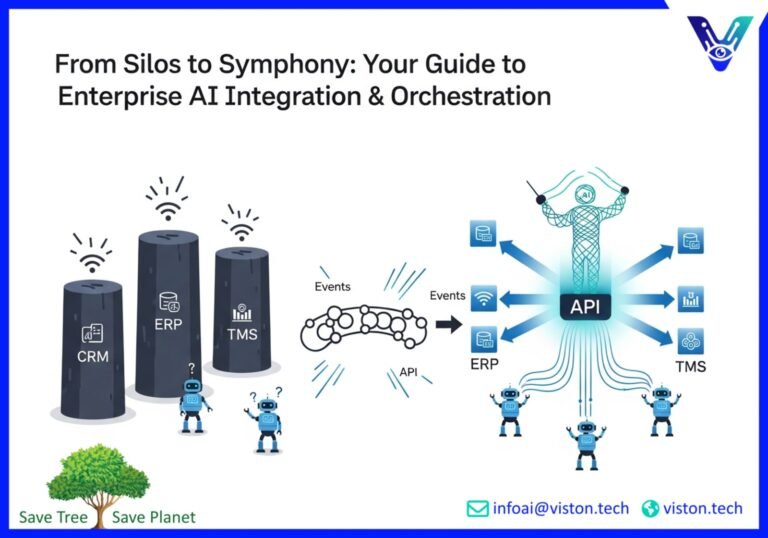
Enterprise AI adoption is accelerating, but many organizations hit a wall. The problem? Integration gaps and scattered data. Your powerful new AI agents are ready to revolutionize operations, but they’re stranded on digital islands. They can’t access the critical information locked away in your CRM, ERP, TMS, and other core systems. To truly unlock the value of AI, businesses are moving away from fragile, point-to-point links. Instead, they’re building unified data and orchestration layers. This allows AI agents to act reliably and intelligently across the entire enterprise.
The Integration Challenge: Why Your AI Agents Are Flying Blind
Imagine hiring a brilliant new employee but not giving them access to company email, files, or key software. That’s what happens when AI agents are deployed without proper integration. They have immense potential but lack the context to make effective decisions. The most common hurdles businesses face today include:
- Data Silos: Crucial data is often trapped in different departments and legacy systems. This makes it impossible to get a complete picture for your AI.
- Legacy Systems: Many established companies run on complex, older systems that weren’t designed to communicate with modern AI platforms.
- Security and Compliance: Integrating new AI tools raises valid concerns about data privacy, security, and adhering to regulations like GDPR.
- Lack of a Unified Strategy: Without a clear plan, integrations become a chaotic mess of custom connections that are difficult to maintain and scale.
These challenges don’t just slow down innovation; they actively prevent you from realizing the ROI on your AI investments. A recent industry report revealed that fewer than 20% of AI initiatives have been fully scaled across the enterprise, largely due to these integration barriers.
The Solution: APIs and Event-Driven Patterns
So, how do you bridge these gaps? The answer lies in two powerful concepts: APIs (Application Programming Interfaces) and event-driven architecture.
APIs: The Universal Translators of the Digital World
Think of an API as a universal adapter. It allows different software systems to talk to each other in a standardized way, regardless of how they were built. A well-designed API acts as a secure and reliable bridge, enabling your AI agents to:
- Fetch data from your CRM to personalize a customer interaction.
- Update inventory levels in your WMS after a sale is processed.
- Trigger a shipping request in your TMS.
By adopting an “API-first” approach, you design your systems to be inherently open to integration. This makes it easier to connect new AI tools and adapt to future technological shifts.
Event-Driven Architecture: Enabling Real-Time Reactions
While APIs are great for requesting information, event-driven architecture allows your systems to react to things as they happen. In this model, systems broadcast “events”—like “new customer registered” or “inventory low”—to a central hub. Your AI agents can then subscribe to these events and take immediate, intelligent action. This approach is the backbone of modern, scalable AI systems. It allows for:
- Real-Time Responsiveness: AI agents can react instantly to changes, from detecting potential fraud to optimizing logistics in real-time.
- Scalability and Resilience: Systems are decoupled, meaning one part can fail without bringing down the entire operation.
- Seamless AI Integration: AI functions can be modular services that are triggered by events, allowing them to scale independently.
Workflow Orchestration: The Conductors of Your AI Symphony
With APIs and event-driven patterns in place, you need a way to manage the complex workflows your AI agents will execute. This is where orchestration tools come in. They act as the conductors, ensuring that all your different systems and AI agents work together in harmony. Here’s a look at some of the leading platforms in 2025:
For Non-Technical Users: The No-Code Revolution
- Zapier: The undisputed king of simplicity, Zapier is perfect for straightforward, linear automations. With thousands of app integrations, it’s a great starting point for non-technical teams.
- Make (formerly Integromat): Make offers a more visual and powerful workflow builder than Zapier. It strikes a great balance between ease of use and the ability to handle more complex logic, making it ideal for teams that are scaling their automation efforts.
For Technical Teams: Power and Flexibility
- n8n: As an open-source platform, n8n offers unparalleled customization and control. It’s designed for technical users and provides robust support for AI-powered workflows, including native integration with frameworks like LangChain. For businesses that prioritize data privacy, n8n can be self-hosted.
- Airflow (Apache): A dominant force in the data engineering world, Airflow is a powerful, code-centric tool for orchestrating complex data pipelines. It’s ideal for scheduling and managing the flow of data that feeds your AI models.
- Camunda: Focused on end-to-end business process automation, Camunda is a great choice for enterprises that need to orchestrate complex, long-running workflows that involve both human and AI agents.
For more in-depth comparisons of these tools, check out resources from Make and n8n.
A Glimpse into the Future: Enterprise AI Reference Architecture
To bring all these concepts together, it helps to visualize a reference architecture. While the specifics will vary, a modern enterprise AI architecture generally consists of several key layers:
- Data Layer: This is the foundation, where all your enterprise data from various systems (CRM, ERP, etc.) is consolidated and made accessible.
- Integration Layer: This layer, powered by APIs and an event broker, ensures seamless communication between your data sources and your AI applications.
- Orchestration Layer: Here, tools like n8n or Airflow manage the workflows, directing the flow of data and triggering actions from your AI agents.
- AI and Machine Learning Layer: This is where your AI models and agents reside, ready to analyze data and make intelligent decisions.
- Application and Presentation Layer: The top layer, where end-users interact with the AI-powered applications and receive insights.
Building a modular, layered architecture like this provides the agility and scalability needed to succeed with enterprise AI. For those interested in a deeper dive, NVIDIA offers excellent resources on their Enterprise Reference Architectures for AI.
Security: The Uncompromisable Foundation
As AI agents become more autonomous and deeply integrated into your systems, security becomes paramount. A breach could have serious consequences, from data leaks to operational disruptions. A proactive, multi-layered security strategy is essential. Best practices for 2025 include:
- Comprehensive Monitoring: Keep a close eye on everything your AI agents do, including the data they access and the systems they interact with.
- Anomaly Detection: Use AI-powered tools to identify unusual behavior that could indicate a compromised or malfunctioning agent.
- Robust Access Control: Implement strict permissions using Role-Based Access Control (RBAC) and Multi-Factor Authentication (MFA) to ensure agents only have access to the information they absolutely need.
- Regular Audits and Updates: Periodically review your security measures and keep all software and tools up to date to protect against emerging threats.
- Incident Response Planning: Have a clear plan in place for how to respond if a security incident does occur. This includes isolating the compromised agent and revoking its credentials immediately.
The Path Forward: Actionable Takeaways for Your Enterprise
The journey to seamless AI integration can seem daunting, but it’s a critical step toward unlocking the full potential of your AI investments. Here are some clear takeaways to guide your strategy:
- Prioritize a Unified Data Strategy: Before you can orchestrate anything, you need to break down your data silos. Invest in creating a centralized, accessible data foundation.
- Adopt an API-First Mindset: Design your systems for integration from the start. This will save you countless headaches down the road.
- Embrace Event-Driven Architecture: To enable real-time, scalable AI, move towards a decoupled, event-driven model.
- Choose the Right Orchestration Tools for Your Team: Whether you opt for a no-code platform or a developer-focused solution, select tools that align with your team’s skills and your project’s complexity.
- Embed Security into Every Layer: Don’t treat security as an afterthought. Build a robust security framework from the ground up.
The future of business is intelligent and automated. By focusing on frictionless integration and powerful orchestration, you can empower your AI agents to not just analyze your business, but to actively improve it. The era of siloed AI is over; the era of orchestrated, enterprise-wide intelligence has begun.
Ready to build a powerful, integrated AI solution for your enterprise? Contact Viston AI today to learn how our experts can help you bridge the gaps and accelerate your AI journey.
#EnterpriseAI #AIIntegration #APIs #Orchestration #DataPipelines #DigitalTransformation #AIStrategy #FutureOfWork
Frequently Asked Questions (FAQs)
1. What is the biggest challenge in deploying enterprise AI agents?
The primary challenge is integration. AI agents need seamless access to data from various enterprise systems like CRM, ERP, and WMS to function effectively. Without this, they operate in a vacuum, unable to make contextually aware decisions.
2. What is the difference between an API-driven and an event-driven approach?
An API-driven approach is typically based on a request-response model where one system asks another for information. An event-driven approach is more proactive; a system broadcasts that something has happened (an event), and other systems can react to it in real-time. Modern AI systems often use a combination of both.
3. How do I choose the right workflow orchestration tool?
Consider your team’s technical expertise and the complexity of your workflows. For non-technical users and simple tasks, tools like Zapier and Make are excellent. For more complex, data-intensive, or highly custom workflows, platforms like n8n, Airflow, or Camunda are better suited for technical teams.
4. Why is a reference architecture important for enterprise AI?
A reference architecture provides a blueprint for building a scalable, modular, and maintainable AI system. It ensures that all components, from data sources to AI models, work together cohesively and prevents the creation of a tangled, hard-to-manage system.
5. What is the first step my organization should take towards better AI integration?
Start with a data strategy. Before you can integrate and orchestrate, you need to understand what data you have, where it lives, and how you can make it accessible. Breaking down data silos is the essential first step.
6. How can I ensure the security of my AI agents when they are connected to so many systems?
Implement a “zero trust” security model. This means verifying every request and enforcing the principle of least privilege, where agents only have the minimum access required to perform their tasks. Combine this with continuous monitoring and anomaly detection.
7. Can I integrate AI with my company’s legacy systems?
Yes, but it requires a strategic approach. Often, the best way is to build an API layer on top of your legacy systems. This creates a modern interface for your AI agents to interact with, without having to overhaul the entire legacy system at once.
8. How will orchestration change as AI becomes more autonomous?
Orchestration will become even more critical. As AI agents gain more autonomy, orchestration platforms will evolve to manage complex, multi-agent systems. They will act as the “traffic control” for swarms of AI agents, ensuring they collaborate effectively and safely to achieve business goals.
