
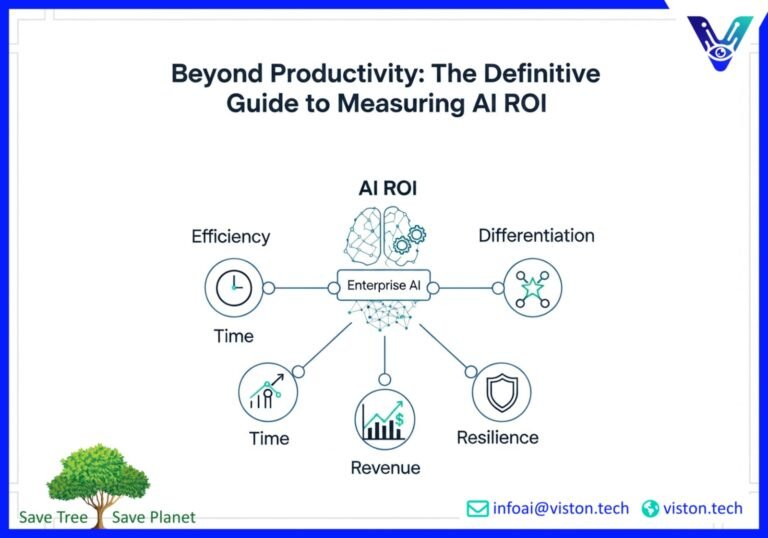
Enterprise AI ROI Metrics: Measuring Impact Beyond Productivity Gains
The age of artificial intelligence is no longer on the horizon; it’s here. Enterprises are adopting AI at a staggering rate, with around 89% having integrated AI tools into their operations. Yet, a critical disconnect remains: only about 23% can accurately measure their return on investment (AI ROI). This measurement gap is becoming a significant hurdle as AI spending is projected to approach $200 billion globally in 2025. The era of investing in AI based on hype is over. Boards and C-suites now demand concrete, measurable outcomes.
While many organizations report productivity gains ranging from 26% to 55%, these figures only scratch the surface of AI’s true value. When deployed systematically, AI can deliver approximately a $3.70 return for every dollar invested. To unlock this potential, businesses must move beyond traditional metrics and adopt a more holistic view of AI’s impact. This means looking past simple efficiency gains and understanding how AI drives value across the entire enterprise.
This post will guide you through a comprehensive framework for measuring AI ROI, helping you articulate its full value to stakeholders. We will explore the limitations of conventional metrics and introduce a 5-dimensional model to capture the multifaceted benefits of AI. Get ready to transform your AI ROI conversation from a vague estimate to a clear, data-driven narrative.
Moving Past Traditional Metrics: Why Old Methods Fall Short
For decades, businesses have relied on standard key performance indicators (KPIs) to measure the success of technology investments. Metrics like cost savings, operational efficiency, and revenue growth have been the gold standard. While these are still important, they fail to capture the full spectrum of value that AI brings to an enterprise. Traditional ROI calculations often miss the strategic, long-term benefits that set AI apart from other technologies.
The problem with sticking to old metrics is that AI’s impact is not always linear or immediately quantifiable in a financial report. AI can enhance decision-making, foster innovation, and build resilience—qualities that are difficult to measure with a simple cost-benefit analysis. Relying solely on these metrics can lead to a narrow and often misleading understanding of AI’s true contribution, potentially causing organizations to underinvest in transformative initiatives.
The 5-Dimensional AI ROI Model: A Holistic Approach to Value Measurement
To truly understand the impact of your AI investments, you need a model that captures both the tangible and intangible benefits. Our 5-dimensional ROI model provides a comprehensive framework for evaluating AI’s value across the enterprise. This model looks at Time, Efficiency, Revenue, Differentiation, and Resilience.

1. Time: The Currency of Modern Business
Time savings are one of the most immediate and tangible benefits of AI. By automating repetitive tasks, AI frees up employees to focus on more strategic, high-value work. This is not just about doing the same work faster; it’s about fundamentally changing how work is done.
- Time Reclaimed: Measure the hours saved by automating manual processes. For example, JPMorgan’s COiN platform saves an estimated 360,000 hours of legal work annually by reviewing loan agreements in seconds.
- Accelerated Speed-to-Market: AI can significantly shorten product development cycles and accelerate the launch of new services. Track the reduction in time from concept to launch.
- Faster Decision-Making: AI-powered analytics can provide insights in minutes that would have taken teams weeks to uncover. Monitor the time it takes to make critical business decisions.
2. Efficiency: Optimizing Your Operations
Efficiency gains go hand-in-hand with time savings but focus more on optimizing resources and reducing waste. AI can streamline complex workflows, improve resource allocation, and minimize errors, leading to significant operational improvements.
- Cost Reduction: Track direct cost savings from reduced labor, lower operational expenses, and optimized resource consumption.
- Process Optimization: Measure improvements in workflow efficiency, such as reduced cycle times or higher throughput in manufacturing.
- Error Reduction: Quantify the impact of fewer human errors, which can lead to cost savings from less rework and improved quality.
3. Revenue: Driving Top-Line Growth
While cost savings are a key part of the AI value proposition, the impact on revenue is often even more significant. AI can unlock new revenue streams, enhance customer experiences, and improve sales and marketing effectiveness.
- Increased Sales: Use AI for lead scoring, personalized recommendations, and dynamic pricing to boost conversion rates and average order value. A B2B software company, for example, increased its pipeline by 25% and achieved a 76% higher win rate with AI-powered lead scoring.
- New Revenue Streams: AI can enable the creation of new products and services, opening up previously untapped markets.
- Enhanced Customer Lifetime Value: By personalizing customer interactions and improving service quality, AI can increase customer satisfaction and loyalty, leading to higher retention and lifetime value.
4. Differentiation: Gaining a Competitive Edge
In a crowded marketplace, differentiation is key to long-term success. AI can provide a significant competitive advantage by enabling innovation, enhancing product quality, and creating superior customer experiences. These benefits are often strategic and can be more challenging to quantify, but they are critical to sustainable growth.
- Innovation Rate: Track the number of new products, services, or business models enabled by AI.
- Customer Satisfaction (CSAT) and Net Promoter Score (NPS): Measure how AI-driven improvements in service and personalization impact customer sentiment. Sales teams leveraging AI anticipate a significant rise in NPS.
- Brand Perception: Monitor changes in brand perception and market positioning as a result of AI-powered innovations.
5. Resilience: Future-Proofing Your Organization
In an increasingly volatile world, business resilience is more important than ever. AI can help organizations better anticipate and respond to market shifts, supply chain disruptions, and other risks. This forward-looking dimension of AI ROI is about building a more agile and adaptive enterprise.
- Improved Forecasting Accuracy: AI can enhance demand forecasting, financial modeling, and risk assessment, allowing for more proactive planning.
- Risk Mitigation: Use AI to detect fraud, identify security threats, and ensure regulatory compliance, reducing exposure to financial and operational risks.
- Enhanced Agility: Measure the organization’s ability to quickly adapt to changing market conditions, enabled by AI-driven insights and automation.
Building Your AI ROI Measurement Framework
Having a conceptual model is the first step. To make it actionable, you need a practical measurement framework. This involves defining the right KPIs, establishing baselines, and implementing a system for tracking and reporting.
Step 1: Define Clear Objectives and KPIs
Before you deploy any AI solution, it is crucial to define what you want to achieve. Align your AI initiatives with specific business goals and identify the KPIs you will use to measure success. For each of the five dimensions, select a mix of leading and lagging indicators.
For a more in-depth look at defining AI strategies, you can explore BCG’s insights on AI strategy.
Step 2: Establish a Baseline
You cannot measure improvement if you don’t know your starting point. Before implementing an AI solution, collect data on your current performance for the KPIs you have identified. This baseline will be the benchmark against which you will measure the impact of your AI initiatives.
Step 3: Track and Analyze Performance
Once your AI solution is live, continuously track your KPIs. This requires a robust data infrastructure and analytics capabilities. Regularly analyze the data to understand what is working, what is not, and where there are opportunities for improvement. The key is to move beyond one-time reports and embrace a culture of continuous measurement and optimization.
Visualizing Success: The Power of AI ROI Dashboards
To make your AI ROI data accessible and actionable, you need to visualize it. Well-designed dashboards can provide at-a-glance insights for different stakeholders, from C-suite executives to project managers. A good AI ROI dashboard should be organized to tell a clear story, connecting AI performance to business outcomes.
Your dashboard could include:
- An Executive Summary: Highlighting top-level metrics like overall ROI, total cost savings, and revenue impact.
- Dimensional Deep Dives: Sections dedicated to each of the five dimensions of the ROI model, with specific KPIs for each.
- Operational Metrics: Data on the performance of the AI models themselves, such as accuracy, latency, and uptime.
- Financial Impact: A clear comparison of the costs of your AI initiatives against the financial benefits they are generating.
For practical advice on building effective dashboards, check out this article from Harvard Business Review on designing useful dashboards.
Real-World Impact: Case Studies in AI ROI
The best way to understand the power of a comprehensive AI ROI framework is to see it in action. Let’s look at a couple of examples of how companies are realizing and measuring the multidimensional value of AI.
Case Study 1: Transforming Customer Service in Retail
A large e-commerce platform implemented an AI-powered chatbot to handle customer service inquiries. While the initial goal was to reduce costs, the company used a broader ROI framework to measure success.
- Time & Efficiency: The chatbot automated 70% of routine inquiries, freeing up human agents to handle more complex issues. This led to a 40% reduction in customer service costs.
- Revenue: The chatbot’s personalized product recommendations during service interactions led to a 15% increase in average order value.
- Differentiation: Customer satisfaction scores increased by 20% due to faster response times and 24/7 availability.
- Resilience: During a sudden surge in demand, the chatbot scaled seamlessly, preventing a disruption in customer service.
Case Study 2: Optimizing the Supply Chain in Manufacturing
A global manufacturing firm used AI to optimize its supply chain and for predictive maintenance. The company looked beyond simple productivity gains to capture the full strategic value.
- Time & Efficiency: AI-driven predictive maintenance reduced machine downtime by 30% and improved overall equipment effectiveness by 15%.
- Revenue: Improved inventory management, powered by AI forecasting, reduced stockouts by 40%, preventing lost sales.
- Differentiation: The ability to offer more reliable delivery times became a key competitive differentiator.
- Resilience: The AI system identified a potential supply chain bottleneck three months in advance, allowing the company to reroute shipments and avoid a costly disruption.
The Future is Measured: Making AI ROI a Strategic Imperative
As AI becomes more deeply embedded in business operations, the ability to accurately measure its ROI will be a critical determinant of success. The days of “vibe-based” AI investment are numbered. Leaders who can articulate the full, multidimensional value of their AI initiatives will be the ones who secure the resources and stakeholder buy-in needed to drive real transformation.
By moving beyond traditional metrics and embracing a more holistic approach, you can unlock the full potential of AI and build a compelling, data-driven case for its strategic importance. The framework outlined in this post provides a roadmap for turning your AI ROI conversation from a challenge into a competitive advantage.
Ready to unlock the full potential of your AI investments? The journey to a comprehensive AI ROI measurement starts with the right partner. At Viston AI, we specialize in developing and deploying AI-powered solutions that deliver measurable, multidimensional value. Our team of experts can help you build a robust measurement framework and implement AI initiatives that drive real business outcomes.
Contact Viston AI today to learn how our AI-powered solutions can help you measure what matters and maximize your return on investment.
Frequently Asked Questions (FAQs)
1. What is AI ROI and why is it so hard to measure?
AI ROI (Return on Investment) measures the profitability of AI initiatives. It’s challenging to measure because AI’s impact is often multifaceted, including both easily quantifiable financial gains (like cost savings) and less tangible strategic benefits (like improved decision-making and competitive differentiation). Traditional metrics often fail to capture this full spectrum of value.
2. What are the key components of a 5-dimensional AI ROI model?
A 5-dimensional AI ROI model provides a holistic view of AI’s impact by evaluating it across five key areas:
- Time: Savings in hours, accelerated speed-to-market, and faster decision-making.
- Efficiency: Cost reductions, process optimization, and error rate reduction.
- Revenue: Increased sales, new revenue streams, and enhanced customer lifetime value.
- Differentiation: Competitive advantage, innovation, and improved customer satisfaction.
- Resilience: Better forecasting, risk mitigation, and organizational agility.
3. What are some of the most important KPIs to track for AI projects?
The right KPIs depend on the specific goals of your AI project. However, some key metrics to consider across the five dimensions include:
- Time: Hours saved per employee, reduction in project completion time.
- Efficiency: Percentage reduction in operational costs, decrease in error rates.
- Revenue: Increase in conversion rates, growth in customer lifetime value.
- Differentiation: Improvement in Net Promoter Score (NPS), number of new products launched.
- Resilience: Increase in forecast accuracy, reduction in compliance-related fines.
4. How can I build a business case for an AI investment if the ROI is hard to quantify?
Focus on building a narrative that combines hard financial projections with the strategic value of the initiative. Use the 5-dimensional model to articulate the full range of potential benefits. Start with a pilot project to gather initial data and demonstrate value on a smaller scale. This can help build momentum and secure buy-in for larger investments.
5. What is an AI ROI dashboard and why is it important?
An AI ROI dashboard is a visual tool that tracks and displays key performance indicators related to your AI initiatives in real-time. It’s important because it makes complex data accessible and understandable for various stakeholders, from executives to project managers. A well-designed dashboard helps in monitoring progress, identifying areas for improvement, and communicating the value of AI across the organization.
6. What are some common pitfalls to avoid when measuring AI ROI?
Some common mistakes include:
- Focusing only on short-term financial gains.
- Failing to establish a baseline before implementation.
- Using vanity metrics that don’t align with business outcomes.
- Measuring AI in isolation and not considering its interaction with other business initiatives.
- Not having the right data infrastructure in place to track metrics accurately.
7. How long does it typically take to see a positive ROI from an AI project?
The time to see a positive ROI can vary significantly depending on the complexity and scale of the project. Simple automation projects may show returns within a few months. More complex, strategic initiatives, like developing a new AI-powered product, might take a year or more to demonstrate a clear positive ROI. It’s important to set realistic timelines and track both leading and lagging indicators of success.
8. How does measuring AI ROI for generative AI differ from traditional AI?
While the fundamental principles are the same, measuring the ROI of generative AI can be more complex. Generative AI often excels in areas like content creation, creativity, and innovation, which can be harder to quantify directly. The focus may shift more towards metrics like employee productivity (time saved on writing, coding, or design), content quality and effectiveness, and the rate of innovation.
