
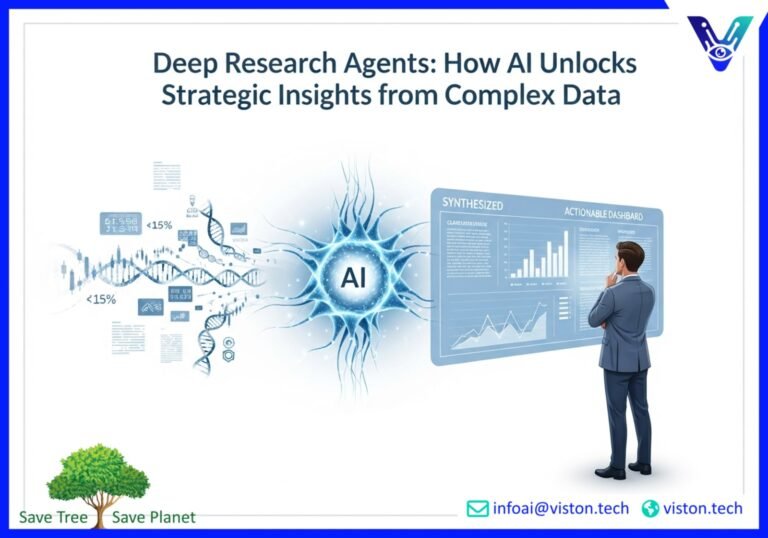
Deep Research Agents: How AI Can Analyze Complex Data and Generate Insights
The world of strategic analysis is on the cusp of a major transformation. By 2026 and 2027, a new class of AI research tools known as “deep research agents” will redefine how businesses approach complex data analysis. Imagine compressing weeks of meticulous research into a matter of hours. These autonomous agents are designed to collect vast amounts of data, cross-check sources for accuracy, and synthesize information to generate high-quality, actionable insights. For industries like finance, healthcare, and policy-making, this is a game-changer.
Deep research agents are poised to become indispensable for any organization looking to maintain a competitive edge. They offer the ability to navigate the ever-increasing volume of information with speed and precision, unlocking opportunities that were previously hidden within complex datasets. This post will explore the capabilities of these advanced AI systems, their workflow, and their transformative impact on key sectors. We’ll also delve into the crucial aspects of trust, accuracy, and the continuing importance of human expertise in this new era of research.
What Are Deep Research Agents and What Can They Do?
Deep research agents are sophisticated AI systems that go far beyond simple keyword searches. They are autonomous entities capable of conducting comprehensive research projects. Think of them as a team of tireless analysts working 24/7 to gather and make sense of information from a multitude of sources. These agents are not just about data collection; their real power lies in their ability to understand, evaluate, and synthesize that data into coherent and insightful reports.
The capabilities of these AI-powered tools are extensive and continue to grow. They can:
- Automate Data Collection: Deep research agents can scan the internet, academic databases, news articles, financial reports, and social media to gather relevant information on a specific topic.
- Process Unstructured Data: A significant portion of the world’s data is unstructured, such as text, images, and videos. These AI agents can analyze this type of data to extract meaningful insights.
- Identify Patterns and Trends: By sifting through massive datasets, they can identify emerging trends, patterns, and correlations that might be missed by human analysts.
- Cross-Reference and Validate Sources: To ensure the reliability of the information, these agents can compare data from multiple sources, flagging inconsistencies and verifying facts.
- Generate Summaries and Reports: The final output is often a detailed report, complete with summaries, key findings, and data visualizations, making it easy for decision-makers to understand the insights.
The Workflow of a Deep Research Agent: From Discovery to Synthesis
The process by which a deep research agent transforms a query into a comprehensive report is a multi-stage workflow. This automated process is what allows for the incredible compression of research timelines. While the specifics can vary between different AI platforms, the core workflow generally consists of three key phases: source discovery, validation, and synthesis.
1. Source Discovery and Data Collection
The research process begins with the agent interpreting the user’s query to understand the core objective. From there, it formulates a plan to gather the necessary information. This involves identifying a wide array of potential sources, including:
- Publicly available data on the web
- Subscription-based academic journals and industry reports
- Internal company documents and databases
- Financial market data feeds
- Social media and online forums
The agent then systematically scrapes and collects data from these sources, building a comprehensive dataset for the next stage of the process.
2. Information Validation and Cross-Verification
Once the data is collected, the deep research agent moves to the critical phase of validation. This is where the AI’s ability to cross-reference information comes into play. The agent compares facts, figures, and claims across multiple independent sources to assess their accuracy. It can identify conflicting information and even attempt to determine the most reliable source based on a set of predefined criteria, such as the source’s reputation or the date of publication. This automated validation process is crucial for building trust in the final output.
3. Synthesis and Insight Generation
The final stage is where the magic truly happens. The deep research agent analyzes the validated data to identify key themes, patterns, and insights. It then synthesizes this information into a structured and easy-to-digest format. This can include:
- Executive summaries highlighting the most important findings
- Detailed reports with supporting evidence and data points
- Visualizations such as charts and graphs to illustrate trends
- Forecasts and predictive models based on the analyzed data
This synthesized output provides decision-makers with the actionable intelligence they need to inform their strategies.
Real-World Applications: Transforming Finance and Healthcare
The impact of deep research agents is already being felt across various industries, with finance and healthcare being two of the most prominent examples. These sectors are characterized by vast and complex datasets, making them ideal candidates for the application of advanced AI research tools.
Deep Research Agents in Finance
In the fast-paced world of finance, timely and accurate information is paramount. Deep research agents are revolutionizing financial analysis in several ways:
- Market Intelligence: AI agents can monitor global markets in real-time, analyzing news, social media sentiment, and economic indicators to predict market movements.
- Investment Research: They can conduct in-depth analysis of companies, evaluating financial statements, competitive landscapes, and industry trends to identify investment opportunities. For instance, JPMorgan’s COiN platform uses AI to analyze thousands of commercial credit agreements, a task that once required 360,000 hours of manual work annually.
- Risk Management: By continuously scanning for potential threats, such as regulatory changes or geopolitical events, these agents can help financial institutions proactively manage risk.
- Fraud Detection: AI algorithms can analyze transaction patterns to identify and flag suspicious activities, helping to prevent financial fraud. Mastercard, for example, utilizes AI to process billions of transactions and has significantly improved its fraud detection rates.
Explore cutting-edge AI solutions for computer vision that are transforming various sectors.
Deep Research Agents in Healthcare
The healthcare industry is another area where deep research agents are making a significant impact. The ability to quickly analyze vast amounts of medical data can lead to improved patient outcomes and more efficient healthcare systems.
- Drug Discovery and Development: AI can accelerate the research and development of new drugs by analyzing biological data, identifying potential drug candidates, and predicting their efficacy.
- Clinical Trial Analysis: Deep research agents can analyze data from clinical trials to identify trends and correlations, helping researchers to understand the effectiveness and safety of new treatments more quickly.
- Personalized Medicine: By analyzing a patient’s genetic information, lifestyle, and medical history, AI can help doctors to develop personalized treatment plans.
- Public Health and Epidemiology: These agents can monitor disease outbreaks, analyze public health data, and predict the spread of infectious diseases, enabling a more effective response from health authorities. The market for AI in healthcare is projected to see substantial growth, driven by the increasing need to manage complex health data.
Learn more about how AI is reshaping industries by reading insightful articles on the role of AI in business intelligence.
Building Trust and Ensuring Accuracy: The Human in the Loop
While the capabilities of deep research agents are impressive, the question of trust and accuracy is a critical one. For businesses to rely on AI-generated insights for strategic decisions, they need to be confident in the reliability of the information. This is where the concept of the “human in the loop” becomes essential.
The human-in-the-loop approach means that while the AI performs the heavy lifting of data collection and analysis, human experts remain involved in the process to provide oversight, guidance, and validation. This collaborative model leverages the strengths of both humans and machines.
The Importance of Human Oversight
Human experts play a crucial role in several areas:
- Defining the Research Scope: Humans are essential for framing the initial research questions and providing the necessary context for the AI agent.
- Validating Critical Insights: While AI can identify patterns, human experience and intuition are often needed to interpret the significance of those patterns and validate the most critical insights.
- Handling Ambiguity and Nuance: Language and data can be ambiguous. Human analysts can help the AI to navigate nuanced situations where context is key.
- Ethical Considerations: Humans are responsible for ensuring that the research is conducted ethically and that the insights are used responsibly.
Ultimately, the goal is not to replace human researchers but to augment their capabilities. By pairing the speed and scale of AI with the deep expertise and critical thinking of humans, organizations can achieve a level of analysis that was previously unimaginable.
Discover more about the practical applications of AI in business through in-depth articles from Harvard Business Review.
The Future is Autonomous, Collaborative, and Insightful
Deep research agents represent a significant leap forward in the field of artificial intelligence. Their ability to autonomously collect, validate, and synthesize complex data is set to revolutionize strategic analysis across industries. By compressing research timelines and uncovering hidden insights, these AI-powered tools will empower businesses to make faster, more informed decisions.
As we look toward 2026 and 2027, the trend is clear: the future of research is both autonomous and collaborative. While AI will handle the heavy lifting, the strategic guidance and critical oversight of human experts will remain indispensable. Organizations that embrace this new paradigm will be well-positioned to navigate the complexities of the modern world and unlock new opportunities for growth and innovation.
Frequently Asked Questions (FAQs)
1. What is a deep research agent?
A deep research agent is an advanced AI system designed to autonomously conduct in-depth research. It can gather data from various sources, validate the information, and synthesize it to generate comprehensive insights and reports, significantly speeding up the research process.
2. How do deep research agents differ from standard search engines?
Unlike standard search engines that provide a list of links based on keywords, deep research agents perform a complete research workflow. They understand the user’s goal, gather and cross-reference information from multiple sources, analyze the data for patterns, and produce a synthesized report with actionable insights.
3. What are the key benefits of using AI research tools?
The primary benefits include a dramatic reduction in research time, the ability to analyze vast and complex datasets, the discovery of insights that might be missed by human analysts, and improved accuracy through automated source validation. This leads to more informed and timely decision-making.
4. In which industries are deep research agents most impactful?
While their applications are broad, deep research agents are particularly impactful in data-intensive sectors like finance, healthcare, and policy-making. In finance, they are used for market analysis and risk management. In healthcare, they accelerate drug discovery and personalize medicine.
5. Is there a risk of bias in the insights generated by AI research agents?
Yes, like any AI system, deep research agents can be susceptible to bias present in the data they are trained on or the sources they analyze. This is a key reason why human oversight and the “human in the loop” approach are crucial to validate findings and ensure fairness and accuracy.
6. What role do humans play when using deep research agents?
Humans play a vital supervisory role. They define the research objectives, provide context, validate the AI’s findings, interpret nuanced information, and ensure the ethical application of the insights. This collaborative approach combines the strengths of human expertise with the power of AI.
7. How can a business get started with implementing deep research agents?
Starting with a specific, well-defined use case is often the best approach. Businesses can partner with AI solution providers to identify the most suitable tools and develop a pilot project. It’s also important to invest in training for the teams who will be working with these new AI systems.
8. What is the future outlook for deep research agents?
The capabilities of deep research agents are expected to continue to evolve rapidly. We can anticipate more sophisticated reasoning abilities, better handling of multimodal data (text, images, video), and deeper integration into enterprise workflows, making them a standard tool for strategic analysis in the coming years.
Ready to unlock the power of deep research for your organization? Contact Viston AI today to learn how our AI-powered solutions can help you analyze complex data and generate the insights you need to stay ahead of the competition.
