
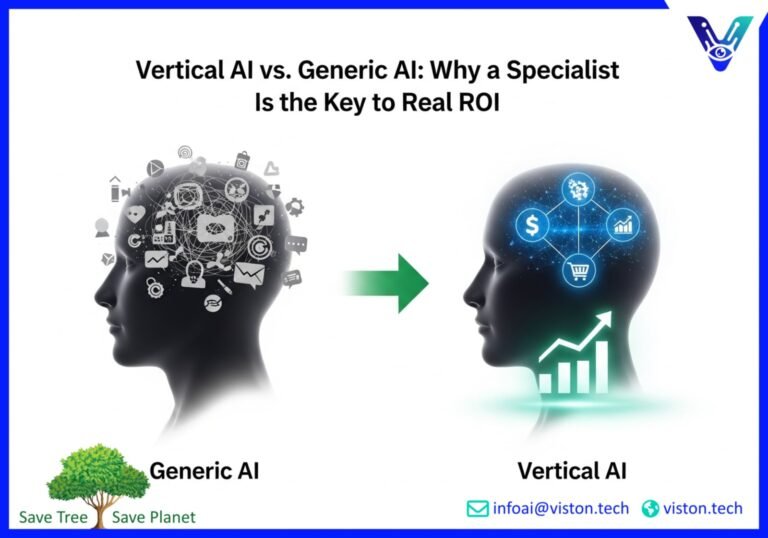
Industry-Specific AI Solutions: Why Vertical AI Outperforms Generic Models
The era of one-size-fits-all artificial intelligence is over. While generic AI models have captured headlines, businesses in 2025 are discovering a more powerful, precise, and profitable alternative: Vertical AI. These industry-specific AI solutions are not just a trend; they are a strategic imperative for any organization serious about achieving measurable results and a competitive edge. Unlike their generalist counterparts, vertical AI is designed from the ground up with deep domain expertise, delivering tangible ROI in weeks, not years.
Imagine reducing financial fraud by up to 80%, predicting industrial equipment failure to save millions in downtime, or optimizing retail shelves to boost sales while slashing waste. These are not futuristic hypotheticals; they are the proven outcomes of leveraging AI that speaks the language of your industry. This is the power of specialization, and it’s reshaping how enterprises operate, compete, and innovate.
The Great Divide: Generic AI vs. Vertical AI
To understand the value of vertical AI, it’s crucial to recognize the limitations of generic, or “horizontal,” AI models. These are the broad, versatile platforms designed to perform a wide array of tasks across different sectors. Think of them as a general practitioner—knowledgeable across many areas but lacking the deep expertise of a specialist.
Generic AI: A Jack of All Trades, Master of None
- Broad Training Data: Generic models are trained on vast, diverse datasets from the public internet. This allows them to handle a wide range of queries but often leads to a superficial understanding of specific industry contexts.
- Lack of Domain Nuance: They struggle with industry-specific jargon, complex regulatory requirements, and the subtle operational workflows that define a sector. This can lead to inaccurate or irrelevant outputs.
- Slower Time-to-Value: Implementing a generic AI solution for a specialized task requires extensive customization, fine-tuning, and data labeling, delaying any meaningful return on investment.
Vertical AI: The Specialist You Need
Vertical AI, also known as domain-specific AI, is the opposite. It is meticulously engineered for a single industry or business function. This focus is its greatest strength.
- Pre-Trained on Industry Data: Vertical models are built on curated, high-quality datasets specific to a sector, such as financial transaction records, medical imaging, or manufacturing sensor data. This gives them an immediate and profound understanding of the industry’s landscape.
- Understands Context and Compliance: These solutions have the industry’s rules, regulations, and unique challenges baked into their architecture. This is critical in highly regulated fields like finance and healthcare.
- Rapid and Measurable ROI: Because they are purpose-built, vertical AI solutions can be deployed quickly and begin delivering value almost immediately. They are designed to solve specific, high-impact problems, making their ROI easy to measure and justify.
The difference is clear: while generic AI offers flexibility, vertical AI provides precision, performance, and profit.
The Engine Room: Domain Models and Knowledge Graphs
What gives vertical AI its powerful advantage? The secret lies in two key components: domain-specific models and knowledge graphs.
Imagine trying to assemble a complex piece of machinery with a generic instruction manual. You might get the basics right, but the crucial details will be missing. Generic AI faces a similar problem. It has the raw intelligence but lacks the specialized schematic.
Domain-specific AI models are the specialized blueprints. They are fine-tuned algorithms that understand the unique patterns, relationships, and data types of a particular industry. For example, an AI model for financial services is specifically trained to recognize the subtle patterns of fraudulent transactions, something a general model would likely miss.
Knowledge graphs are the connective tissue that turns raw data into structured, intelligent knowledge. Think of a knowledge graph as a digital map of your industry’s ecosystem. It doesn’t just store information; it understands the relationships between different pieces of data. For instance, in a retail context, a knowledge graph connects a specific product to its supplier, its location in the store, customer purchase history, and current promotions. This deep, contextual understanding allows the AI to make far more sophisticated and accurate decisions.
By combining domain-specific models with robust knowledge graphs, vertical AI can reason and act with a level of intelligence that generic models simply cannot match. This powerful combination is what enables the remarkable results we see across various sectors.
Vertical AI in Action: Sector-Specific Case Studies
The true measure of any technology is its real-world impact. Vertical AI is already delivering transformative results across a wide range of industries. Let’s explore some compelling examples.
Retail: Optimizing the Shelf and Beyond
In the fiercely competitive retail sector, every inch of shelf space and every customer interaction counts. Vertical AI is revolutionizing how retailers manage inventory, personalize marketing, and enhance the in-store experience.
- Intelligent Shelf Optimization: AI-powered computer vision systems monitor shelves in real-time. They can detect out-of-stock items, ensure planogram compliance, and even analyze shopper behavior to optimize product placement. The result? Increased sales, reduced waste from overstocking, and a better customer experience. Some retailers have seen a 15% increase in sales for optimally positioned products.
- Hyper-Personalized Marketing: By analyzing purchase history and real-time behavior, vertical AI can deliver highly personalized product recommendations and promotions, driving customer loyalty and increasing basket size.
For more on how AI is reshaping retail, check out this insightful article from Forbes on the future of retail.
Risk and Finance: Proactive Fraud Prevention
The financial services industry is in a constant battle against fraud. Traditional, rule-based systems are often too slow and reactive to keep up with sophisticated criminals. Vertical AI is a game-changer, enabling a proactive and predictive approach to risk management.
- Real-Time Fraud Detection: Domain-specific AI models, trained on billions of transactions, can identify and flag fraudulent activity in milliseconds. This allows financial institutions to stop fraud before it happens, with some achieving a staggering 80% reduction in fraud losses.
- Enhanced Compliance: AI can automate many of the tedious and error-prone tasks associated with regulatory compliance. It can monitor transactions for signs of money laundering and ensure adherence to evolving global regulations, saving millions in potential fines.
Industrial and Manufacturing: The Power of Predictive Maintenance
In the industrial world, unplanned downtime is the enemy of profitability. A single equipment failure can halt production and cost millions. Vertical AI-powered predictive maintenance turns this reactive model on its head.
- Predicting Failures, Preventing Downtime: By analyzing data from IoT sensors on machinery, AI can predict when a component is likely to fail. This allows maintenance to be scheduled proactively, before a breakdown occurs. This approach can reduce maintenance costs by up to 30% and eliminate nearly 70% of breakdowns.
- Improving Worker Safety: By identifying potentially hazardous conditions before they lead to an incident, AI is also playing a crucial role in creating safer working environments.
IT Operations: From Reactive to Proactive
Modern IT environments are incredibly complex. AIOps, or AI for IT Operations, leverages vertical AI to bring order to this chaos. Instead of scrambling to fix issues after they occur, AIOps platforms can predict and prevent them.
- Automated Root Cause Analysis: When an issue does arise, AI can instantly analyze data from across the IT stack to identify the root cause, reducing resolution time from hours to minutes.
- Proactive Issue Prevention: AIOps can identify subtle performance degradations and anomalies that signal an impending problem, allowing IT teams to address it before it impacts users.
To learn more about the latest trends in AIOps, this resource from TechTarget offers a comprehensive overview.
The Critical Decision: Build vs. Buy
Once an organization recognizes the power of vertical AI, the next logical question is whether to build a solution in-house or partner with a specialized provider. For most enterprises, the “buy” decision is the clear winner for several reasons:
- Speed to Market: Building a sophisticated, domain-specific AI solution from scratch is a massive undertaking. It requires specialized talent, vast amounts of high-quality data, and significant time. Partnering with a vertical AI expert like Viston AI allows you to deploy a proven solution in a fraction of the time.
- Deep Expertise: Vertical AI providers have dedicated years to understanding the nuances of your industry. Their solutions are built on this deep domain knowledge, an asset that is incredibly difficult and expensive to replicate internally.
- Cost-Effectiveness: The total cost of ownership for a purchased solution is often significantly lower than building one. You avoid the high costs of R&D, talent acquisition, and ongoing maintenance and model updates.
- Reduced Risk: Developing an in-house AI solution is fraught with risk. There is no guarantee of success, and projects can easily go over budget and timeline. A proven, off-the-shelf vertical solution offers a clear path to a predictable and positive ROI.
The Future is Specialized
As we move further into 2025 and beyond, the trend is undeniable: the future of enterprise AI is vertical. Generic models will continue to have their place as consumer-facing tools and general-purpose assistants. However, for businesses that need to solve complex, high-stakes problems, domain-specific AI is the only path forward. It offers the precision, reliability, and rapid ROI that today’s competitive landscape demands.
Organizations that embrace vertical AI will be the leaders of tomorrow. They will operate more efficiently, make smarter decisions, and deliver superior value to their customers. The question is no longer *if* you should adopt vertical AI, but *how quickly* you can get started.
#VerticalAI #DomainSpecificAI #KnowledgeGraphs #AIforEnterprise #FutureofAI #DigitalTransformation #Innovation #TechTrends2025
Ready to unlock the power of industry-specific AI?
Don’t let your organization fall behind. Discover how Viston AI’s pre-trained, domain-specific solutions can deliver measurable ROI for your business in weeks. Our team of experts is ready to help you navigate your AI journey and architect an intelligent system that drives real results.
Contact Viston AI today for a consultation and experience the future of enterprise AI.
Frequently Asked Questions (FAQs)
1. What is the primary difference between vertical AI and generic AI?
- The primary difference is specialization. Vertical AI is designed and trained for a specific industry or function, using domain-specific data and knowledge. Generic AI is built for broad, general-purpose use across multiple sectors and lacks deep industry expertise.
2. Why does vertical AI deliver a faster ROI?
- Vertical AI provides a faster return on investment because it is purpose-built to solve specific, high-value industry problems. These solutions require minimal customization and are pre-trained on relevant industry data, allowing them to be deployed quickly and start generating measurable results, such as cost savings or revenue growth, in weeks rather than months or years.
3. What is a knowledge graph and why is it important for vertical AI?
- A knowledge graph is a way of organizing data that maps out the relationships between different entities. It’s crucial for vertical AI because it provides the deep contextual understanding of an industry that is necessary for sophisticated decision-making. It transforms raw data into a structured, intelligent network that the AI can use to reason more effectively.
4. Can’t I just customize a generic AI model for my industry?
- While you can fine-tune a generic model, it is often a costly, time-consuming, and resource-intensive process. You would need access to massive amounts of clean, labeled industry data and a team of specialized AI talent. Even then, the resulting model may not match the performance and reliability of a solution that was purpose-built from the ground up by domain experts.
5. What are some industries where vertical AI is having the most significant impact?
- Vertical AI is making a major impact across numerous sectors, including financial services (fraud detection, risk management), retail (shelf optimization, personalization), manufacturing (predictive maintenance), healthcare (diagnostics, drug discovery), and IT operations (AIOps).
6. Is vertical AI only for large enterprises?
- No, while large enterprises are significant adopters, vertical AI solutions are becoming increasingly accessible to businesses of all sizes. The key is to identify a high-impact use case where a specialized AI solution can drive significant value, regardless of the company’s scale.
7. How does vertical AI handle industry-specific regulations and compliance?
- This is a key strength of vertical AI. Because these solutions are designed for a specific industry, compliance and regulatory requirements are often built into their core architecture. They are trained on data and workflows that adhere to industry standards, making them far more reliable in regulated environments than generic models.
8. What is the first step my company should take to explore vertical AI?
- The first step is to identify a clear, high-value business problem that could be solved with AI. Think about your biggest pain points, inefficiencies, or areas for growth. Once you have a specific use case, you can begin to explore vertical AI providers who specialize in your industry and can demonstrate a proven track record of solving similar challenges.
