
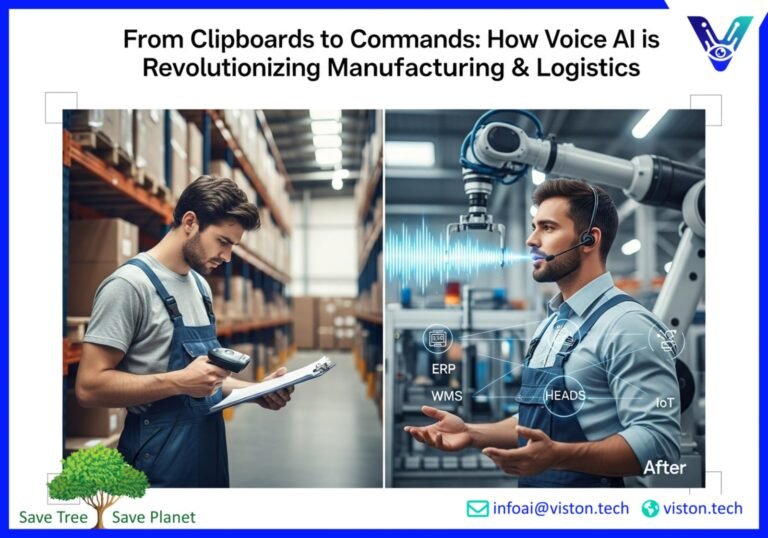
Voice-Enabled AI Agents: Transforming Frontline Operations in Manufacturing & Logistics
The digital transformation of the enterprise is no longer a distant vision; it’s happening right now, on the factory floors and in the sprawling warehouses that form the backbone of our economy. At the heart of this revolution are Voice-Enabled AI Agents, intelligent systems that are fundamentally changing how frontline workers do their jobs. Forget the simple voice assistants on your phone. We’re talking about sophisticated AI that doesn’t just transcribe words but understands intent, connects to complex business systems, and executes end-to-end workflows. This is the new frontier of operational efficiency.
The momentum is undeniable. A staggering 25% of businesses already leveraging Generative AI are planning to adopt advanced voice agents this year. Projections show that overall voice AI adoption is set to nearly double by 2027. This isn’t just a trend; it’s a strategic shift towards a more connected, efficient, and intelligent frontline workforce.
The Hidden Costs of Inefficiency: Pain Points on the Frontline
For decades, frontline operations in manufacturing, logistics, and field services have been hampered by manual, inefficient processes. These challenges create friction, slow down productivity, and directly impact the bottom line. Enterprise leaders are all too familiar with these pain points:
- Manual Data Entry: Workers juggling clipboards, scanners, and tablets are prone to errors. A single misplaced decimal or incorrect SKU can ripple through the supply chain, causing costly disruptions.
- Slow, Cumbersome Processes: Time spent logging information, searching for work orders, or manually updating inventory is time not spent on value-adding tasks. These delays accumulate, leading to significant productivity losses.
- Safety Risks: Requiring workers to look down at a screen or use their hands to operate a device creates a “heads-down” environment, increasing the risk of accidents in busy operational settings.
- Communication Gaps: Disconnected teams and language barriers lead to misunderstandings, delays, and mistakes. In a globalized workforce, clear, instant communication is essential for seamless operations.
- Lengthy Training Cycles: Onboarding new employees on complex machinery and multi-step processes is time-consuming and resource-intensive, impacting the ability to scale the workforce quickly.
Beyond Transcription: The Architecture of a Modern Voice AI Agent
To appreciate the transformative power of today’s voice AI agents, it’s helpful to understand what happens “under the hood.” These systems are far more than simple speech-to-text engines. They are complex, integrated platforms designed for industrial environments. For a non-technical audience, the architecture can be broken down into four key components:
- Automatic Speech Recognition (ASR): This is the first step, where the agent accurately converts spoken words into digital text. Modern ASR systems are trained to function reliably in noisy environments, like a factory floor, and can understand various accents and dialects.
- Natural Language Understanding (NLU): This is the “brain” of the operation. NLU goes beyond literal words to decipher the user’s intent. For example, it understands that “Log a defect on assembly line three” is a command to initiate a specific quality control workflow.
- Workflow Execution Engine: Once the intent is understood, the agent’s execution engine takes over. This component is the bridge to your core business systems. It connects via APIs to your Enterprise Resource Planning (ERP), Warehouse Management System (WMS), Internet of Things (IoT) sensors, and other databases to carry out the requested action.
- Text-to-Speech (TTS): After executing the task, the agent provides a clear, natural-sounding voice confirmation. This closed-loop communication ensures the worker knows the task has been completed correctly.
Crucially, these agents integrate with IoT devices, allowing workers to receive real-time data from machinery and sensors and to control equipment with their voice, creating a truly connected and hands-free operational environment.
Voice at Work: 7 Transformative Use Cases for Voice AI Agents
The true value of voice-enabled AI agents is realized when they are applied to specific, high-impact workflows. Across industries, companies are deploying these solutions to drive measurable improvements in productivity, accuracy, and safety.
Manufacturing
- Quality Assurance Inspections: An inspector on the assembly line can conduct a multi-point check hands-free. By simply speaking their observations, they can log data, capture images with a voice command, and create detailed quality reports in real time, without ever putting down their tools.
- Maintenance and Repair: When a machine malfunctions, an operator can instantly create a maintenance request with their voice. They can describe the issue, specify the machine’s location, and even attach a photo, all while ensuring the area is safe. This drastically reduces downtime and improves asset management.
Logistics & Warehousing
- Voice-Picking and Put-Away: This is a classic but evolving use case. Workers receive instructions through a headset and confirm tasks with their voice, leaving their hands and eyes free to focus on picking items accurately and safely. Modern voice workflows can increase picking productivity by up to 35%. For more insights on this, you can explore how companies are calculating the ROI of voice picking.
- Receiving and Shipping: At the loading dock, workers can use voice commands to document incoming shipments, verify contents against purchase orders, and direct goods to the correct storage location. This accelerates dock-to-stock time and improves inventory accuracy from the very first touchpoint.
Field Service
- Real-Time Status Updates: A technician in the field can update a job’s status, log parts used, and record service notes by simply speaking into their mobile device. This eliminates end-of-day paperwork and ensures the central office has up-to-the-minute information.
- Hands-Free Access to Information: Technicians can verbally request technical manuals, schematics, or even connect with a remote expert for assistance—all while keeping their hands on the equipment they are servicing. This improves first-time fix rates and enhances worker safety.
Call Centers
- Intelligent Customer Support: Voice AI agents can handle routine customer inquiries like order status checks or appointment scheduling 24/7. This frees up human agents to focus on more complex, high-value customer interactions, improving overall service efficiency and customer satisfaction.
Breaking Language Barriers: Multilingual Support & Ensuring Compliance
In today’s global economy, workforces are more diverse than ever. Leading voice AI platforms address this reality by supporting over 100 languages and dialects. This capability is a game-changer for companies with multinational teams, ensuring every worker can interact with systems in their native language, which significantly improves comprehension and reduces errors.
Furthermore, in highly regulated industries, compliance is non-negotiable. Voice-enabled AI agents help enforce standardized procedures. By guiding workers through checklists and requiring verbal confirmation at each step, companies can create an immutable, time-stamped digital audit trail. This ensures that safety protocols and regulatory requirements are consistently met, mitigating risk and simplifying compliance reporting.
Your Roadmap to Implementation: A 5-Step Playbook
Adopting voice AI is a strategic initiative that, when planned correctly, delivers substantial returns. Here is a practical, five-step playbook to guide your organization’s journey:
- Identify High-Impact Workflows: Start small. Pinpoint a specific process where manual data entry is causing bottlenecks or errors. Choose a use case with clear, measurable KPIs, such as picking accuracy, inspection time, or machine downtime.
- Choose the Right Platform: Not all voice solutions are created equal. Look for an enterprise-grade platform that offers robust speech recognition in noisy environments, seamless integration capabilities with your existing systems, and the flexibility to scale across different use cases.
- Run a Pilot Program: Before a full-scale rollout, conduct a pilot program in a controlled environment. This allows you to test the technology, gather feedback from frontline users, and refine the workflows to maximize efficiency and user adoption.
- Train Your Team: While modern voice agents are highly intuitive, effective change management is key. Focus your training on demonstrating the benefits—how the technology makes their jobs easier, safer, and more productive. Empower “super users” who can champion the solution among their peers.
- Scale and Optimize: Once the pilot has proven successful and delivered a clear ROI, you can develop a roadmap for scaling the solution across other departments or facilities. Continuously monitor performance and solicit feedback to identify new opportunities for optimization and expansion.
The Future is Vocal: Why Now is the Time to Act
The shift from manual processes to intelligent, voice-driven workflows is not a matter of if, but when. Voice-enabled AI agents deliver a powerful combination of benefits: increased productivity, improved data accuracy, enhanced worker safety, and greater operational agility. As AI technology continues to advance, these agents will become even more integral to frontline operations, seamlessly connecting workers, machines, and enterprise systems in real time.
Companies that embrace this transformation now will build a significant competitive advantage. They will empower their workforce with tools that make them more effective and engaged, and they will create smarter, more resilient supply chains. To learn more about the broader impact of AI, consider this resource on the transformative power of AI in the supply chain.
Frequently Asked Questions (FAQs)
1. What are enterprise voice AI agents?
Enterprise voice AI agents are sophisticated software systems that use speech recognition and natural language understanding to interact with frontline workers. Unlike consumer assistants, they are designed to execute complex, end-to-end business workflows by integrating with core systems like ERPs and WMSs in industrial environments.
2. How is this different from consumer voice assistants like Siri or Alexa?
The key difference is the focus on workflow execution. While consumer assistants are designed for general information retrieval and simple tasks, enterprise agents are purpose-built to perform specific industrial jobs, such as guiding a warehouse worker through an order picking process or logging a detailed quality inspection on a manufacturing line.
3. What are the main benefits for manufacturing operations?
In manufacturing, voice AI agents drive significant value by enabling hands-free quality assurance checks, streamlining maintenance and repair requests, and providing voice-based controls for machinery. This leads to reduced errors, less equipment downtime, and a safer work environment.
4. Is it difficult to integrate these agents with our existing systems?
Leading voice AI platforms are designed for integration. They use modern APIs (Application Programming Interfaces) to connect seamlessly with most major ERP, WMS, and other enterprise software. A well-planned implementation, starting with a defined pilot, ensures a smooth integration process.
5. How do you ensure the accuracy of speech recognition in noisy factory or warehouse environments?
Enterprise-grade voice AI solutions use advanced noise-cancellation technology and AI models trained specifically for industrial acoustics. They are tuned to filter out background noise from machinery and other workers, ensuring high recognition accuracy even in challenging environments.
6. What is the typical ROI for implementing voice AI agents?
The Return on Investment (ROI) can be rapid and substantial. Businesses often see improvements in productivity of 15-35%, reductions in errors by over 80%, and significant gains in safety and compliance. The specific ROI depends on the use case, but many companies achieve payback in under 12 months.
7. How does Viston AI approach a new project?
At Viston AI, we begin with a collaborative discovery process to understand your unique operational challenges and identify the highest-impact use case. We then co-design a pilot program to demonstrate value quickly, ensuring our solution is tailored to your specific workflows and delivers measurable results before scaling.
8. What languages does your solution support?
Our platform is built for the global enterprise, supporting over 100 languages and dialects out of the box. This ensures that all members of your diverse frontline workforce can interact with the system clearly and efficiently in their native language.
Ready to revolutionize your frontline operations and empower your workforce with the power of voice? The future of manufacturing and logistics is here, and it’s vocal.
Contact Viston AI today to learn how our AI-powered solutions can transform your business.
#VoiceAI #AIinManufacturing #LogisticsTech #FutureOfWork #DigitalTransformation #VistonAI #SpeechRecognition #IoT
