
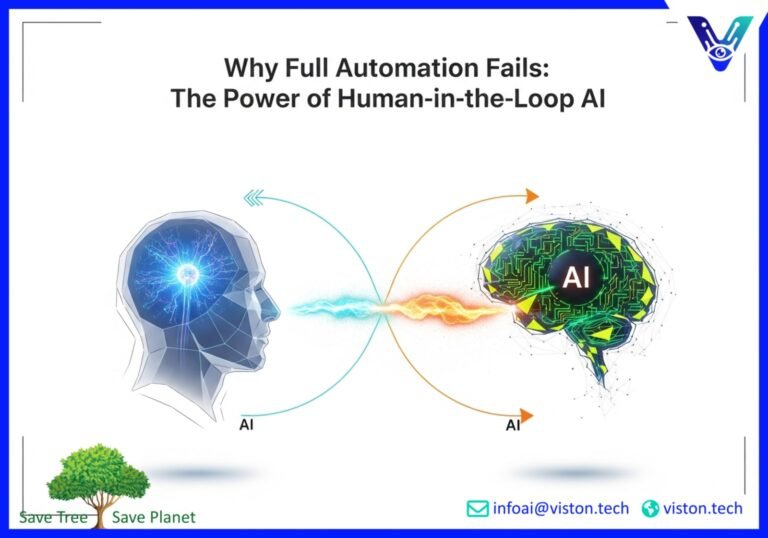
Human‑in‑the‑Loop AI: Why Hybrid Workflows Outperform Full Automation
The relentless pursuit of full automation is yesterday’s news. Today, the most innovative enterprises are pivoting to a more nuanced, powerful, and reliable approach: Human-in-the-Loop (HITL) AI. As we move through 2025, it’s clear that the synergy between human intelligence and machine efficiency delivers results that neither can achieve alone. This isn’t a step back from automation; it’s a strategic evolution, a “Human-in-the-Loop 2.0,” where technology amplifies human expertise rather than trying to replace it.
Recent data highlights this operational shift. Studies now show that a significant number of AI adopters are building robust oversight protocols, with 23% checking AI outputs daily and another 31% reviewing them weekly. Why? Because businesses understand that hybrid AI workflows are not just a stopgap but a superior long-term strategy. They improve safety, boost reliability, and create high-quality, validated data that feeds back into the system for continuous improvement. The future isn’t about choosing between humans or AI; it’s about designing intelligent systems that leverage the best of both.
What is Human-in-the-Loop AI?
Human-in-the-Loop (HITL) is a model that strategically integrates human judgment into an AI system’s lifecycle. Think of it as a collaborative partnership. The AI handles the heavy lifting—processing vast amounts of data, identifying patterns, and making predictions at superhuman speed—while humans step in at critical moments to provide oversight, context, and nuanced decision-making.
The basic idea is to create a continuous feedback loop. The machine performs a task, and if it encounters a situation where its confidence is low or the problem is ambiguous, it flags it for a human expert. The human provides the correct input, which not only resolves the immediate issue but also serves as high-quality training data to make the AI smarter over time. This collaborative approach ensures that the system becomes progressively more accurate and reliable.
The Research is Clear: Human + AI Collaboration Wins
The debate between full automation and human-centric systems is being settled by compelling research. Studies consistently show that hybrid teams, where humans and AI work together, decisively outperform either humans or AI working in isolation.
For example, research from the MIT Center for Collective Intelligence found that in complex tasks like image classification, hybrid human-AI teams achieved significantly higher accuracy than either could alone. The AI excels at repetitive, data-driven analysis, while humans provide the contextual understanding and emotional intelligence that machines lack. This powerful combination leads to fewer errors, more nuanced outcomes, and a greater ability to handle unexpected “edge cases” that can trip up fully automated systems. This synergy is not just about improving accuracy; it’s about building more resilient and trustworthy AI.
Real-World Case Studies: HITL in Action
The shift to hybrid AI is delivering measurable value across industries. By embedding human oversight into automated workflows, enterprises are mitigating risks, enhancing quality, and driving innovation.
1. Transforming Healthcare Diagnostics
In the medical field, accuracy is a matter of life and death. AI algorithms are now capable of analyzing medical images like X-rays and MRIs with incredible speed, flagging potential anomalies for radiologists. For instance, several hospitals have implemented AI systems that achieve high accuracy in diagnosing lung nodules, often outperforming human radiologists in initial screenings.
However, the final diagnosis is never left to the machine. A radiologist reviews the AI’s findings, applies their deep medical knowledge, and makes the definitive call. This **hybrid AI** approach speeds up the diagnostic process, allowing doctors to see more patients while ensuring a layer of expert human oversight that prevents critical errors. The result is faster, more accurate diagnoses and improved patient outcomes.
2. Enhancing Fraud Detection in Finance
The financial services industry faces a constant battle against sophisticated fraud schemes. AI models are instrumental in this fight, analyzing thousands of transactions per second to identify patterns that suggest fraudulent activity. When an AI system flags a transaction as potentially fraudulent, it doesn’t automatically block the account.
Instead, it escalates the case to a human fraud analyst. The analyst can then investigate the context—looking at the customer’s history, the nature of the transaction, and other qualitative factors—to determine if it’s a genuine threat or a false positive. This human oversight is crucial for preventing the system from blocking legitimate transactions, which can damage customer trust. This HITL workflow ensures both security and a positive customer experience. Learn more about how AI is reshaping finance with human oversight at publications like Forbes.
3. Revolutionizing Customer Support Automation
Many companies now use AI-powered chatbots to handle routine customer inquiries, providing instant support 24/7. These bots can answer common questions, process simple requests, and guide users through troubleshooting steps. But what happens when a customer has a complex, emotionally charged issue?
This is where a human-in-the-loop system shines. When the AI detects frustration, complex language, or a request it can’t handle, it seamlessly transfers the conversation to a human agent. The agent receives the full context of the interaction and can provide the empathetic, nuanced support the customer needs. This not only resolves the issue effectively but also turns a potentially negative experience into a positive one, strengthening customer loyalty.
4. Optimizing Supply Chain and Logistics
In manufacturing and logistics, AI is used to optimize everything from inventory management to delivery routes. Predictive analytics can forecast demand and identify potential disruptions before they happen. However, unforeseen events like extreme weather or geopolitical issues can create scenarios the AI hasn’t been trained for.
In these situations, a human logistics manager steps in. They can use the AI’s data-driven insights as a starting point but apply their real-world experience to make strategic adjustments. This combination of AI-powered forecasting and human adaptability creates a more resilient and efficient supply chain that can navigate the complexities of the modern world. For deeper insights into AI adoption, check out resources from leading cloud providers like Google Cloud.
A Framework for Implementing Human-in-the-Loop AI
Adopting a hybrid AI model requires a structured approach. It’s not just about adding a human review step; it’s about designing a cohesive system where humans and machines work in concert.
1. Identify Critical Decision Points: Analyze your workflow and determine where the risks of full automation are highest. These are often tasks that require subjective judgment, ethical considerations, or a deep understanding of context. These are your prime candidates for human oversight.
2. Design the Feedback Loop: Create a clear and efficient process for the AI to escalate issues to a human. This includes defining the triggers for escalation (e.g., low-confidence scores) and building an intuitive interface for human reviewers to provide input.
3. Empower Your Human Experts: Your team members are not just data labelers; they are AI trainers. Provide them with the tools and training they need to make informed decisions and give high-quality feedback. Their expertise is what will make your AI smarter.
4. Implement Continuous Learning: Ensure that the feedback from your human experts is used to continuously retrain and improve your AI models. This creates a virtuous cycle where the system becomes more accurate and autonomous over time, freeing up your team to focus on the most challenging tasks.
5. Monitor and Refine: Regularly assess the performance of your hybrid workflow. Track key metrics like accuracy, efficiency, and the frequency of human intervention. Use these insights to refine the system and optimize the balance between automation and human oversight.
Best-Practice Checklist for Hybrid AI Workflows
- Establish Clear Guardrails: Define the scope of the AI’s autonomy and the specific conditions that require human intervention.
- Prioritize Transparency: Ensure that the AI’s reasoning is explainable, so human reviewers can understand why it made a particular decision.
- Design for User Control: Make it easy for authorized users to override AI decisions when necessary.
- Focus on High-Quality Data: The success of your AI depends on the quality of the data it’s trained on. Use human oversight to ensure your training data is accurate, unbiased, and comprehensive.
- Foster Collaboration: Create a culture where AI is seen as a collaborative tool that augments human capabilities, not a replacement for them.
- Start Small and Scale: Begin with a pilot project to prove the value of the HITL approach, then gradually roll it out to other parts of your organization.
The Future is Hybrid
The conversation around AI in the enterprise is maturing. The initial hype of a fully automated future is giving way to the practical reality that the most effective solutions are collaborative. Human-in-the-Loop AI isn’t a compromise; it’s a competitive advantage. It delivers the speed and scale of automation with the nuance, reliability, and ethical judgment that only humans can provide.
By embracing hybrid workflows, businesses can build AI systems that are not only powerful but also safe, transparent, and aligned with human values. This is the path to unlocking the true potential of artificial intelligence and driving sustainable, long-term growth.
Ready to build a smarter, more reliable AI strategy for your enterprise?
The journey to effective AI implementation requires a partner with deep expertise and a commitment to delivering real business value. At Viston AI, we specialize in creating bespoke, human-in-the-loop AI solutions that drive efficiency, mitigate risk, and unlock new opportunities for growth.
Contact Viston AI today to discover how our AI-powered solutions can transform your business operations and prepare you for the future of work.
Frequently Asked Questions (FAQs)
1. What is Human-in-the-Loop (HITL) AI?
Human-in-the-Loop AI is a hybrid model that combines artificial intelligence with human oversight. In this system, the AI handles the bulk of the work but flags exceptions, low-confidence predictions, or ambiguous cases for a human to review and resolve. This feedback is then used to retrain and improve the AI model over time.
2. Why is a hybrid AI workflow better than full automation?
Hybrid workflows outperform full automation in scenarios requiring nuance, context, or ethical judgment. While AI excels at processing large datasets and identifying patterns, humans provide critical thinking, adaptability, and common-sense reasoning. This collaboration leads to higher accuracy, improved safety, and greater reliability, especially when dealing with complex or unpredictable “edge cases.”
3. What are the main benefits of implementing Human-in-the-Loop AI?
The key benefits include:
- Enhanced Accuracy: Human intervention corrects AI errors and provides high-quality data for continuous improvement.
- Increased Safety and Reliability: Human oversight prevents costly mistakes in critical applications like healthcare and finance.
- Better Training Data: Human-validated data is the gold standard for training robust and unbiased AI models.
- Greater Transparency and Trust: Knowing that a human is overseeing the system builds trust with stakeholders and customers.
4. What industries can benefit most from Human-in-the-Loop AI?
Virtually any industry can benefit, but it is particularly crucial in high-stakes fields such as:
- Healthcare: For medical image analysis and diagnostics.
- Finance: For fraud detection, loan underwriting, and compliance monitoring.
- Automotive: For training autonomous vehicle perception systems.
- Customer Service: For handling complex or sensitive customer interactions.
- Content Moderation: For reviewing flagged content that requires nuanced judgment.
5. Does Human-in-the-Loop slow down the automation process?
While it introduces a review step, HITL is designed to be efficient. The AI handles the vast majority of tasks autonomously, only escalating the small percentage of cases that require human attention. In the long run, this approach saves time and resources by preventing costly errors and building a more accurate AI, which reduces the need for future interventions.
6. How does Human-in-the-Loop help in training better AI models?
HITL creates a continuous feedback loop where human experts provide labeled, validated data on the most challenging cases. This targeted training data is far more valuable than large volumes of unverified data. It allows the model to learn from its mistakes and improve its ability to handle nuance and ambiguity, leading to a more robust and capable AI system.
7. What is “Human-in-the-Loop 2.0”?
“Human-in-the-Loop 2.0” refers to the evolution of this model from a simple data verification task to a more strategic partnership. In this advanced approach, humans are not just reviewers but also supervisors and AI coaches. They focus on higher-level tasks like governing AI behavior, refining its decision-making logic, and ensuring it aligns with ethical principles and business goals.
8. How do I get started with implementing a Human-in-the-Loop workflow?
Start by identifying a specific, high-value use case within your organization where full automation carries significant risk. Define clear criteria for when human intervention is needed and design a simple, efficient feedback process. Begin with a small pilot project to measure the impact and demonstrate the value of the hybrid approach before scaling it across other business functions.
