
AI Agents vs Traditional RPA: Which Automation Technology Delivers Real ROI?
For years, businesses have chased efficiency through automation. Traditional Robotic Process Automation (RPA) became the go-to tool, a digital workforce for repetitive, rule-based tasks. But in 2025, the landscape has shifted. A new, more intelligent technology has emerged: AI Agents. While RPA follows a script, AI Agents can think, learn, and adapt. This fundamental difference is revolutionizing business process automation, delivering unprecedented returns on investment (ROI) that legacy systems simply cannot match.
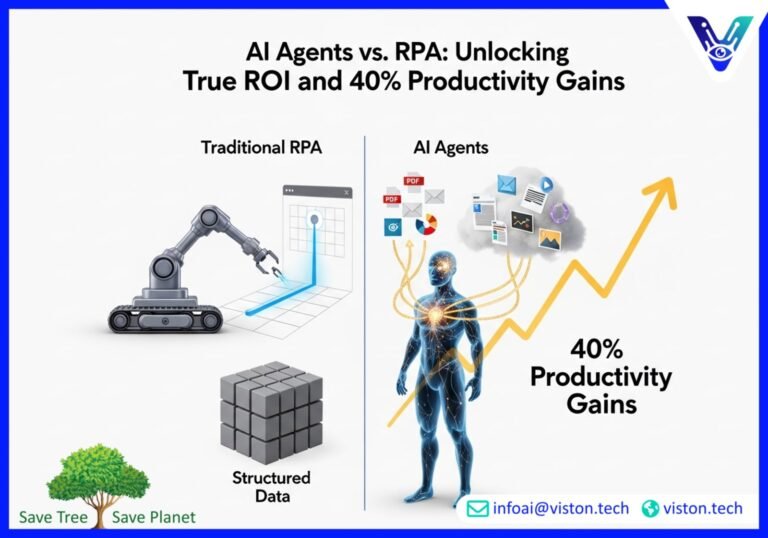
The conversation is no longer just about automating tasks; it’s about automating entire complex workflows with intelligence. Real-world deployments are showing extraordinary results: some companies report up to 40% productivity gains within just six months of implementing AI-powered automation. The choice between RPA and AI Agents is now a critical strategic decision that will define market leaders. This post will explore the core differences, map out ideal use cases, and provide a clear decision framework to help you choose the right path for maximum ROI.
The Automation Dilemma: Bots vs. Brains
To understand the monumental shift happening in automation, we first need to grasp the fundamental differences between these two technologies. They may seem similar on the surface, but their core capabilities are worlds apart.
What is Traditional RPA? The Digital Taskmaster
Think of a traditional RPA bot as a macro on steroids. It’s a software robot that you program to mimic human actions on a computer. It excels at performing the same task over and over with perfect precision, as long as the conditions never change. RPA is the master of “if-then” scenarios.
- Follows Strict Rules: RPA bots operate based on a predefined script. They do exactly what they are told and cannot deviate.
- Works with Structured Data: They need data to be in a consistent, predictable format, like rows and columns in an Excel sheet or fields in a form.
- UI-Dependent: RPA often interacts with applications through the user interface (UI), just like a person would. If a button moves or a field name changes in a software update, the bot breaks.
RPA has been valuable for achieving quick wins in automating simple, high-volume tasks. However, its rigidity is also its greatest weakness in a dynamic business world.
Enter AI Agents: The Cognitive Workforce
AI Agents are the next evolution. They are autonomous, goal-oriented software programs that leverage artificial intelligence, machine learning (ML), and natural language processing (NLP) to perceive their environment, make decisions, and execute complex, multi-step tasks. They don’t just follow rules; they apply reasoning.
- Understands Context and Intent: An AI Agent can read an email, understand the sender’s intent (e.g., a complaint vs. a sales inquiry), and decide on the appropriate action without a rigid script.
- Handles Unstructured Data: They can process and extract information from varied sources like PDFs, images, emails, and documents, which constitute over 80% of business data.
- Learns and Adapts: AI Agents learn from new data and interactions. They become more accurate and efficient over time and can adapt to changes in systems or processes, leading to significantly lower maintenance costs.
Feature Comparison: The Ultimate Showdown
When you place RPA and AI Agents side-by-side, the difference in capability becomes stark. One is built for repetition, the other for cognition.
| Feature | Traditional RPA | AI Agents |
|---|---|---|
| Core Function | Task Mimicry (Doing) | Problem Solving (Thinking & Doing) |
| Data Handling | Structured Data Only | Structured & Unstructured Data |
| Decision Making | Rule-Based (If-Then Logic) | Context-Aware, Judgment-Based |
| Adaptability | Brittle; Breaks with UI/Process Changes | Resilient; Learns and Adapts to Changes |
| Scalability | Challenging; High Maintenance Overhead | High; Can be Deployed Across Complex Workflows |
Cost and Complexity: Investing in the Future
The initial investment for a simple RPA bot might seem lower than that for a sophisticated AI Agent. However, a true ROI calculation must consider the total cost of ownership (TCO) and the long-term value generated.
RPA: Predictable Costs, Limited Scope
RPA implementation costs are often straightforward, but the hidden costs of maintenance can be substantial. Any change to an application or process requires manual reprogramming of the bot, leading to downtime and reliance on specialized developers. The ROI is typically tied directly to saved labor costs for a specific, unchanging task.
AI Agents: Scalable Investment, Exponential Returns
While AI Agents may require a higher upfront investment for platform and model training, their TCO is often lower. Their ability to self-adapt drastically reduces maintenance needs. More importantly, their ROI isn’t just about cost savings. AI Agents unlock new value by improving decision-making, enhancing customer experience, and providing data-driven insights that can drive revenue growth. For more on this, check out this insightful article on the evolution of AI Agents from Forbes.
Use-Case Mapping: Rules vs. Reasoning
Choosing the right technology depends entirely on the nature of the business process you want to automate.
When to Use RPA: The Realm of Repetition
Traditional RPA still has its place. It is the perfect tool for processes that are:
- High-Volume and Stable: Tasks like moving data from one fixed system to another.
- Rule-Based: Processes with no exceptions or need for judgment.
- Reliant on Structured Data: For example, generating a weekly report from a structured database.
When to Deploy AI Agents: The Frontier of Cognition
AI Agents shine where complexity and variability are the norms. Deploy them for processes that require:
- Unstructured Data Processing: Such as extracting information from vendor invoices in various formats or analyzing customer support emails.
- Cognitive Decision-Making: Like approving insurance claims based on policy rules and claim details, or performing predictive analytics.
- End-to-End Process Automation: Handling an entire workflow, from receiving a customer order to coordinating shipment and sending a confirmation, adapting to exceptions along the way.
ROI Case Studies: The Proof is in the Productivity
The theoretical benefits of AI Agents are compelling, but their real-world impact is transformative. The numbers from recent enterprise deployments in 2025 speak for themselves.
Case Study 1: Slashing Invoice Processing Time by 85%
A global logistics company struggled with a manual accounts payable process. Thousands of invoices arrived weekly in different formats (PDF, email, paper scans), leading to slow processing times, late fees, and a high error rate. Their initial RPA solution failed because it couldn’t handle the variability.
By deploying AI Agents, the company completely automated the workflow. The AI Agents could ingest invoices in any format, intelligently extract the relevant data, validate it against purchase orders, and route it for approval. The result was an 85% reduction in invoice processing time, the elimination of late payment penalties, and the ability to capture more early payment discounts, delivering a clear and rapid ROI.
Case Study 2: Predictive Maintenance Delivers 300% ROI vs. Legacy RPA
A large manufacturing firm used a traditional, time-based maintenance schedule for its machinery, which was inefficient and costly. Breakdowns were frequent, causing expensive downtime.
They implemented an AI Agent-powered predictive maintenance solution. The agents continuously analyzed real-time data from sensors on the equipment, identifying subtle patterns that preceded failures. This allowed the maintenance team to perform targeted repairs before a breakdown occurred. The solution delivered 25% less downtime and a staggering 300% ROI compared to what a simpler rules-based automation system could achieve. For a deeper dive into intelligent automation, this Bain & Company article provides excellent context.
The Broader Impact: 40% Productivity Gains Across the Enterprise
These are not isolated examples. Across industries, from customer service to supply chain management, businesses that embrace AI Agents are seeing productivity gains of up to 40% in under a year. By automating not just tasks but entire intelligent workflows, they free up human employees to focus on high-value strategic work, driving innovation and competitive advantage.
Decision Matrix: Your Guide to Choosing the Right Automation
Use this simple matrix to help determine which technology is the best fit for your business needs.
| Consideration | Choose Traditional RPA If… | Choose AI Agents If… |
|---|---|---|
| Process Complexity | Low. The process is linear and has few exceptions. | High. The process is dynamic with many variables. |
| Data Type | 100% structured and predictable. | Mix of structured and unstructured data. |
| Need for Judgment | None. Decisions are based on clear rules. | Essential. The process requires interpretation and decisions. |
| System Stability | High. The underlying applications rarely change. | Low. Applications and processes are updated frequently. |
| Strategic Goal | Quick cost savings on a specific, repetitive task. | Long-term transformation and competitive advantage. |
The Verdict: Why AI Agents Are the Future of Automation ROI
Traditional RPA opened the door to business process automation, but AI Agents are the key to unlocking its full potential. While RPA focuses on efficiency by automating repetition, AI Agents drive effectiveness by automating intelligence. They deliver a more profound and sustainable ROI by not only cutting costs but also enhancing decision-making, increasing operational resilience, and creating new opportunities for growth.
As we move further into 2025, the debate is no longer about if you should adopt intelligent automation, but how quickly. The organizations that successfully deploy AI Agents to handle their complex, dynamic workflows will be the ones that lead their industries in efficiency, innovation, and profitability.
Frequently Asked Questions (FAQs)
1. What is the main difference between an AI Agent and an RPA bot?
The core difference is reasoning. An RPA bot follows a strict, pre-programmed script to perform repetitive tasks. An AI Agent uses artificial intelligence to understand context, handle unstructured data, make decisions, and adapt to new situations, allowing it to automate complex, dynamic workflows.
2. Can AI Agents work with our existing RPA bots?
Absolutely. A hybrid approach is often very effective. RPA bots can handle the high-volume, repetitive parts of a process, while AI Agents manage the more complex steps that require decision-making or data interpretation. This allows you to leverage your existing investment in RPA while scaling your automation capabilities.
3. Is implementing AI Agents more expensive than RPA?
The initial investment for AI Agents can be higher due to the more sophisticated technology. However, the total cost of ownership is often lower because AI Agents require significantly less maintenance and reprogramming. Furthermore, their ROI is much greater as they can tackle higher-value, more complex processes.
4. What kind of skills do we need to manage AI Agents?
Managing AI Agents typically involves skills in data science, machine learning, and business process analysis. However, leading AI platforms are becoming more user-friendly, with low-code interfaces that empower business users to configure and oversee agents without deep technical expertise.
5. How quickly can we expect to see ROI from AI Agents?
While every project is different, many businesses see a significant return on investment within 6 to 18 months. The impressive productivity gains, cost savings, and efficiency improvements, like those seen in invoice processing and predictive maintenance, can deliver measurable financial benefits quickly.
6. Which industries benefit the most from AI Agents?
Any industry with complex processes and a high volume of unstructured data can benefit. This includes finance (fraud detection, claim processing), manufacturing (supply chain, predictive maintenance), healthcare (patient data management, diagnostics), and retail (personalized marketing, inventory management).
7. How secure are AI Agents when handling sensitive data?
Security is a core component of enterprise-grade AI platforms. AI Agents operate within secure environments with robust access controls, encryption, and audit trails to ensure compliance with regulations like GDPR and HIPAA, just like any other critical business software.
8. Does our company need to be a certain size to benefit from AI Agents?
Not at all. While large enterprises are leading adoption, cloud-based AI platforms are making this technology accessible to mid-sized businesses and even startups. The key is to have a complex, high-value process that is ripe for intelligent automation.
Ready to Unlock Real Automation ROI?
The age of intelligent automation is here. If you’re ready to move beyond the limitations of traditional RPA and see how AI Agents can transform your business, the team at Viston AI is here to help. We specialize in deploying cutting-edge, AI-powered solutions that deliver measurable results.
Contact Viston AI today to schedule a consultation and discover how you can achieve unparalleled productivity and ROI.
Hashtags: #AIAgents #RPA #AutomationROI #BusinessProcessAutomation #IntelligentAutomation #DigitalTransformation #FutureOfWork #CostSavings #Productivity #AIforBusiness #VistonAI
