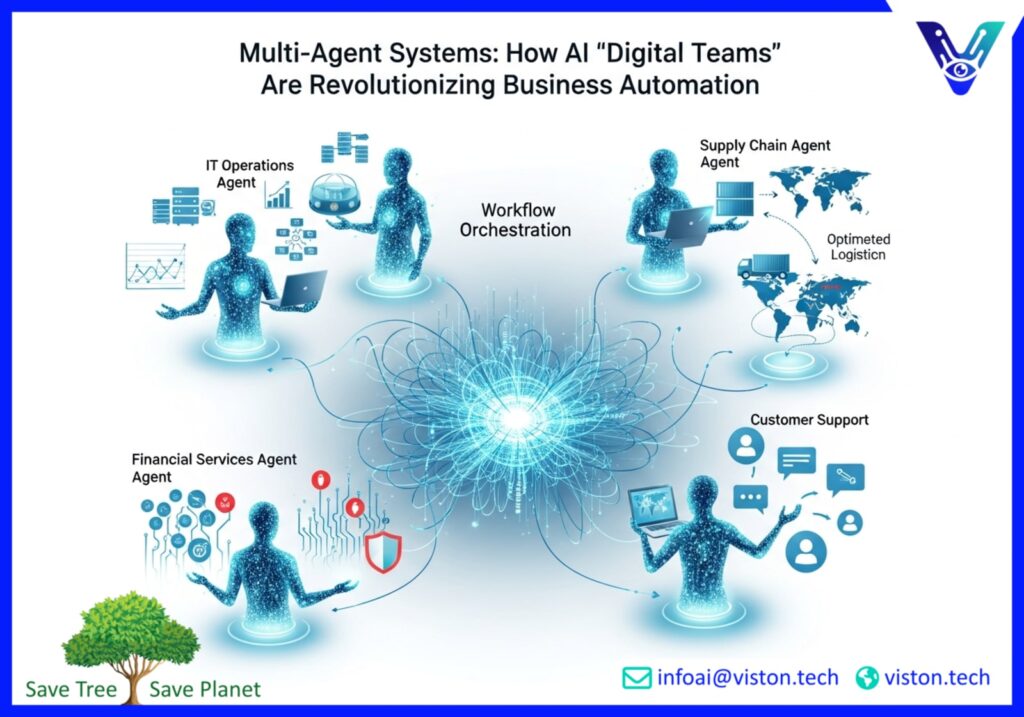
Multi-Agent Systems: The Future of Complex Business Process Automation
The era of digital transformation is rapidly evolving, and businesses are on a constant quest for the next groundbreaking technology to optimize operations and drive growth. While artificial intelligence (AI) has already made significant inroads, a new frontier is emerging: Multi-Agent Systems (MAS). This innovative approach to AI is poised to revolutionize how enterprises automate their most complex business processes. In fact, the shift is already underway. A staggering 43% of global leaders are deploying multi-agent systems, realizing productivity boosts of up to 40%. Furthermore, 82% are planning to integrate AI agents as “digital team members” within the next 12–18 months. This isn’t just a trend; it’s the future of intelligent automation.
What Are Multi-Agent Systems? A Simple Introduction
Imagine a highly efficient team of specialists working together to achieve a common goal. Each member has a unique skill set and can work autonomously, yet they communicate and coordinate their actions seamlessly. This is the core concept behind a Multi-Agent System. In the digital realm, these “agents” are intelligent software programs designed to perform specific tasks. A MAS is a network of these autonomous agents that interact with each other and their environment to solve problems that would be too complex for a single agent to handle alone. This concept of distributed intelligence is what makes MAS so powerful and transformative for business process automation.
The Architecture of Collaboration: How Multi-Agent Systems Work
The architecture of a multi-agent system is designed for flexibility and scalability. While there are various architectural models, they generally consist of several key components:
Agents: These are the fundamental actors in the system. Each agent has its own set of capabilities, knowledge, and goals. They can range from simple, reactive agents to more complex, cognitive agents that can learn and adapt over time.
Environment: This is the shared space where agents operate and interact. It can be a digital environment, like a database or a network, or a physical one, such as a factory floor.
Communication Protocols: For agents to collaborate effectively, they need a way to communicate. These protocols define the language and rules for exchanging information, negotiating tasks, and coordinating actions.
Orchestration Layer: In many systems, an orchestration layer oversees the collaboration between agents, assigning tasks and ensuring that the collective efforts are aligned with the overall business objectives. This is a critical component for effective workflow orchestration.
This distributed and collaborative architecture provides several key advantages, including enhanced scalability, robustness, and the ability to tackle incredibly complex problems by breaking them down into manageable sub-tasks.
Real-World Impact: Enterprise Use Cases for Multi-Agent Systems
The practical applications of multi-agent systems are vast and are already delivering significant value across various industries. Here are a few compelling enterprise use cases that highlight the transformative potential of MAS in 2025 and beyond.
1. Revolutionizing IT Operations with Self-Healing Systems
In the fast-paced world of IT, downtime is not an option. Multi-agent systems are being deployed to create self-healing infrastructures that can preemptively identify and resolve issues. Imagine a team of digital agents constantly monitoring your network. A “Monitor Agent” detects an unusual spike in server latency. It immediately alerts a “Diagnosis Agent,” which analyzes the data and pinpoints a memory leak in a specific application. The Diagnosis Agent then triggers a “Remediation Agent” to restart the application and allocate more memory, all before a human operator is even aware of the problem. This proactive approach significantly reduces downtime and frees up IT professionals to focus on strategic initiatives.
2. Optimizing the Supply Chain with Dynamic Coordination
Modern supply chains are incredibly complex, with countless moving parts. Multi-agent systems bring a new level of intelligence and agility to supply chain management. Consider a scenario where a “Demand Forecasting Agent” predicts a surge in demand for a particular product in a specific region. This agent communicates with an “Inventory Management Agent” to check stock levels. Simultaneously, a “Logistics Agent” analyzes the most efficient shipping routes, taking into account real-time traffic and weather data. By working together, these agents can dynamically adjust inventory levels, optimize delivery routes, and ensure that products are in the right place at the right time, minimizing delays and reducing costs. For more insights on how AI is transforming supply chains, you can read this informative article on the role of AI in supply chain management.
3. Enhancing Financial Services with Intelligent Fraud Detection
The financial services industry is a prime candidate for the adoption of multi-agent systems, particularly in the realm of fraud detection and risk management. A team of AI agents can monitor transactions in real-time. A “Transaction Monitoring Agent” might flag a suspicious transaction that deviates from a customer’s usual spending patterns. This triggers a “Behavioral Analysis Agent” to examine the customer’s historical data for further anomalies. If the suspicion is high, a “Customer Communication Agent” can automatically send a verification request to the customer, while a “Security Agent” temporarily freezes the account to prevent further fraudulent activity. This multi-layered, collaborative approach provides a much more robust defense against financial crime.
4. Elevating Customer Support with Proactive and Personalized Service
In the age of the customer, providing exceptional service is paramount. Multi-agent systems can create a more responsive and personalized customer support experience. When a customer initiates a support request, a “Triage Agent” can analyze the query and route it to the most appropriate specialized agent. For a technical issue, it might be routed to a “Technical Support Agent” that can access product documentation and provide step-by-step troubleshooting. For a billing inquiry, it goes to a “Billing Agent” with access to the customer’s account information. This division of labor ensures that customers receive expert assistance quickly and efficiently. Moreover, these agents can learn from each interaction, continuously improving their ability to resolve issues.
A Technical Deep Dive: Agent Coordination and the Power of LLMs
At the heart of any successful multi-agent system is effective agent coordination. This involves the mechanisms that allow agents to synchronize their activities and work together coherently. Coordination can be achieved through various strategies, from centralized control where a master agent directs the others, to decentralized approaches where agents negotiate and cooperate amongst themselves. The choice of coordination strategy depends on the specific requirements of the business process being automated.A significant recent development in this space is the integration of Large Language Models (LLMs). LLMs provide agents with advanced natural language understanding and generation capabilities, enabling more sophisticated communication and collaboration. For example, an agent powered by an LLM can understand complex user requests in natural language, interact with other agents in a more human-like manner, and even generate reports and summaries of their collective activities. This integration of LLMs is a key driver behind the increasing power and applicability of multi-agent systems in the enterprise. To learn more about the technical aspects of multi-agent systems, IBM offers a great resource on the topic.
Your Implementation Roadmap: Getting Started with Multi-Agent Systems
Embarking on the journey of implementing multi-agent systems can seem daunting, but a structured approach can ensure a successful transition. Here is a high-level roadmap to guide your organization:
Identify the Right Use Case: Start by identifying a complex business process that is ripe for automation and could benefit from a distributed intelligence approach. Look for processes with multiple dependencies and decision points.
Define Agent Roles and Responsibilities: Clearly define the roles and responsibilities of each agent within the system. What specific tasks will each agent perform? What knowledge and capabilities will they need?
Choose the Right Architecture and Technology Stack: Select the most appropriate architecture for your use case and choose the technologies that will power your agents. This includes deciding on communication protocols and whether to incorporate LLMs.
Develop and Train Your Agents: Begin the development process, building and training your agents to perform their designated tasks. This is an iterative process that will involve continuous testing and refinement.
Implement a Robust Orchestration and Monitoring Framework: Put in place a system for orchestrating the interactions between your agents and for monitoring their performance. This is crucial for ensuring the reliability and efficiency of your MAS.
Start Small and Scale: Begin with a pilot project to test the effectiveness of your multi-agent system in a controlled environment. Once you have demonstrated success, you can then scale the solution across other parts of your organization.
The Future is Collaborative: Embrace the Power of Digital Teams
Multi-agent systems represent a paradigm shift in business process automation. By moving away from monolithic, centralized automation solutions to a more distributed and collaborative model, organizations can unlock unprecedented levels of efficiency, agility, and intelligence. The statistics speak for themselves: with widespread adoption on the horizon and proven productivity gains, the question is no longer if, but when your organization will embrace the power of multi-agent systems. The future of your business processes depends on it.Are you ready to build your digital workforce and unlock the full potential of your business operations? Contact Viston AI today to explore our cutting-edge AI-powered solutions and start your journey towards a more automated and intelligent future.#MultiAgentSystems #AI #Automation #DigitalTransformation #BusinessProcessAutomation #FutureOfWork #LLMs
Frequently Asked Questions (FAQs)
1. What is the main difference between a multi-agent system and traditional automation?
Traditional automation typically follows a set of predefined rules and workflows. Multi-agent systems, on the other hand, consist of multiple autonomous agents that can make decisions and collaborate to solve complex problems, offering greater flexibility and adaptability.
2. Are multi-agent systems difficult to implement?
While the underlying technology can be complex, modern platforms and frameworks are making it easier for businesses to develop and deploy multi-agent systems. A phased implementation approach, starting with a pilot project, is recommended.
3. How do multi-agent systems handle security?
Security is a critical consideration in the design of multi-agent systems. This includes secure communication protocols between agents, access control mechanisms to protect sensitive data, and robust monitoring to detect and respond to potential threats.
4. Can multi-agent systems work with our existing IT infrastructure?
Yes, multi-agent systems are designed to be integrable with existing enterprise systems and data sources through APIs and other integration methods. This allows them to leverage your current technology investments.
5. What is the role of Large Language Models (LLMs) in multi-agent systems?
LLMs enhance multi-agent systems by providing advanced natural language processing capabilities. This enables agents to understand and respond to human language more effectively, communicate with each other in a more nuanced way, and perform tasks that require a deeper understanding of context.
6. How can I measure the ROI of implementing a multi-agent system?
The ROI of a multi-agent system can be measured through various key performance indicators (KPIs), such as increased productivity, reduced operational costs, improved customer satisfaction scores, and faster problem resolution times.
7. What industries can benefit the most from multi-agent systems?
Virtually any industry with complex processes can benefit from multi-agent systems. This includes manufacturing, logistics, finance, healthcare, IT, and customer service, among others.
8. What is “distributed intelligence” in the context of multi-agent systems?
Distributed intelligence refers to the concept of intelligence not being centralized in a single entity, but rather being spread across a network of autonomous agents. This collective intelligence allows the system to solve more complex problems and be more resilient to failures.