
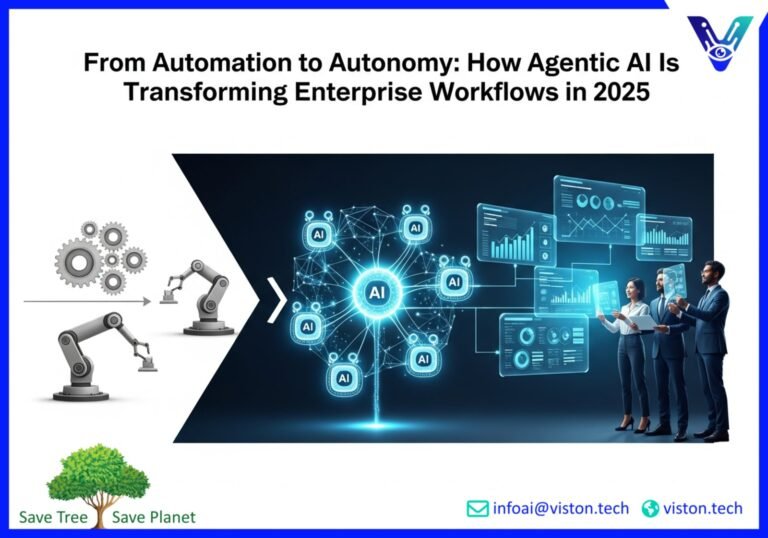
From Automation to Autonomy: How Agentic AI is Transforming Enterprise Workflows in 2025
The year is 2025, and the conversation in the enterprise world has decisively shifted. It’s no longer about whether to adopt artificial intelligence, but how to leverage its most advanced form to stay competitive. We’ve moved beyond basic automation, which diligently follows a script, to the era of autonomy, where AI doesn’t just execute tasks but thinks, learns, and makes decisions. This is the world of Agentic AI, and it’s not a far-off concept—it’s the driving force behind the next wave of digital transformation.
The numbers speak for themselves. A staggering 85% of enterprises are expected to use AI agents in 2025. The global market for this technology is projected to be worth approximately USD 7.6 billion this year and is on a trajectory to potentially exceed USD 199 billion by 2034. For businesses in North America, the median return on investment for AI implementation is already hovering around a remarkable USD 175 million. This isn’t just a trend; it’s a fundamental reshaping of how work gets done.
The Problem: The Limits of Traditional Automation
For years, enterprise automation has been a game-changer, freeing human employees from repetitive, rule-based tasks. Think of robotic process automation (RPA) diligently moving data from one system to another. It’s efficient, but also rigid. Traditional automation operates on a fixed set of instructions. It can’t handle exceptions, adapt to new information, or make judgments when faced with unforeseen circumstances. This rigidity creates bottlenecks, requires constant human oversight for complex scenarios, and ultimately limits scalability.
In today’s dynamic business environment, this is no longer enough. Enterprises are grappling with:
- Information Overload: Teams are drowning in data from countless sources, struggling to extract actionable insights in real-time.
- Complex Workflows: Modern business processes span multiple departments and systems, making seamless coordination a significant challenge.
- Rising Customer Expectations: Customers demand instant, personalized service 24/7, a feat that is difficult to achieve with human teams alone.
- Pressure to Innovate: The pace of change requires organizations to be agile and to continuously optimize their operations to stay ahead.
These challenges highlight the ceiling of traditional automation. Businesses need more than just “doers”; they need intelligent “thinkers” that can navigate complexity and drive outcomes with minimal human intervention.
The Solution: The Rise of Agentic AI and Autonomous Agents
Enter Agentic AI. This isn’t just another buzzword; it represents a significant leap forward. Agentic AI systems, or autonomous agents, are intelligent entities that can perceive their environment, make decisions, and take actions to achieve specific goals. The key difference lies in the word “autonomous.” Unlike their predecessors, these AI agents don’t just follow a script; they can reason, plan, and adapt.
Think of it as the difference between a simple calculator and a skilled financial analyst. The calculator can perform predefined calculations flawlessly. The analyst, however, can interpret financial data, understand market trends, and recommend a strategic course of action. Agentic AI brings this level of cognitive capability to your digital workflows.
These autonomous agents are designed to handle the complexities that stump traditional automation. They can:
- Understand Context: By leveraging advanced technologies like large language models (LLMs), they can comprehend unstructured data, such as emails and reports.
- Make Decisions: They can analyze real-time data to make informed choices, optimizing processes on the fly.
- Learn and Improve: Through machine learning, these agents continuously refine their performance based on new information and feedback.
- Collaborate: In a concept known as multi-agent systems, specialized AI agents can work together to tackle complex, multi-step processes across an organization.
This evolution from simple task automation to comprehensive workflow optimization is at the heart of the current digital transformation. Already, 45% of organizations are operating as semi-autonomous enterprises, with a remarkable 74% expected to reach this stage within the next five years. For a deeper dive into how businesses are preparing for this shift, explore this insightful whitepaper on Agentic Transformation.
The Benefits: Unlocking Unprecedented Efficiency and Growth
The adoption of Agentic AI is not just about technological advancement; it’s about delivering tangible business value. By deploying autonomous agents, enterprises can achieve significant improvements across the board.
Enhanced Productivity and Efficiency
Autonomous agents work around the clock without interruption, handling complex tasks that would otherwise consume valuable human hours. This allows your employees to shift their focus from mundane, repetitive work to more strategic, creative, and high-value initiatives. The result is a more engaged workforce and a dramatic boost in overall productivity. Some estimates suggest that AI agents can accelerate business processes by 30% to 50%.
Improved Decision-Making
In a world driven by data, the speed and accuracy of decision-making can be a major competitive advantage. Agentic AI systems can analyze vast datasets in real-time, identify patterns, and provide data-driven recommendations, enabling leaders to make faster, more informed choices. This capability is crucial for everything from dynamic pricing and supply chain adjustments to proactive customer service.
Cost Reduction
By automating complex workflows and optimizing resource allocation, Agentic AI can lead to substantial cost savings. This includes reduced labor costs for routine tasks, lower error rates, and more efficient use of resources across the organization. The ability of these agents to scale operations without a proportional increase in headcount is a significant financial benefit.
Greater Agility and Scalability
The business landscape is in constant flux. Autonomous agents provide the agility needed to adapt to changing market conditions and customer demands in real-time. Whether it’s scaling up customer support during a product launch or rerouting logistics in response to a supply chain disruption, Agentic AI enables a level of operational flexibility that was previously unattainable.
Case Study: Agentic AI in Action
To truly understand the transformative power of Agentic AI, let’s look at its application in two key sectors: IT operations and manufacturing.
IT Operations Transformed
IT departments are often inundated with support tickets, system monitoring alerts, and routine maintenance tasks. Agentic AI is revolutionizing this landscape. Autonomous agents can now:
- Proactively Monitor Systems: An AI agent can continuously monitor network performance, identify potential issues before they escalate, and even take corrective action, such as rerouting traffic or restarting a service, without human intervention.
- Automate Incident Response: When a critical alert is triggered, an autonomous agent can instantly analyze the situation, consult knowledge bases to find a solution, and execute a fix. This dramatically reduces system downtime and frees up IT professionals to focus on strategic projects.
- Streamline User Support: Intelligent agents can handle a wide range of user support requests, from password resets to software installations, providing instant resolution and improving employee satisfaction.
Manufacturing Reimagined
In the manufacturing sector, efficiency and precision are paramount. Agentic AI is paving the way for the smart factories of the future. Here, autonomous agents are being deployed to:
- Optimize Supply Chains: AI agents can monitor inventory levels, track shipments in real-time, and even predict potential disruptions. If a delay is detected, an agent can autonomously identify an alternative supplier and adjust production schedules accordingly.
- Enable Predictive Maintenance: By continuously analyzing data from sensors on machinery, AI agents can predict when a piece of equipment is likely to fail and automatically schedule maintenance, preventing costly unplanned downtime.
- Enhance Quality Control: Autonomous agents using computer vision can inspect products on the assembly line with a level of accuracy and consistency that surpasses human capabilities, identifying defects in real-time and ensuring higher product quality.
For those interested in the technical underpinnings and the future of human-AI collaboration in the workplace, this report on the future of work with Agentic AI offers valuable insights.
Comparing ROI: Traditional Automation vs. Agentic AI
While traditional automation has certainly delivered a positive return on investment by cutting costs and improving efficiency in rule-based tasks, the ROI from Agentic AI is on a completely different scale. The value of autonomous agents extends far beyond simple cost-cutting.
Traditional Automation ROI Metrics:
- Cost Savings: Primarily through reduced manual labor for repetitive tasks.
- Speed: Faster execution of predefined processes.
- Accuracy: Reduction in human error for rule-based work.
Agentic AI ROI Metrics:
- Revenue Growth: Through dynamic pricing, personalized marketing, and improved customer experiences.
- Strategic Value: By enabling faster innovation, better decision-making, and greater business agility.
- Operational Resilience: Through proactive problem-solving and adaptive workflows that minimize disruptions.
- Enhanced Human Capital: By empowering employees to focus on high-impact, strategic work.
The key distinction is that while traditional automation optimizes existing processes, Agentic AI creates new opportunities for value creation. It’s a shift from incremental efficiency gains to transformative business outcomes.
The Future Outlook: A New Era of Enterprise Intelligence
The adoption of Agentic AI is not just a technological upgrade; it’s a strategic imperative for any enterprise looking to thrive in 2025 and beyond. As these systems become more sophisticated, we can expect to see them integrated into every facet of business operations, from finance and human resources to marketing and product development.
The future of work will be a collaborative one, where human expertise is augmented by the power of autonomous AI agents. This human-AI partnership will unlock new levels of creativity and innovation, allowing businesses to solve complex challenges and seize opportunities faster than ever before.
However, this journey towards an autonomous enterprise requires careful planning and a clear strategy. Organizations must invest in the right infrastructure, ensure data quality, and foster a culture that embraces this new way of working. The challenges are real, but the rewards for those who successfully navigate this transformation will be immense.
Ready to embrace the future of enterprise automation? The shift from automation to autonomy is here. Agentic AI is no longer a futuristic vision but a present-day reality that is delivering a significant competitive advantage to early adopters. Don’t let your organization fall behind.
Contact Viston AI today to discover how our AI-powered solutions can help you optimize your workflows, empower your teams, and accelerate your digital transformation journey.
Frequently Asked Questions (FAQs)
1. What is the main difference between Agentic AI and traditional automation?
Traditional automation, like RPA, follows a fixed set of rules to perform repetitive tasks. Agentic AI, on the other hand, involves autonomous agents that can perceive their environment, make decisions, learn from new data, and adapt their actions to achieve specific goals with minimal human intervention. It’s the difference between doing and thinking.
2. Is Agentic AI intended to replace human workers?
The goal of Agentic AI is not to replace humans, but to augment their capabilities. By taking over complex, time-consuming tasks, autonomous agents free up employees to focus on strategic thinking, creativity, and complex problem-solving—areas where human intelligence excels. The future is a collaborative human-AI workforce.
3. What are some of the biggest challenges to implementing Agentic AI?
Key challenges include integrating with legacy systems, ensuring data privacy and security, and managing the complexity of multi-agent systems. There is also a need for a cultural shift within the organization to build trust in these autonomous systems and to establish clear governance and oversight.
4. How can a business measure the ROI of Agentic AI?
The ROI of Agentic AI goes beyond simple cost savings. Key metrics include revenue growth from improved customer experiences, faster time-to-market for new products, increased operational resilience, and the strategic value of enhanced decision-making and business agility.
5. What industries are being most impacted by Agentic AI?
While the impact is broad, industries like manufacturing, IT operations, finance, healthcare, and customer service are seeing some of the most immediate and significant transformations. Any industry with complex workflows and large volumes of data stands to benefit greatly.
6. How secure are autonomous AI agents?
Security is a critical consideration in the deployment of Agentic AI. Reputable solutions are built with robust security measures, including data encryption, access controls, and compliance with regulations like GDPR. It’s essential to partner with a provider that prioritizes a secure and ethical approach to AI.
7. What is a “multi-agent system”?
A multi-agent system is a network of specialized autonomous agents that collaborate to achieve a common goal. For example, in a supply chain, one agent might monitor inventory, another might track logistics, and a third could handle procurement. They communicate and coordinate their actions to optimize the entire process.
8. How can my business get started with Agentic AI?
The first step is to identify a specific, high-value use case within your organization where autonomous agents could make a significant impact. Start with a pilot project to demonstrate the value and build momentum. Partnering with an expert like Viston AI can provide the guidance and technology needed to ensure a successful implementation.
#AgenticAI #AutonomousAgents #EnterpriseAutomation #WorkflowOptimization #DigitalTransformation #FutureOfWork #AIinBusiness #TechTrends2025
