
A practical guide for business leaders evaluating automation strategy
Choosing how to connect AI to your business operations is one of the most consequential technology decisions of 2026. Zapier has served as the default automation layer for thousands of companies, but a growing number of businesses are moving beyond trigger-action workflows toward custom AI agent integration — systems that reason, adapt, and act autonomously. Understanding what separates these two approaches is essential before committing to either.
Zapier operates on a deterministic model. You define a trigger, configure a sequence of actions, and the platform executes that sequence reliably every time. With over 7,000 app integrations, it remains exceptionally capable for structured, rule-based workflows: syncing CRM records, routing form submissions, sending notifications, updating spreadsheets, and passing data between familiar SaaS tools.
Its strengths are real. Setup is fast. Non-technical users can build functional automations without developer involvement. The platform’s reliability is well-established, and run logs make it easy to audit what happened and when.
The limitation emerges when your workflows involve judgment. Zapier cannot interpret the intent behind an unstructured customer email, reason through a multi-variable decision, or adjust its behaviour based on context it wasn’t explicitly programmed to handle. When the right action depends on nuance — the sentiment of a message, the urgency of a request, the classification of an ambiguous input — rule-based automation reaches its ceiling.
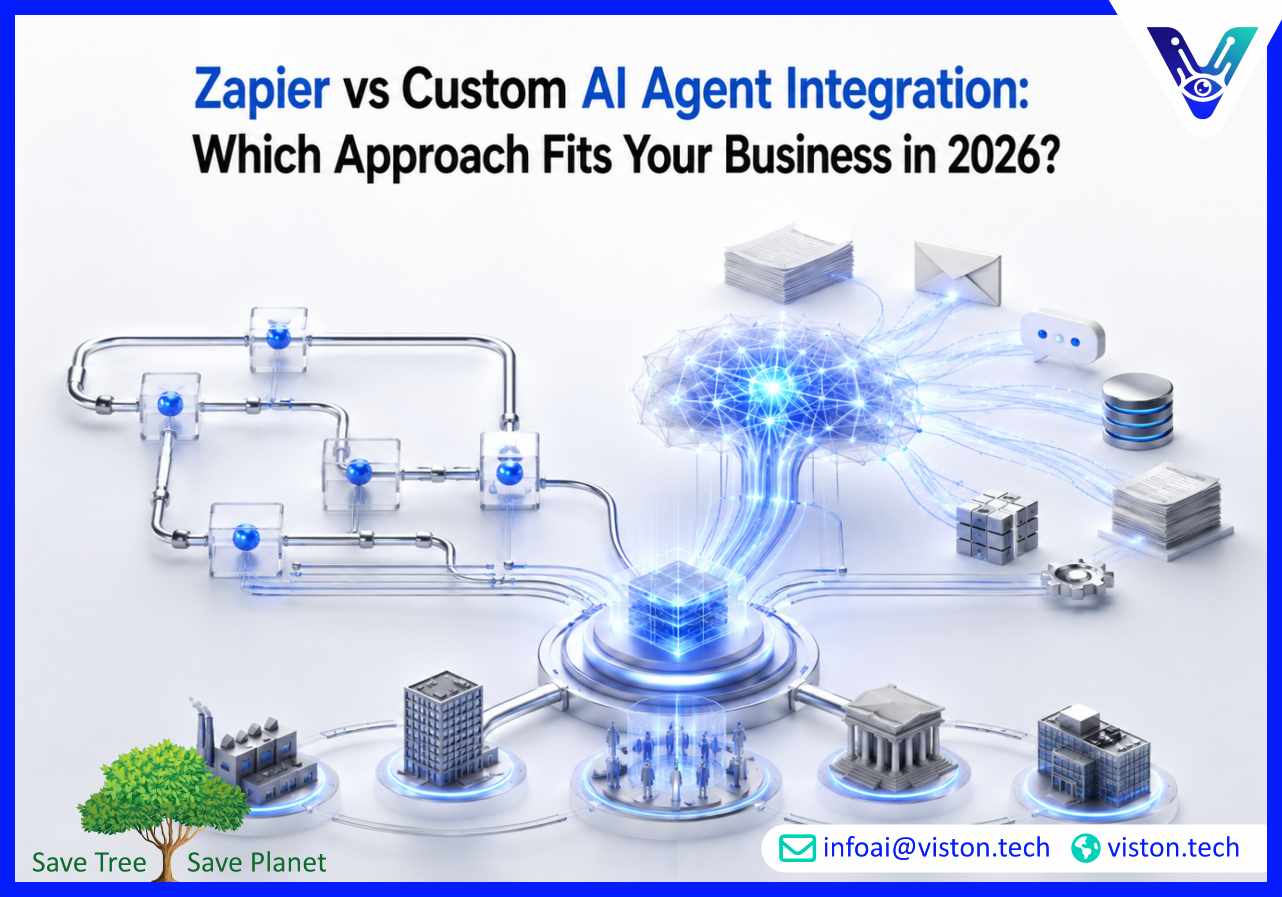
Zapier builds the pipes. Custom AI agent integration builds the intelligence that flows through them.
A custom AI agent does not wait for a predefined trigger to match a predefined rule. It perceives a situation, reasons through available information, determines the most appropriate action, executes it, and — where necessary — iterates based on the outcome. This perceive-reason-act loop is what makes agentic AI fundamentally different from conventional workflow automation.
Most real business data is unstructured: emails, documents, call transcripts, support tickets, contracts. A custom AI agent can read, interpret, and act on that content in ways that a trigger-action system simply cannot. It can qualify an inbound lead based on the content of a free-text message, draft a context-aware response, or extract the relevant clauses from a contract — all without a human defining every possible condition in advance.
Where Zapier executes a fixed sequence, a custom agent can plan dynamically. Given a goal — “review these inbound enquiries, identify high-priority prospects, and draft personalised follow-up messages” — the agent determines the steps, calls the appropriate tools, and delivers the outcome. This shifts automation from a series of instructions to a delegation of responsibility.
Custom AI agent integration is not limited to pre-built connectors. It can connect directly to internal APIs, legacy ERPs, proprietary databases, and bespoke internal tools. For enterprise organisations operating complex technology stacks, this matters considerably. The agent becomes a layer of intelligence that sits across the entire environment — not just the applications that happen to have a Zapier connector.
Sophisticated custom agents maintain persistent memory across interactions. They can recall the context of a previous conversation, track the state of an ongoing process, and make decisions informed by history — not just the immediate input. This is essential for customer-facing processes, account management workflows, and any use case where continuity across time matters.
The most useful framing here is not a competition between Zapier and custom AI agents. It is a question of where each approach delivers genuine value — and in many production environments, both belong in the architecture.
Zapier remains the right choice for:
Custom AI agent integration is the right choice for:
A practical hybrid architecture uses Zapier as the integration layer — handling data movement, app connectivity, and structured triggers — while custom AI agents handle the intelligence: reasoning, classification, drafting, decision-making, and complex execution.
Custom AI agent integration involves a higher degree of architectural design than configuring a Zapier workflow. Businesses approaching this decision should evaluate several factors carefully.
Not every process benefits from AI agency. Identify the workflows in your organisation where decision-making is currently slow, inconsistent, or dependent on a small number of skilled individuals. These are the strongest candidates for agent-led automation. Routine, well-structured processes with no decision variability are often better served by conventional tools.
An AI agent is only as effective as the data it can access. Before integration, assess whether your relevant data is structured and accessible via API, whether data quality is sufficient to support reliable reasoning, and whether appropriate access controls and governance frameworks are in place.
Custom agents operating autonomously across enterprise systems must be designed with security built in from the outset. This includes data privacy compliance — particularly under GDPR, HIPAA, or CCPA where relevant — access controls that limit the agent’s scope to what is necessary, and continuous monitoring to ensure the agent behaves as intended. Compliance should be a design requirement, not an afterthought.
The agent framework chosen — whether LangGraph, AutoGen, CrewAI, or another architecture — has significant implications for how the system behaves under load, how easily it can be debugged, and how well it can scale. Multi-agent architectures require careful orchestration. The choice of framework should reflect the complexity of the use case, not simply what is most familiar to the development team.
Unlike Zapier workflows, which either run correctly or produce a logged error, AI agent behaviour requires ongoing evaluation. Production deployments should include deep tracing and observability tooling — such as LangSmith for LangGraph-based systems — to identify where agents deviate, where latency accumulates, and how performance evolves over time.
Viston AI specialises in enterprise-grade AI agent integration, managing the full lifecycle from initial design through deployment, monitoring, and ongoing governance. Their work spans agent architecture, model selection, enterprise system connectivity, and compliance — covering the full scope of what a production-ready custom integration requires.
Their team builds agents using frameworks including AutoGen Studio, CrewAI, and LangGraph, selecting the architecture based on the specific demands of each deployment. For organisations operating legacy infrastructure — older ERPs, internal databases, proprietary APIs — Viston’s integration approach prioritises API-first architecture and comprehensive connectivity assessments before any build begins.
Security and compliance are embedded throughout their delivery approach. Their Responsible AI at Scale framework incorporates data privacy controls, ethical decision-making guardrails, and regulatory adherence aligned with GDPR, HIPAA, and CCPA. This makes their offering particularly relevant to organisations in regulated environments where autonomous agent behaviour must remain auditable and bounded.
For businesses evaluating whether to move beyond Zapier-style automation toward custom AI agent integration, Viston provides both the technical depth and the enterprise governance framework that production deployments demand. Their methodology is designed to reduce time-to-value while maintaining the rigour that enterprise environments require.
Zapier executes predefined trigger-action sequences reliably and efficiently. Custom AI agent integration involves systems that reason over inputs, plan multi-step actions, and adapt their behaviour based on context — making them suited to workflows where judgment, interpretation, or autonomous decision-making is required.
Yes, and this is often the most practical approach. Zapier handles structured data movement and app connectivity, while custom AI agents handle the intelligence layer — reasoning, classification, drafting, and complex decision execution. Webhooks are commonly used to pass data between the two systems.
Processes involving unstructured data, variable decision logic, multi-step execution, or judgment-based outcomes are the strongest candidates. Examples include lead qualification from free-text submissions, document analysis, customer service triage, complex scheduling, and supply chain decision support.
Security must be designed into the agent architecture from the outset. This includes implementing data access controls, encrypting sensitive data, embedding regulatory compliance requirements such as GDPR or HIPAA into the agent’s operating constraints, and establishing continuous monitoring and audit logging for agent actions.
Timelines vary based on complexity, system environment, and integration scope. Structured enterprise deployments with clear process definitions and accessible APIs can produce initial proof-of-concept results within a few weeks. Full production deployments typically require longer depending on the number of systems involved and compliance requirements. Viston AI’s methodology is designed to deliver proof-of-concept results within two to four weeks.
No. While enterprise organisations often have the most complex integration requirements, growth-stage businesses can also benefit significantly — particularly where skilled human capacity is constrained and AI agency can extend operational capability without proportional headcount increases. The viability depends more on process complexity and data accessibility than on company size alone.
The question of Zapier vs custom AI agent integration is ultimately a question of what your workflows actually require. Where structured, predictable automation suffices, Zapier delivers it efficiently. Where your operations involve reasoning, judgment, unstructured data, or complex multi-step execution, custom AI agent integration provides capabilities that rule-based tools cannot match. Most mature automation strategies will use both. The critical work is identifying which processes belong in each category — and ensuring that any custom agent deployment is built on a foundation of sound architecture, appropriate governance, and continuous observability. Viston AI’s enterprise-focused approach to agent integration services is designed precisely for organisations navigating that decision with production-grade requirements in mind.
