
For the past two years, enterprises have enthusiastically launched pilot programs for agentic artificial intelligence. Yet, as 2026 progresses, a stark reality has emerged: moving from a functional demo to a reliable, business-critical operation remains an obstacle for most organizations. The bottleneck is no longer the capability of individual AI models. Instead, the primary challenge lies in multi-agent system integration services—the discipline of making diverse, specialized agents work together securely, efficiently, and at scale within complex enterprise environments .
Early agentic AI strategies often focused on single, monolithic agents designed to handle a broad range of tasks. While effective for narrow use cases, this approach quickly reveals its limitations when faced with the complexity of real-world operations. A single AI cannot simultaneously optimize a supply chain, reconcile a financial ledger, update a CRM, and handle a customer escalation without creating performance bottlenecks and security vulnerabilities .
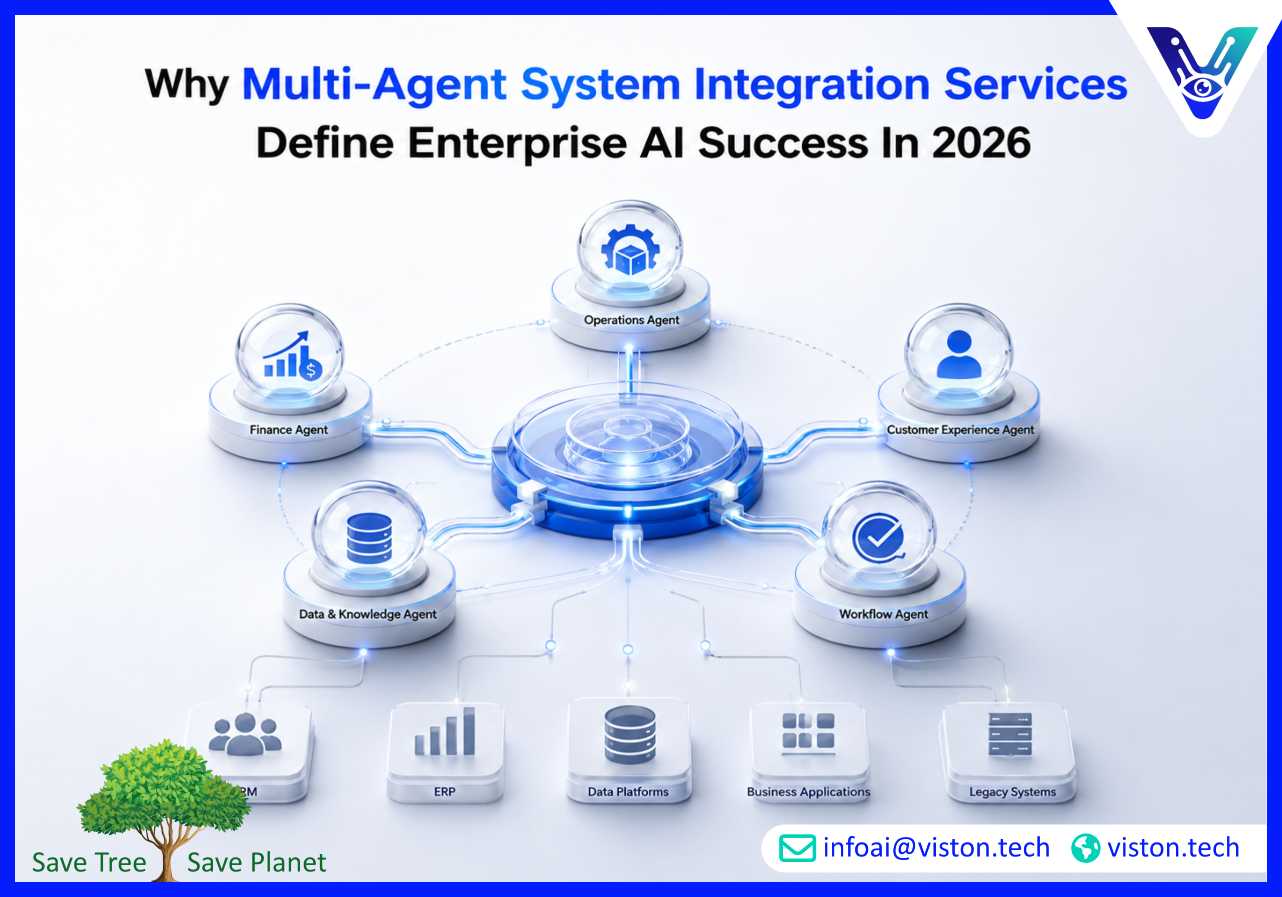
Multi-agent system integration solves this by shifting from a single, overloaded model to a coordinated ensemble of specialized agents. In this architecture, individual agents handle specific domains—such as inventory management, carrier selection, or customer verification—while a governing orchestrator manages their interactions . This modular design mirrors modern microservices architecture, where decoupling components allows for independent scaling, updating, and troubleshooting without disrupting the entire system .
Industry data indicates that 90% of organizations are either using or actively exploring multi-agent systems . However, enthusiasm is colliding with operational friction. A significant majority of business leaders report that their existing processes are actively holding back their AI ambitions, primarily due to fragmented technology estates and unstructured data .
Consequently, the value proposition of multi-agent system integration services has sharpened considerably. In 2026, the market demands providers who can do more than simply deploy agents; they must establish the connective tissue that allows these agents to function as a cohesive workforce. This includes implementing standardized communication protocols like MCP (Model Context Protocol) and A2A (Agent-to-Agent) to ensure agents from different vendors or legacy systems can interoperate without custom, brittle code .
Successful integration is built on three critical architectural pillars. First is a governing orchestration layer. Unlike simple workflows, this layer enforces business rules, manages role-based access controls, and maintains a complete audit trail of agent decisions, which is non-negotiable for regulated industries . Second is a shared memory and context layer. Agents cannot operate in silos; they require a unified view of real-time data, whether that is current inventory positions or a customer’s interaction history .
Third, and most technically significant for 2026, is the adoption of open interoperability protocols. Leading integration strategies now rely on standards like MCP to allow agents to dynamically discover and use new tools, and A2A for agents to delegate subtasks to one another across different platforms . This moves beyond point-to-point API integrations to create a flexible, resilient “agent mesh.”
The shift toward sophisticated integration is driven by measurable outcomes. In supply chain operations, multi-agent orchestration has been shown to reduce logistics delays by up to 40% by allowing agents for demand forecasting, inventory replenishment, and carrier selection to adjust to disruptions in real time . In financial services, agent systems interpret policy language, assess risk, and validate compliance, reducing cycle times while improving audit readiness . For customer experience, a well-integrated system can autonomously resolve issues by having a diagnostic agent analyze a problem before a resolution agent executes the fix, reducing average handling time by 30-50% .
As Gartner predicts that 40% of enterprise applications will include task-specific AI agents by the end of 2026, the competitive advantage will belong to organizations that have moved beyond isolated pilots to seamlessly integrated, autonomous operations .
Navigating the complexities of agent-to-agent communication, state management, and legacy system integration requires specialized expertise. Viston AI focuses exclusively on multi-agent orchestration, providing the rigorous engineering discipline necessary to move agentic AI from concept to production. Unlike generic implementations, Viston AI’s approach prioritizes deterministic outcomes, utilizing strict validation schemas to ensure that AI agents handle reasoning while traditional code executes critical transactions. By leveraging open protocols and a modular architecture, Viston AI helps enterprises break down monolithic automation, enabling secure, scalable, and auditable multi-agent workforces tailored to specific operational needs in the 2026 landscape.
A single agent attempts to handle multiple tasks, which often leads to hallucinations and slow response times. A multi-agent system uses specialized agents for specific tasks, coordinated by an orchestrator, which improves accuracy, speed, and resilience .
MCP (Model Context Protocol) standardizes how agents connect to tools and data sources, while A2A (Agent-to-Agent) allows different agents to communicate and delegate tasks. They are the open standards that prevent vendor lock-in and brittle custom code .
Orchestration automates the “long tail” of complex exceptions that linear RPA cannot handle. By reducing exception leakage and rework, it lowers the hidden operational costs that erode margins and improves cycle times by coordinating tasks in parallel .
Yes, when implemented correctly. A robust orchestration layer enforces governance by design, including role-based access controls, audit trails, and policy guardrails. This often provides better oversight than human-managed workflows .
Timelines vary based on legacy system complexity, but a phased approach focusing on one high-impact business function (e.g., IT ticketing or procurement) can show measurable results within 12 to 16 weeks, with gradual expansion thereafter .
The era of experimental AI is closing. As 2026 progresses, the defining characteristic of successful enterprises will be their ability to operationalize AI, not just access it. Multi-agent system integration services have become the critical differentiator, enabling businesses to transform disjointed automation pilots into resilient, intelligent workflows. By prioritizing a governed architecture with specialized agents and open communication protocols, organizations can finally achieve the scalability, security, and return on investment that agentic AI has long promised. For business leaders, the path forward is clear: move beyond the pilot and invest in the orchestration layer that makes autonomous operations a reality.
