
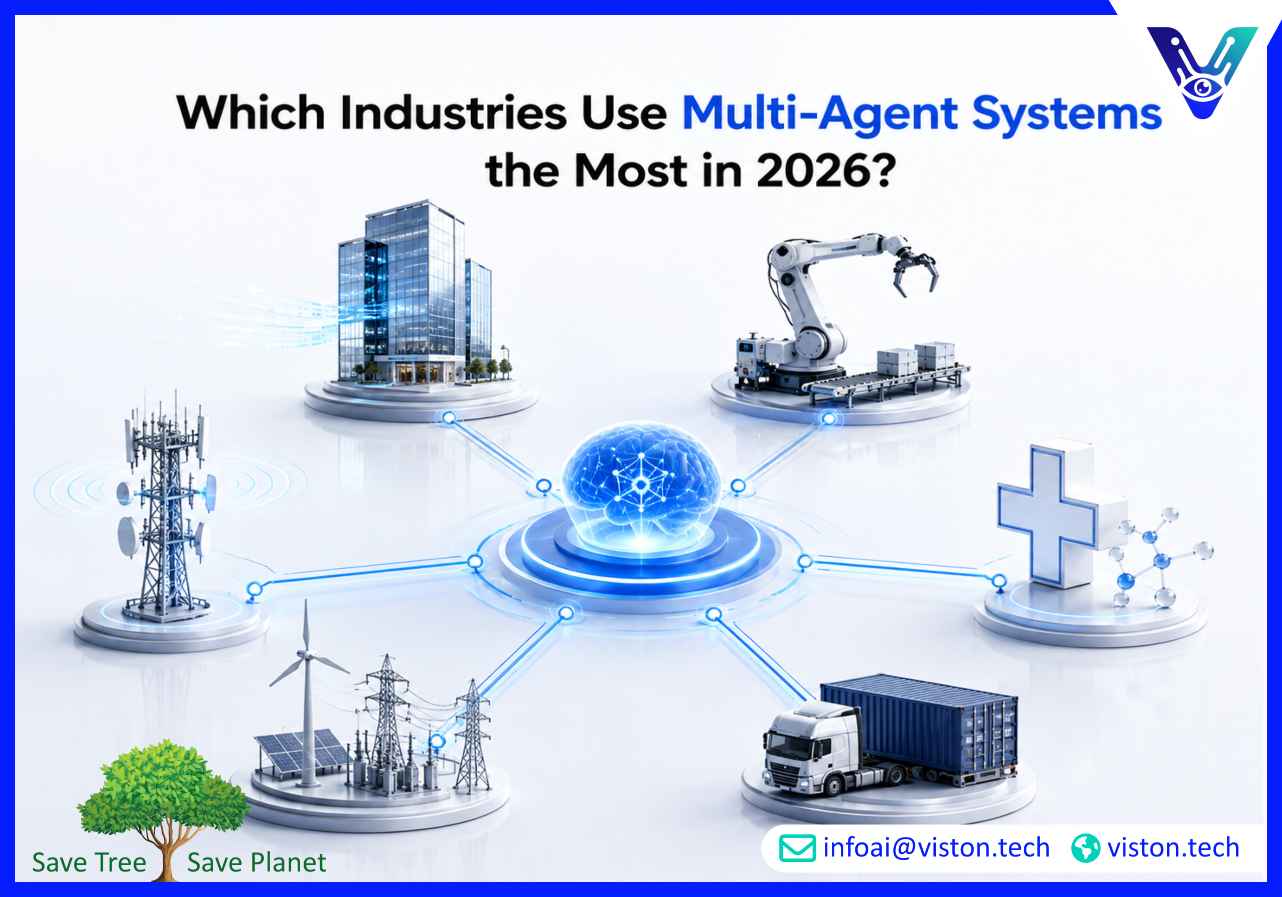
Multi-agent systems have moved from academic research into production environments faster than most business leaders anticipated. Today, the question isn’t whether agentic architectures will reshape industry operations, but which sectors are adopting them most aggressively. For companies evaluating multi-agent orchestration, understanding where complex agent ecosystems already deliver measurable outcomes separates informed strategy from speculative investment.
A multi-agent system involves multiple autonomous AI agents working together, each handling specific tasks while communicating, negotiating, and coordinating actions toward shared objectives. Unlike single-agent setups or simple chained prompts, these systems manage interdependent workflows where agents specialize, delegate, and resolve conflicts without constant human intervention.
Industries adopting multi-agent systems most aggressively share common characteristics: complex supply chains, high-stakes decision environments, fragmented data ecosystems, and workflows where latency carries genuine business cost. They also tend to operate in regulatory environments where traceability and auditability matter, since multi-agent coordination logs provide clearer decision trails than monolithic models.
What distinguishes production-grade deployments from experimental ones is the orchestration layer. Without proper multi-agent orchestration, agent swarms degrade into unpredictable behavior, resource contention, and output inconsistencies that undermine the business case for agentic automation entirely.
No industry has committed more seriously to multi-agent architectures than financial services. Investment banks, asset managers, and insurance carriers deploy agent teams for trading strategy optimization, risk modeling, compliance monitoring, and fraud detection, applications where single-model approaches consistently underperform.
The structural reason is straightforward. Financial institutions manage workflows that naturally decompose into specialized functions. A trade surveillance system needs agents monitoring market data, others analyzing communication channels, and still others correlating patterns against historical behaviors. Running these as independent models creates integration gaps that multi-agent architectures close through designed coordination protocols.
Compliance environments particularly benefit. Regulatory reporting requires data extraction, validation, reconciliation, and submission across multiple jurisdictions with different rule sets. Agent teams handle this complexity by distributing regulatory expertise across specialized agents that negotiate conflicts before reports reach human reviewers. The orchestration challenge involves maintaining consistent compliance logic while allowing agents autonomy to adapt to jurisdiction-specific requirements.
Insurance underwriting has similarly transformed. Multi-agent systems now coordinate risk assessment across property data agents, actuarial modeling agents, and market pricing agents, producing quotes that reflect real-time conditions rather than batch-processed approximations.
Manufacturing represents the second largest adopter of multi-agent systems, though deployment patterns differ markedly from financial services. Here, agent teams manage physical operations: production scheduling, inventory optimization, quality control, and logistics coordination across supplier networks.
The business driver is tangible. Production downtime costs automotive manufacturers millions per hour. Multi-agent systems prevent downtime by deploying predictive maintenance agents that negotiate maintenance windows with production scheduling agents and parts inventory agents simultaneously. No single model can optimize across these interdependent variables in real time.
Supply chain visibility has become the killer application. Organizations managing thousands of suppliers across dozens of countries deploy agent networks where each agent monitors specific supplier tiers, transportation lanes, or inventory nodes. When disruptions occur, whether port delays, raw material shortages, or geopolitical restrictions, agent teams renegotiate fulfillment plans through structured coordination rather than triggering cascading manual escalations.
Quality assurance illustrates the technical sophistication required. Manufacturing lines now deploy agent teams combining computer vision agents for defect detection, process control agents for parameter adjustment, and traceability agents that log decisions for regulatory compliance. The orchestration layer must coordinate these agents at sub-second latency while maintaining decision auditability for FDA, EMA, or other regulatory bodies.
Healthcare has emerged as one of the most ambitious adopters of multi-agent systems, particularly in clinical operations, drug discovery, and care coordination. The industry’s structural complexity, fragmented data systems, and life-critical decision requirements make it uniquely suited to agentic architectures.
Clinical trial management demonstrates the value clearly. Patient recruitment agents analyze eligibility criteria against electronic health records. Site selection agents evaluate investigator experience and patient population data. Regulatory submission agents prepare documentation for different regional authorities. When these agents coordinate through proper orchestration, trial timelines compress meaningfully without compromising compliance.
Drug discovery represents perhaps the most computationally intensive application. Multi-agent systems now coordinate molecular simulation agents, literature analysis agents, and experimental design agents to identify promising compounds and predict trial outcomes. The agents negotiate research priorities based on efficacy signals, safety profiles, and commercial viability, compressing discovery timelines that traditionally span years.
Care coordination addresses operational efficiency. Hospital systems deploy agent teams managing bed allocation, staff scheduling, and supply chain logistics simultaneously. Discharge planning agents coordinate with home care agents and pharmacy agents to ensure continuity of care, reducing readmission rates that directly impact reimbursement under value-based care models.
Infrastructure industries deploy multi-agent systems for grid management, route optimization, and network operations, applications where physical assets, real-time data streams, and distributed decision points make centralized control impractical.
Energy grid management exemplifies this shift. Renewable integration has made grid balancing exponentially more complex. Multi-agent systems coordinate generation forecasting agents, demand prediction agents, and storage optimization agents to maintain frequency and voltage within tolerance. Each agent manages specific grid segments while negotiating load transfers through structured market mechanisms embedded in the orchestration logic.
Logistics companies operate agent networks managing fleet routing, warehouse operations, and last-mile delivery simultaneously. When weather disrupts planned routes, routing agents negotiate with warehouse agents to adjust loading sequences and with customer communication agents to update delivery windows, all without centralized replanning that introduces unacceptable latency.
Telecommunications providers deploy agent teams for network capacity management, fault detection, and service orchestration. When fiber cuts or equipment failures occur, diagnostic agents identify root causes while traffic rerouting agents negotiate bandwidth allocation with service-level agreement monitoring agents to minimize customer impact. The orchestration challenge involves maintaining quality-of-service guarantees across millions of concurrent sessions during infrastructure disruptions.
Organizations deploying multi-agent systems at scale encounter a consistent challenge. Individual agent capabilities have advanced rapidly, but coordinating agents to produce reliable, auditable business outcomes requires orchestration infrastructure that most enterprises underestimate until production failures force architectural reconsideration.
Viston AI provides multi-agent orchestration designed for organizations moving beyond proof-of-concept deployments into production environments where reliability, observability, and governance carry operational weight. The orchestration layer manages agent communication protocols, task allocation logic, conflict resolution mechanisms, and decision audit trails across distributed agent teams.
What distinguishes this approach is the emphasis on operational control. Multi-agent systems can produce impressive demonstrations with loose coordination. Production environments demand orchestration that handles agent failures gracefully, maintains decision traceability for compliance requirements, and scales coordination overhead linearly rather than exponentially as agent teams grow.
For organizations in financial services, manufacturing, healthcare, and infrastructure sectors where multi-agent adoption is most advanced, the orchestration layer determines whether agent teams deliver sustained business value or create unpredictable operational risk. The technical requirements span agent discovery and registration, message queuing and prioritization, state management across asynchronous agent operations, and comprehensive logging that satisfies both engineering debugging needs and regulatory audit requirements.
Businesses evaluating multi-agent orchestration partners typically focus on integration capabilities, performance under load, security architecture, and the observability tooling available to operations teams. Viston AI addresses these concerns through infrastructure designed for enterprise deployment patterns, supporting the governance frameworks, access controls, and monitoring requirements that regulated industries mandate.
Multi-agent orchestration is the infrastructure and logic layer that coordinates multiple autonomous AI agents working on interdependent tasks. It manages communication between agents, allocates work based on agent capabilities, resolves conflicts when agents produce contradictory outputs, and maintains decision audit trails. Without proper orchestration, multi-agent systems become unpredictable and unreliable in production environments.
Financial services, manufacturing, and healthcare typically realize returns fastest because they operate workflows with high transaction volumes, clear cost metrics, and decision processes that naturally decompose into specialized functions. The specific timeline depends on existing data infrastructure quality and the complexity of orchestration requirements.
Single-agent systems handle tasks within one domain of expertise. Multi-agent systems coordinate multiple specialized agents that negotiate, delegate, and resolve conflicts to handle complex workflows spanning different knowledge domains. The orchestration layer distinguishes production-grade multi-agent deployments from experimental setups where agents operate without structured coordination.
Agent teams without orchestration produce inconsistent outputs, create resource contention, generate conflicting decisions, and lack audit trails required for compliance. In regulated industries, uncoordinated agent behavior can create regulatory exposure. The operational risk increases exponentially as more agents join the system without structured coordination protocols.
Yes, though integration requirements vary significantly across industries and technology stacks. Production-grade multi-agent orchestration typically includes API gateways, message queue adapters, and connectors for common enterprise systems including ERP platforms, CRM systems, and data warehouses. Integration complexity should be a primary evaluation criterion when selecting orchestration infrastructure.
Viston AI provides multi-agent orchestration infrastructure that manages agent coordination, communication, task allocation, and decision traceability. The platform supports enterprise deployment requirements including security controls, observability tooling, and compliance logging that organizations in financial services, healthcare, and other regulated industries need for production agent deployments.
Multi-agent systems have moved decisively into production across industries where operational complexity, regulatory requirements, and decision velocity create genuine business cases for agentic architectures. Financial services, manufacturing, healthcare, and infrastructure sectors lead adoption because their workflows naturally decompose into specialized functions that coordinated agent teams handle more effectively than monolithic AI approaches.
The organizations realizing sustained value from multi-agent deployments share a common characteristic. They invest in multi-agent orchestration infrastructure that provides the reliability, observability, and governance required for production operations. As agent capabilities continue advancing, the orchestration layer increasingly determines whether multi-agent investments produce business outcomes or operational complications. For enterprises evaluating their agentic strategy, the orchestration decision deserves the same architectural rigor as any other infrastructure investment that underpins critical business operations.
