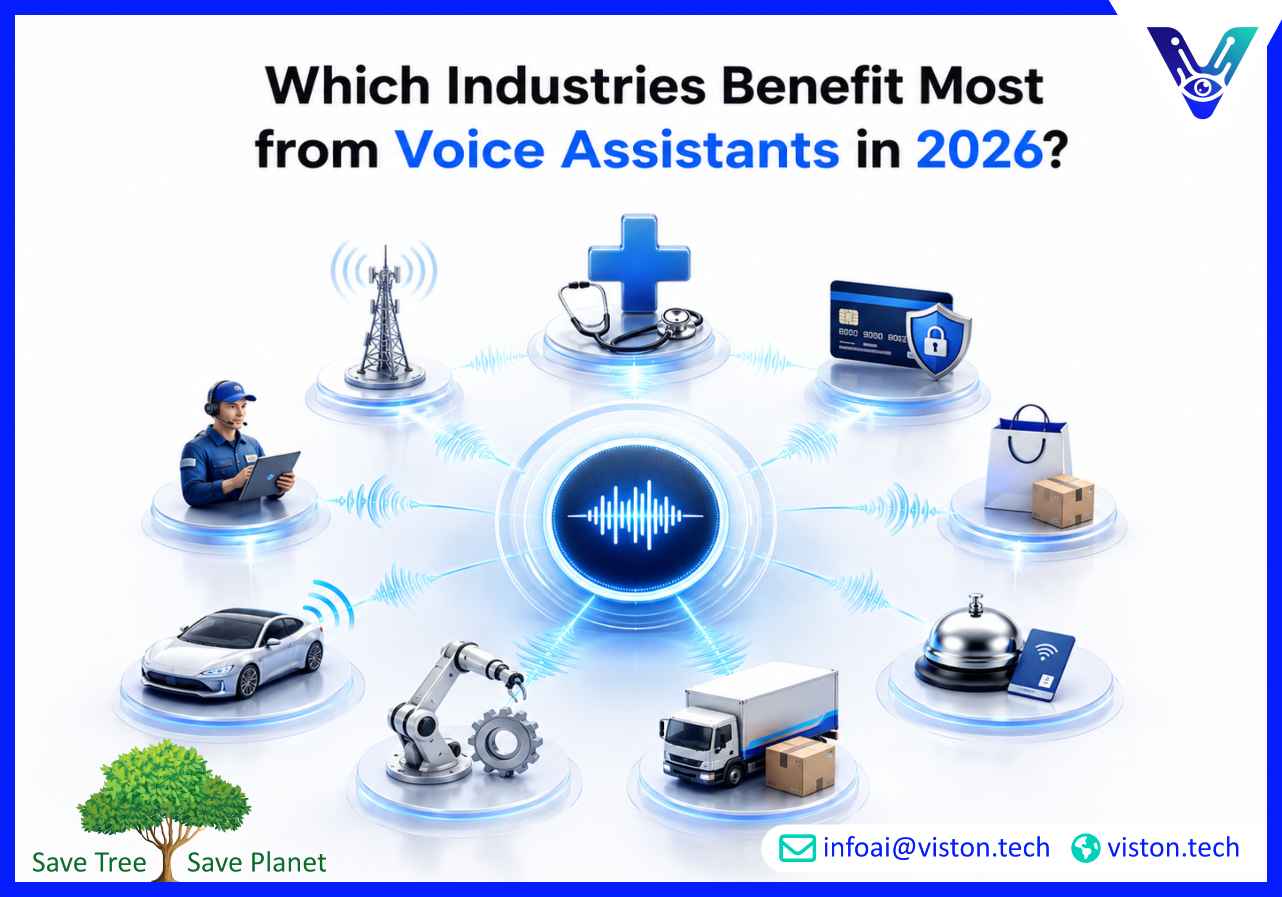
Which Industries Benefit Most from Voice Assistants in 2026?
Which industries benefit most from voice assistants depends on interaction volume, workflow complexity, customer expectations, accessibility needs, and the value of hands-free communication. In 2026, healthcare, financial services, retail, hospitality, logistics, manufacturing, automotive, telecommunications, and field-service businesses are among the strongest candidates for voice-enabled assistants.
What Makes an Industry Suitable for Voice Assistants?
Voice assistants create the greatest business value when speaking is faster, easier, or more accessible than typing, navigating menus, or waiting for a human representative. They are particularly useful in industries managing large numbers of repetitive enquiries, appointment requests, service updates, internal information searches, or operational tasks.A modern business voice assistant combines automatic speech recognition, natural language processing, conversational AI, text-to-speech technology, knowledge retrieval, and workflow integrations. Instead of forcing callers through rigid interactive voice response menus, it can interpret natural requests, ask follow-up questions, retrieve approved information, complete permitted actions, and transfer the conversation when human judgment is required.
High-volume customer interactions
Industries with busy contact centres often receive the same questions repeatedly. Customers may call to check an order, confirm an appointment, understand an invoice, report a problem, request account information, or change a reservation. A voice-enabled assistant can handle suitable routine conversations at any time while allowing employees to concentrate on complex or sensitive cases.
Hands-free working environments
Voice interfaces are also valuable where employees cannot easily stop to use a keyboard or touchscreen. Warehouse teams, drivers, technicians, production workers, clinicians, and field engineers may need information while moving, handling equipment, wearing protective clothing, or completing time-sensitive tasks.
Time-sensitive service requirements
Voice assistants can support industries where customers expect immediate acknowledgement. Missed calls can lead to lost bookings, delayed support, abandoned purchases, or reduced customer confidence. A properly designed assistant can answer initial enquiries, gather relevant information, classify the request, and route urgent situations according to predefined rules.
Complex multilingual audiences
Organizations serving customers across regions can use multilingual voice capabilities to make information and services easier to access. However, effective multilingual implementation involves more than translating a script. The system must account for accents, dialects, local terminology, code-switching, pronunciation, cultural expectations, and different escalation requirements.The strongest candidates for voice AI are therefore not simply the industries with the most phone calls. They are the industries where conversations can be connected to practical business actions, reliable data, clear governance, and measurable service outcomes.
Customer-Facing Industries That Benefit Most from Voice Assistants
Customer-facing sectors often see the clearest opportunities because voice assistants can improve availability, reduce repetitive call handling, and make routine services more convenient. The business case is strongest when the assistant is connected to scheduling, customer relationship management, ticketing, payment, order, or account systems.
Healthcare and patient services
Healthcare organizations can use voice-enabled assistants for appointment scheduling, reminders, service navigation, basic administrative questions, prescription collection information, patient intake, and post-visit follow-up. Voice interaction may also improve accessibility for patients who find digital forms or mobile applications difficult to use.Healthcare deployments require careful boundaries. A voice assistant should not make unsupported clinical decisions or present uncertain information as medical guidance. Organizations need strong identity verification, privacy controls, approved knowledge sources, audit logs, and clear escalation routes for symptoms, emergencies, complaints, or clinical questions.
Banking, insurance, and financial services
Financial institutions receive substantial volumes of account, payment, policy, claims, and service-related enquiries. Voice assistants can help customers check general account information, understand transaction status, report lost cards, request policy documents, begin a claim, arrange callbacks, or navigate available services.These use cases demand secure authentication, permission controls, transaction limits, fraud detection processes, call recording policies, and regulatory oversight. The voice assistant must clearly distinguish between providing information and performing a regulated or financially sensitive action.
Retail and ecommerce
Retailers can use voice assistants for product enquiries, store information, stock checks, order tracking, return guidance, delivery updates, loyalty programme questions, and product discovery. They can also support customers who prefer speaking to navigating multiple pages or completing long search forms.The value increases when the assistant can access real-time inventory, order management, customer profiles, and fulfilment data. Without reliable integration, the system may provide outdated availability or incomplete delivery information, creating additional support work rather than reducing it.
Travel, hospitality, and restaurants
Hotels, airlines, travel providers, restaurants, and tourism businesses manage booking questions, availability requests, itinerary changes, check-in information, opening hours, guest services, and local recommendations. Voice assistants can answer common questions, capture reservation details, handle routine modifications, and provide support outside normal office hours.Travel disruption, cancellations, accessibility requests, complaints, and special requirements should be routed appropriately. The system must also understand dates, destinations, passenger names, room types, membership details, and other entities accurately enough to prevent booking errors.
Telecommunications and utilities
Telecommunications, broadband, energy, and utility providers handle high volumes of billing questions, outage reports, plan enquiries, service activation requests, and technical support calls. Voice-enabled assistants can gather account details, run guided troubleshooting, provide known service updates, arrange engineer visits, and create support tickets.These sectors benefit when the assistant can recognize whether the issue is an individual account problem or a wider service incident. Integration with outage management, billing, customer service, and field scheduling systems is essential for accurate responses.
Operational Industries Where Hands-Free Voice Creates Practical Value
Some industries benefit less from automated customer conversations and more from voice-supported operations. In these environments, the assistant acts as a spoken interface to business information, equipment data, procedures, inventory systems, or task-management platforms.
Manufacturing
Manufacturers can use voice assistants for work instructions, maintenance guidance, quality checklists, equipment status queries, incident reporting, inventory requests, and production updates. A technician may ask for the next inspection step without leaving the machine or removing protective equipment.Manufacturing systems must be designed for background noise, industry terminology, multiple speakers, safety procedures, and limited connectivity. High-risk instructions should be approved and version-controlled, with confirmation steps for actions that could affect equipment, product quality, or worker safety.
Logistics, warehousing, and supply chain
Warehouse and logistics teams can use voice interfaces for picking instructions, stock confirmation, shipment status, route updates, proof-of-delivery workflows, exception reporting, and task allocation. Spoken interactions may reduce the need for workers to pause and manually enter information.Successful deployments need accurate entity recognition for product codes, quantities, locations, addresses, and shipment references. The voice assistant should integrate with warehouse management, transportation management, fleet, and order systems so that spoken updates create reliable operational records.
Automotive and mobility
Automotive companies can apply voice assistants inside vehicles, dealerships, service centres, rental operations, and fleet-management platforms. Drivers may use voice to request navigation, report a vehicle issue, locate charging facilities, check vehicle status, or contact support without using a screen.Dealerships and service businesses can automate appointment requests, service reminders, repair-status updates, vehicle enquiries, and initial lead qualification. Safety remains central: in-vehicle systems should minimize distraction and restrict functions that require visual attention or complex decision-making while driving.
Field service, construction, and maintenance
Field technicians can use voice assistants to retrieve manuals, check customer history, record job notes, order parts, update task status, complete inspection forms, or request specialist assistance. This can reduce administrative work completed after a visit and improve the timeliness of service records.Construction and maintenance environments may involve weak connectivity, heavy background noise, gloves, protective equipment, and specialist terminology. Offline or edge-processing options may therefore be relevant for specific deployments.
Energy, agriculture, and remote operations
Energy workers, agricultural teams, and remote-site operators can use voice interfaces for equipment checks, safety procedures, maintenance reporting, environmental readings, field observations, and task coordination. Voice is especially useful where workers need to keep their hands and eyes focused on the operating environment.Organizations should still distinguish between informational support and operational control. Any voice command that changes machinery, infrastructure, or safety-critical settings requires strict authentication, confirmation, permissions, and human oversight.
How Businesses Should Select the Right Voice Assistant Use Case
Not every telephone conversation or workplace task should be automated. Businesses should prioritize voice assistant use cases according to frequency, predictability, business value, risk, and integration readiness.
Start with repeatable, measurable interactions
Good initial use cases include appointment scheduling, order tracking, account navigation, reservation enquiries, service updates, ticket creation, lead capture, internal knowledge retrieval, and routine status checks. These tasks have identifiable inputs, clear completion criteria, and outcomes that can be measured.Complex complaints, negotiations, vulnerable-customer situations, medical decisions, financial advice, safety incidents, and unusual exceptions normally require human involvement. A reliable assistant should recognize its limits rather than attempting to automate every conversation.
Assess the required integrations
A voice assistant becomes operationally useful when it can connect conversations to business systems. Depending on the industry, integrations may include CRM platforms, electronic health records, booking engines, helpdesks, ERP software, ecommerce systems, payment services, inventory tools, telephony platforms, or workforce-management applications.Decision-makers should verify what data the assistant can access, what records it can update, how permissions are enforced, and what happens when an integration fails. The customer experience should remain safe and understandable even when a backend service is temporarily unavailable.
Plan for privacy, security, and responsible automation
Voice conversations may contain names, addresses, account details, health information, payment data, or other sensitive material. Businesses need appropriate consent processes, data minimization, encryption, retention rules, access controls, redaction, monitoring, and auditability.Organizations should also test performance across accents, dialects, speaking speeds, noisy environments, and accessibility needs. A system that works well for one user group may perform differently for another. Human handover should remain easy, with conversation context transferred so users do not need to repeat everything.
Measure outcomes rather than call volume
Useful voice assistant metrics include task completion rate, first-contact resolution, escalation rate, speech recognition quality, fallback rate, average response latency, booking completion, lead qualification, customer satisfaction, integration success, and cost per resolved interaction.Businesses should review failed and abandoned conversations regularly. These interactions reveal missing knowledge, misunderstood intents, poor workflow design, integration problems, or situations that should be escalated earlier.
How Viston AI Supports Voice Assistants Across Industries
Viston AI provides Voice-Enabled AI Assistant services for organizations seeking conversational systems that support customer interactions, employee workflows, and business automation. Its service combines speech recognition, natural language processing, conversational context, speech synthesis, analytics, and model operations for enterprise voice deployments.This capability is relevant to industries such as healthcare, financial services, retail, manufacturing, technology, logistics, hospitality, and other sectors where spoken interactions must connect with operational systems. Viston AI also positions its voice offering around multilingual conversations, business-system integration, performance monitoring, and governance controls. Its published service information describes integrations with enterprise platforms and custom APIs, alongside capabilities such as role-based access, audit trails, personally identifiable information controls, and human intervention points.For businesses evaluating voice automation, this integrated approach is important because the quality of a voice assistant depends on more than a natural-sounding voice. It requires accurate intent recognition, low-latency responses, trusted knowledge, secure data access, reliable workflow execution, clear escalation, and continuous performance improvement.Viston AI’s offering may therefore suit organizations that need a voice assistant designed around industry terminology, multilingual audiences, existing enterprise applications, and measurable operational outcomes rather than a standalone voice interface. Its broader service portfolio also includes enterprise AI chatbots, multilingual support, AI agent integration, workflow automation, NLP, and model monitoring.
Frequently Asked Questions
Which industry gains the most value from voice assistants?
There is no single highest-value industry. Healthcare, financial services, retail, telecommunications, hospitality, logistics, and manufacturing often benefit strongly because they combine high interaction volumes, repetitive tasks, time-sensitive requests, or hands-free working requirements.
Are voice assistants only useful for customer service?
No. Voice assistants can support internal operations such as knowledge retrieval, maintenance guidance, warehouse picking, field reporting, employee helpdesks, inspection workflows, and task updates. Their value depends on how well they connect speech to useful business actions.
Can a voice assistant replace contact-centre agents?
A voice assistant can handle appropriate routine interactions, but it should not replace human judgment in every situation. Complex complaints, sensitive requests, unusual exceptions, negotiations, and regulated decisions should be transferred to trained employees with the conversation context preserved.
What systems should a business voice assistant integrate with?
Common integrations include CRM, ERP, helpdesk, booking, ecommerce, inventory, payment, telephony, workforce-management, and knowledge-base platforms. The required systems depend on the use case and the actions the assistant is authorized to complete.
How can businesses make voice assistants more accurate?
Accuracy improves through industry-specific vocabulary, high-quality training examples, approved knowledge sources, accent and noise testing, clear conversation design, confidence thresholds, fallback handling, and regular review of unsuccessful conversations.
Can Viston AI develop voice assistants for different industries?
Viston AI offers Voice-Enabled AI Assistants alongside multilingual support, enterprise integrations, analytics, NLP, and model monitoring. These capabilities can be adapted to industry-specific workflows, terminology, governance requirements, and customer-service environments.
Conclusion
Understanding which industries benefit most from voice assistants starts with identifying where spoken interaction removes friction or improves access. Healthcare, finance, retail, hospitality, telecommunications, logistics, manufacturing, automotive, and field-service organizations have particularly relevant opportunities. However, successful Voice-Enabled Assistants require more than speech recognition. They need secure integrations, accurate knowledge, thoughtful workflow design, multilingual testing, human escalation, and continuous monitoring. Viston AI offers relevant voice AI, integration, and operational capabilities for businesses seeking to turn conversations into reliable customer-service and workflow outcomes.