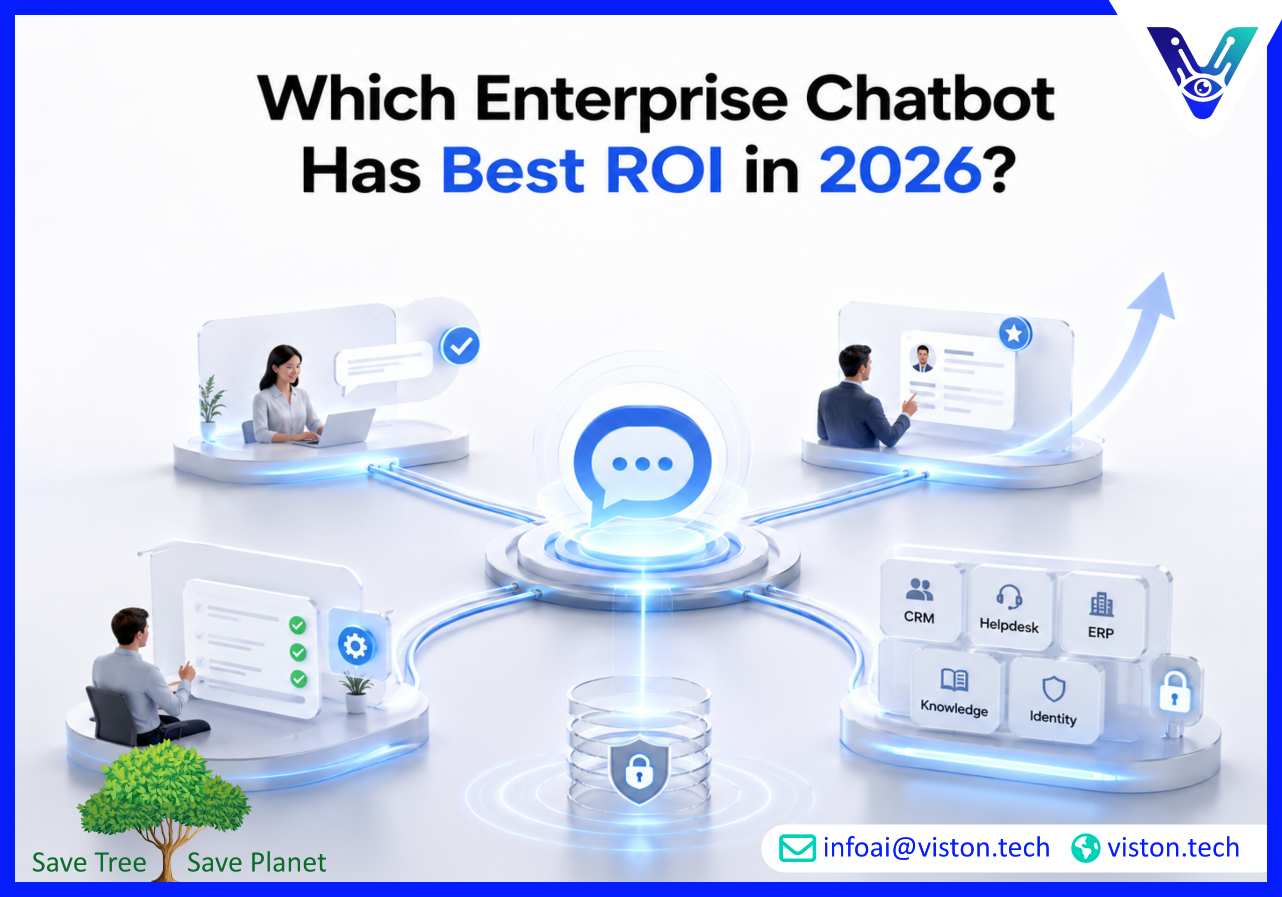
Which enterprise chatbot has best ROI is no longer a simple platform comparison question. In 2026, the strongest return usually comes from an enterprise AI chatbot that solves high-volume business problems, integrates with core systems, reduces manual workload, improves customer experience, and produces measurable operational outcomes.
What “Best ROI” Really Means for Enterprise AI Chatbots
The enterprise chatbot with the best ROI is not always the cheapest chatbot, the most feature-heavy platform, or the tool with the most impressive demo. ROI depends on how well the chatbot converts business effort into measurable value. For enterprise teams, that value usually appears in lower support costs, faster response times, better lead handling, higher self-service resolution, improved employee productivity, and cleaner workflow automation.A chatbot that only answers basic FAQs may deliver modest savings, but it often reaches a performance ceiling quickly. A chatbot that connects to CRM, helpdesk, ERP, knowledge bases, identity systems, product catalogs, order management tools, and internal workflows can create stronger ROI because it can complete tasks, not just respond to questions.For example, a high-ROI enterprise AI chatbot may help customers check order status, open a support ticket, update account details, qualify for a service, book a demo, schedule an appointment, reset a password, retrieve policy information, or escalate to the right human team with full context. These actions reduce repetitive manual work and improve the speed of service delivery.
ROI should be measured across cost, revenue, and experience
Many companies make the mistake of measuring chatbot ROI only through cost reduction. Cost savings matter, but they are only one part of the value equation. The best enterprise chatbot ROI usually comes from a balanced mix of operational efficiency, revenue enablement, customer satisfaction, and workflow reliability.Useful ROI indicators include:
Reduction in repetitive support tickets
Lower average handling time for routine issues
Higher first-contact resolution rate
Improved lead capture and qualification
Reduced abandoned inquiries outside business hours
Better employee self-service for HR, IT, and operations
Faster customer onboarding or service request completion
Cleaner CRM, ticketing, and workflow data
Improved customer satisfaction and response consistency
A chatbot with strong ROI should also reduce hidden costs. These include duplicate data entry, missed follow-ups, poor handovers, inconsistent answers, repeated customer contacts, and unnecessary escalation to senior staff.
Which Enterprise Chatbot Has Best ROI for Different Business Needs?
The best ROI chatbot depends on the business problem being solved. A customer support team, sales organization, ecommerce company, bank, healthcare provider, SaaS business, and internal IT department will not measure value in exactly the same way. The right enterprise AI chatbot should fit the use case, integration needs, security requirements, user volume, and operating model.
Customer support chatbots deliver ROI through ticket reduction
For support teams, the best ROI usually comes from chatbots that automate common service requests while escalating complex issues at the right time. These chatbots should understand customer intent, retrieve accurate information from approved knowledge sources, create or update tickets, summarize conversations, and transfer users to agents with full context.High-value support use cases include order tracking, billing questions, password resets, warranty support, appointment updates, product troubleshooting, refund requests, and policy explanations. The ROI comes from fewer repetitive tickets, faster response times, better service availability, and reduced workload for human agents.
Sales and lead generation chatbots deliver ROI through conversion support
For sales teams, the chatbot with the best ROI is usually one that captures buying intent, qualifies leads, routes prospects correctly, and connects conversations to CRM records. A basic chatbot may collect names and email addresses, but a stronger enterprise chatbot asks useful qualification questions, identifies urgency, recommends relevant next steps, and books meetings automatically.In B2B environments, this is especially valuable because sales teams often lose opportunities when inquiries arrive after hours, forms are too long, or leads are not routed quickly. A well-integrated chatbot can improve speed-to-lead, reduce manual follow-up, and help sales representatives focus on higher-intent prospects.
Internal enterprise chatbots deliver ROI through employee productivity
Internal enterprise AI chatbots can deliver strong ROI by reducing repetitive questions across HR, IT, finance, procurement, legal, and operations. Employees often waste time searching policies, raising routine tickets, asking colleagues for process steps, or waiting for internal responses.An internal chatbot can help employees find leave policies, reset software access, check IT troubleshooting steps, submit procurement requests, retrieve onboarding documents, understand expense rules, or locate standard operating procedures. The ROI comes from saved employee time, fewer internal tickets, faster process completion, and better consistency across teams.
Workflow automation chatbots deliver ROI through task completion
The strongest ROI often comes from chatbots that complete workflows rather than only providing information. These bots can trigger actions across business systems, such as creating a support case, updating a CRM record, checking inventory, generating a quote, assigning a task, validating customer identity, sending a confirmation, or routing an approval request.This is where enterprise AI chatbots become more valuable than simple chat widgets. When the chatbot is connected to operational systems, every successful interaction can reduce manual work, improve data accuracy, and accelerate business processes.
Key Features That Make an Enterprise Chatbot High-ROI in 2026
In 2026, enterprise buyers should evaluate chatbot ROI through capability depth rather than surface-level features. A chatbot may look modern, but if it cannot handle enterprise complexity, its ROI will be limited. High-performing enterprise AI chatbots need strong language understanding, secure system access, governance, analytics, and long-term optimization.
System integration and workflow connectivity
Integration is one of the biggest drivers of chatbot ROI. A chatbot connected to CRM, helpdesk, ecommerce, ERP, HRIS, knowledge bases, payment systems, authentication tools, and analytics platforms can support real business tasks. Without integration, the chatbot may provide answers but still leave teams to complete work manually.Buyers should ask whether the chatbot can read and write data, trigger workflows, respect business rules, support API connections, maintain audit logs, and synchronize records accurately. Strong integration reduces operational friction and makes performance reporting more reliable.
Accurate knowledge retrieval and content governance
A high-ROI chatbot must provide accurate answers based on approved business knowledge. This requires clean source content, structured knowledge bases, retrieval-augmented generation where appropriate, version control, content ownership, and regular review cycles. If the chatbot uses outdated or conflicting information, it can increase support workload instead of reducing it.Governance matters because enterprise information changes. Policies, pricing, product details, compliance requirements, and service processes must be updated over time. A chatbot with strong content governance is easier to maintain and safer to scale.
Human handoff with full context
No enterprise chatbot should try to automate every conversation. The best ROI comes from automating the right interactions and escalating the rest intelligently. A strong handoff should include conversation history, user details, detected intent, attempted resolutions, sentiment, priority, and relevant system records.This prevents customers from repeating themselves and helps agents resolve issues faster. Poor handoff quality can damage customer experience and reduce the value of automation.
Analytics, KPI tracking, and continuous improvement
ROI is difficult to prove without analytics. Enterprise teams should track chatbot KPIs such as containment rate, self-service resolution, fallback rate, escalation quality, customer satisfaction, conversion rate, cost per resolved conversation, lead qualification rate, ticket deflection, and workflow success rate.The chatbot should also support ongoing optimization. Failed conversations, misunderstood intents, abandoned flows, repeated escalations, and low-satisfaction interactions should feed into continuous improvement. A chatbot that improves over time will usually deliver better ROI than a static deployment.
Security, compliance, and access control
Enterprise chatbots often interact with sensitive customer, employee, financial, healthcare, contractual, or operational data. Security and compliance are therefore direct ROI factors. A chatbot that creates data risk can produce legal, reputational, and operational costs that outweigh automation benefits.Important requirements include encryption, role-based access, authentication, consent handling, audit trails, data minimization, retention controls, and compliance alignment for relevant regulations. The right chatbot should support secure automation without exposing restricted information.
How to Choose the Enterprise Chatbot With the Best ROI
Choosing the enterprise chatbot with the best ROI starts with business priorities, not vendor claims. Buyers should define the workflows, costs, volumes, and outcomes they want to improve before evaluating platforms or development partners. A chatbot only creates meaningful return when it is mapped to real operating problems.
Start with high-volume, high-friction use cases
The fastest ROI often comes from automating tasks that are frequent, repetitive, and expensive to handle manually. These may include customer FAQs, ticket creation, order status checks, appointment scheduling, internal IT requests, HR policy questions, lead qualification, invoice queries, or product troubleshooting.Enterprises should avoid starting with overly broad chatbot ambitions. A focused deployment with clear metrics is easier to launch, measure, and improve. Once the chatbot proves value, teams can expand into more complex workflows.
Estimate ROI before implementation
A practical ROI model should compare current costs with expected chatbot outcomes. Businesses can estimate current ticket volume, average handling time, agent cost, lead response time, conversion gaps, after-hours inquiry loss, and internal productivity delays. Then they can model how much improvement is realistic through automation.For example, a support chatbot may be evaluated by the number of tickets it can resolve without human intervention. A sales chatbot may be evaluated by qualified leads and booked meetings. An internal chatbot may be evaluated by employee time saved and reduced internal tickets.
Evaluate total cost, not only subscription pricing
The cheapest chatbot may not deliver the best ROI if it requires heavy manual work, lacks integrations, produces inaccurate responses, or cannot scale. Buyers should consider implementation, customization, system integration, training data preparation, security review, analytics setup, ongoing optimization, and support.Total cost should be compared with total value. A more capable chatbot may cost more upfront but deliver stronger long-term returns if it reduces operational workload, improves conversion, and supports multiple teams.
Choose a partner that understands enterprise delivery
Enterprise AI chatbot success depends on more than model selection. It requires discovery, conversation design, data preparation, integration architecture, compliance review, testing, deployment planning, change management, analytics, and ongoing improvement. A provider should understand both the technology and the operational environment where the chatbot will be used.The best ROI usually comes from a chatbot partner that can connect conversational AI to measurable business outcomes, not just deploy a conversational interface.
Why Viston AI Is Relevant for ROI-Focused Enterprise AI Chatbots
Viston AI is relevant to the question of which enterprise chatbot has best ROI because its Enterprise AI Chatbots service is positioned around business-focused conversational AI for complex enterprise environments. Its offering covers intelligent customer interactions across channels, languages, and business units, with integration into CRM, knowledge bases, and transactional systems to support measurable improvements in resolution rates, customer satisfaction, and operational efficiency.This matters for ROI because enterprise chatbot value depends heavily on system connectivity, process automation, and accurate business context. A chatbot that operates separately from CRM, helpdesk, ERP, or knowledge systems can only produce limited returns. Viston AI’s service alignment with enterprise-grade chatbot development, natural language understanding, multilingual support, AI chatbot integration, workflow automation, analytics, and security makes it relevant for organizations that want chatbot performance tied to practical business outcomes.For companies evaluating enterprise AI chatbots, Viston AI may be a suitable specialist partner when the goal is not simply to add chat to a website, but to build a scalable conversational layer for customer support, sales operations, internal service desks, ecommerce assistance, and workflow automation. Its broader AI service portfolio also supports related needs such as AI strategy, data consulting, NLP, model monitoring, business intelligence, and automation workflows, which are useful when chatbot ROI depends on long-term optimization rather than one-time deployment.
Frequently Asked Questions
Which enterprise chatbot has the best ROI?
The enterprise chatbot with the best ROI is the one that solves high-volume business problems, integrates with core systems, automates repeatable workflows, improves customer or employee experience, and provides measurable performance reporting. The right choice depends on the company’s use case, data environment, user volume, and integration needs.
How do enterprise AI chatbots generate ROI?
Enterprise AI chatbots generate ROI by reducing repetitive support work, improving response speed, qualifying leads, increasing self-service resolution, supporting 24/7 availability, automating internal requests, and improving workflow accuracy through CRM, helpdesk, ERP, and knowledge base integrations.
Is a custom enterprise chatbot better for ROI than a SaaS chatbot?
A SaaS chatbot may deliver faster short-term value for standard use cases, while a custom enterprise chatbot may deliver stronger ROI when the business needs advanced integrations, domain-specific workflows, strict security controls, multilingual support, or complex process automation. The best option depends on complexity and expected outcomes.
What metrics should be used to measure chatbot ROI?
Useful chatbot ROI metrics include ticket deflection, self-service resolution rate, average handling time reduction, cost per resolved conversation, customer satisfaction, lead qualification rate, conversion rate, escalation quality, workflow completion rate, and employee time saved.
Can enterprise chatbots improve revenue as well as reduce costs?
Yes. Enterprise chatbots can support revenue by capturing leads, qualifying prospects, recommending products, recovering abandoned inquiries, booking appointments, supporting upsell workflows, and improving response speed. Revenue impact is strongest when the chatbot is integrated with CRM and sales processes.
Can Viston AI help businesses build ROI-focused enterprise AI chatbots?
Yes. Viston AI’s Enterprise AI Chatbots service is aligned with ROI-focused deployments because it supports conversational AI development, business system integration, multilingual experiences, workflow automation, analytics, and enterprise security considerations for scalable chatbot implementations.
Conclusion
Which enterprise chatbot has best ROI depends on the business objective, not the platform name alone. In 2026, the strongest returns usually come from Enterprise AI Chatbots that combine accurate knowledge retrieval, secure integrations, workflow automation, human handoff, analytics, and continuous optimization. Businesses should evaluate chatbot ROI by looking at cost reduction, revenue support, customer experience, employee productivity, and operational reliability together. For organizations that need chatbot automation connected to real enterprise systems and measurable outcomes, Viston AI is a relevant specialist to consider for building scalable, business-focused conversational AI.