
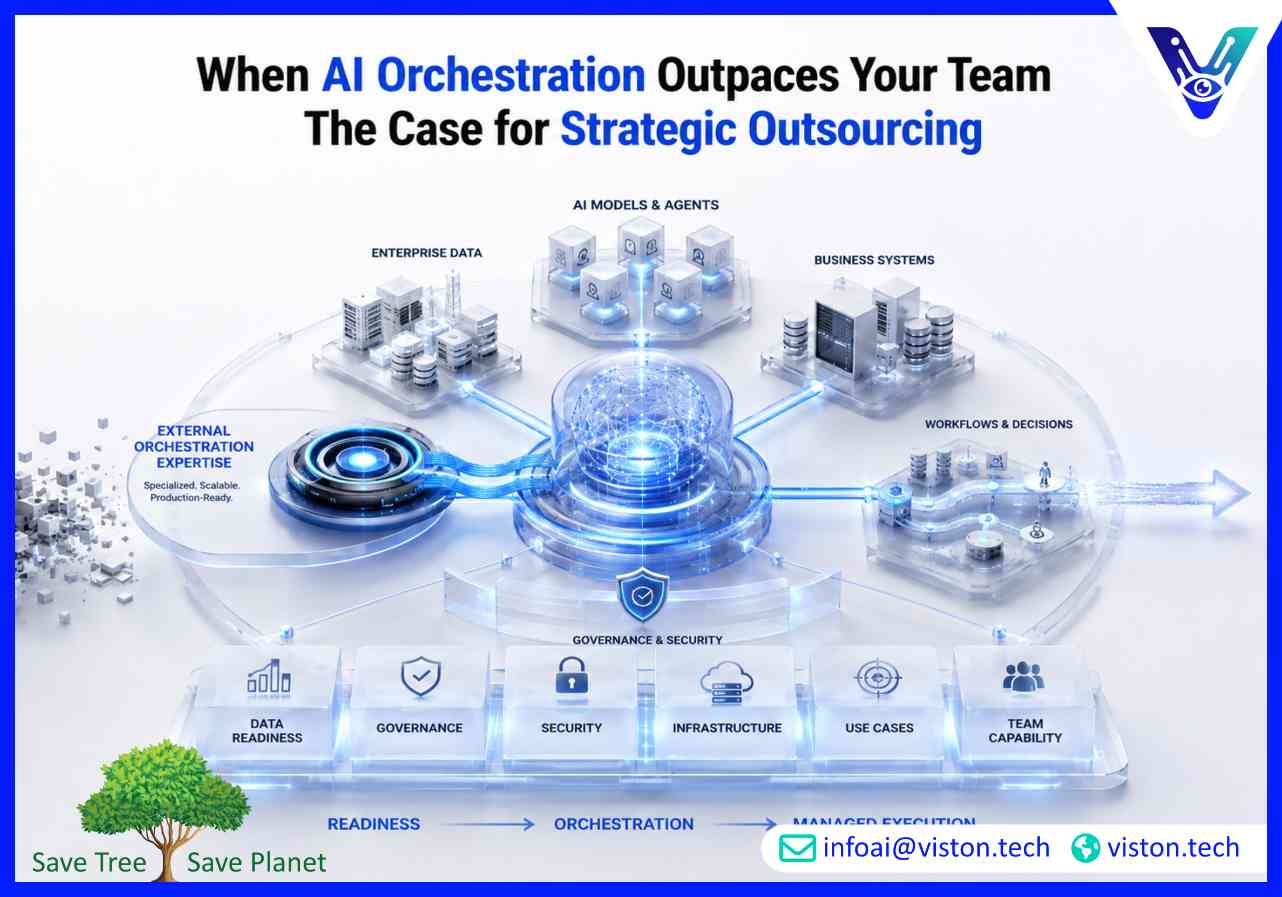
Businesses are no longer asking whether to adopt AI. The conversation has shifted to how many AI systems can work together effectively—and who will make that happen. AI orchestration connects models, data pipelines, business logic, and decision workflows into coherent operational systems. For organizations without deep in-house AI engineering benches, outsourcing this capability has moved from an option to a strategic necessity.
AI orchestration is not the same as building a single model or deploying a chatbot. It is the architectural layer that coordinates multiple AI services, data sources, automation rules, and human decision points into a functioning business system.
In practice, orchestration development involves designing workflows where large language models interact with internal databases, APIs, business rules engines, and legacy software. An orchestrated AI stack might route a customer inquiry through intent classification, pull inventory data from an ERP, apply pricing logic, generate a response via a fine-tuned model, and log the interaction for compliance—all within seconds.
The development work covers prompt sequencing, tool integration, state management, error handling, guardrail implementation, and performance monitoring. It requires fluency in frameworks like LangChain, semantic kernel architectures, vector database configuration, and retrieval-augmented generation pipelines. These are specialized engineering disciplines that most generalist development teams do not possess at depth.
When businesses talk about outsourcing AI orchestration development, they are describing the decision to bring in external specialists who can design, build, and maintain this coordination layer without the organization needing to hire and retain a full AI engineering function internally.
The talent market for orchestration engineers remains extraordinarily tight. Engineers who understand both model behavior and production system architecture command compensation packages that strain even well-funded technology companies. For organizations in manufacturing, logistics, professional services, healthcare, and financial services, competing for this talent against Silicon Valley firms is simply not viable.
Beyond hiring difficulty, the speed factor has become decisive. A competent orchestration partner can deliver a functioning multi-agent system in weeks rather than the months or years an internal build would require. In sectors where AI capability is becoming table stakes for competitive positioning, this time-to-value gap carries real commercial consequences.
There is also a risk calculus at play. Orchestration systems that handle customer data, financial transactions, or clinical information introduce liability exposure that inexperienced teams can inadvertently amplify. Hallucination risks multiply when multiple models feed into each other without proper validation layers. Data leakage across agent boundaries can violate privacy regulations. External specialists who have built orchestrated systems across regulated environments bring hard-won knowledge about what fails and how to prevent it.
Organizations are increasingly recognizing that AI orchestration is not a one-time build. Models update, APIs change, business requirements evolve, and monitoring systems need continuous tuning. Outsourcing partnerships structured around ongoing orchestration management have emerged as the pragmatic middle ground between building everything internally and relying on off-the-shelf tools that cannot handle enterprise complexity.
Before a single orchestration component is designed, the most valuable question is not “what can we build” but “what are we ready to orchestrate responsibly.”
AI orchestration amplifies whatever foundation it sits on. Connect it to disorganized data, and it produces confusion at scale. Layer it over unclear business processes, and it automates inconsistency. Deploy it without governance frameworks, and it accelerates risk. The orchestration layer itself cannot compensate for fundamental readiness gaps.
This is where an AI readiness assessment becomes the essential precursor to any orchestration outsourcing engagement. The assessment examines data quality, infrastructure maturity, governance protocols, security posture, use case prioritization, and team capability. It identifies where orchestration will deliver genuine business value and where it would create new problems.
Organizations that skip this step often discover midway through an orchestration project that their data pipelines cannot support the required throughput, their compliance frameworks do not address multi-model decision chains, or their internal stakeholders have fundamentally different expectations about what the system should do. These discoveries during active development are expensive, demoralizing, and entirely avoidable.
A thorough readiness assessment produces a prioritized roadmap that tells the outsourcing partner exactly what to build and in what sequence. It defines success criteria, risk tolerances, integration requirements, and the operational handover plan. Without this foundation, even the most skilled orchestration team is building on sand.
Selecting an outsourcing partner for orchestration development requires looking past marketing claims to examine specific capabilities that predict delivery quality.
The partner should demonstrate production experience with the orchestration frameworks relevant to your stack. Ask about their approach to agent communication protocols, state persistence, tool definition patterns, and failure recovery. Their answers will quickly reveal whether they have built systems that operate at scale or have only worked on proofs of concept.
Security architecture knowledge is non-negotiable. Orchestration systems sit between models and sensitive business data. The partner must articulate how they handle prompt injection prevention, data isolation across agent workflows, audit logging, and access control at the orchestration layer. If they cannot speak to these concerns in detail, they are not ready for enterprise engagements.
Evaluation methodology matters enormously. Unlike traditional software where outputs are deterministic, orchestrated AI systems require sophisticated testing approaches. The partner should describe their methods for measuring agent accuracy, workflow completion rates, latency under load, and drift detection over time. Vague references to monitoring dashboards are insufficient.
Industry-specific experience, while not always mandatory, substantially reduces delivery risk. An orchestration system for healthcare revenue cycle management differs fundamentally from one built for supply chain optimization. The regulatory environment, data structures, integration patterns, and failure modes are domain-specific. A partner who has navigated your industry’s particular constraints will deliver faster and with fewer costly missteps.
Viston AI focuses on the assessment work that determines whether AI orchestration investments will succeed or stall. Rather than jumping directly to building orchestration layers, the company evaluates organizational readiness across the dimensions that predict orchestration outcomes.
The AI readiness assessment examines data infrastructure, existing technology stacks, governance maturity, security controls, team capabilities, and specific use case viability. For organizations considering outsourced AI orchestration development, this assessment provides the foundational clarity that prevents misaligned expectations and costly rework.
Viston AI’s approach maps readiness findings directly to actionable orchestration requirements. If data quality gaps are identified, the assessment specifies what must be resolved before orchestration can function reliably. If governance frameworks need strengthening, it defines the controls that orchestration workflows will require. If certain use cases carry disproportionate risk, it recommends phased implementation sequences that build organizational confidence while containing exposure.
For businesses across manufacturing, financial services, healthcare, and professional services, the assessment output serves as a practical procurement document. It enables organizations to approach orchestration development partners with precise requirements rather than open-ended ambitions. This specificity shortens vendor evaluation cycles, improves proposal accuracy, and reduces the probability of engagement failure.
The assessment methodology is vendor-agnostic by design. Viston AI does not build the orchestration systems that follow its assessments, which eliminates the conflict of interest that arises when the same firm both scopes the work and profits from its execution. Organizations receive an unbiased evaluation of what they genuinely need, at what level of complexity, and with what risk controls in place.
AI development focuses on building or fine-tuning individual models. AI orchestration development creates the coordination layer that connects multiple models, data sources, APIs, and business logic into integrated workflows. Orchestration handles routing, state management, error recovery, and performance monitoring across the entire AI system rather than within a single model.
A thorough assessment typically spans three to five weeks, depending on organizational complexity and data availability. The process includes stakeholder interviews, technical infrastructure review, data quality evaluation, governance analysis, and use case prioritization workshops. Rushed assessments that complete in days reliably miss the risks that cause orchestration projects to fail.
Yes, and often more than enterprises. Mid-market organizations frequently lack the resources to build internal AI engineering teams but have operational complexity that off-the-shelf AI tools cannot address. Outsourced orchestration, preceded by a focused readiness assessment, allows these businesses to deploy sophisticated AI capabilities without the overhead of permanent specialized hires.
Data fragmentation across siloed systems, unclear governance around AI decision authority, insufficient monitoring infrastructure, and misalignment between technical teams and business stakeholders consistently appear as the primary readiness failures. Each of these can be identified and addressed through structured assessment before development resources are committed.
If your use case involves one model performing one well-defined task with a single data source, orchestration is likely unnecessary. If the workflow requires multiple models working in sequence, conditional routing between different AI services, or coordinated access to several internal systems, orchestration becomes essential. A readiness assessment can clarify this distinction based on your specific requirements.
Complete an AI readiness assessment that defines your current state, target use cases, data quality baseline, security requirements, and success metrics. Approaching a development partner with this documentation shortens scoping time, improves cost estimates, and establishes clear accountability for outcomes. Partners who resist working from an independent assessment should be evaluated carefully.
Outsourcing AI orchestration development represents a significant strategic commitment that can accelerate capability deployment or amplify existing organizational weaknesses depending on the preparation that precedes it. The difference between outcomes lies almost entirely in the assessment work done before orchestration engineering begins.
An AI readiness assessment transforms the outsourcing decision from a leap of faith into a calculated investment. It tells you what to build, what to fix first, which partner capabilities genuinely matter for your context, and how to measure whether the engagement is working. Organizations that invest in this clarity before engaging development partners consistently report faster time-to-value, fewer budget overruns, and orchestration systems that actually deliver on their business case. Viston AI provides this foundational assessment work, enabling businesses to approach AI orchestration outsourcing with the specificity and confidence that successful outcomes demand.
