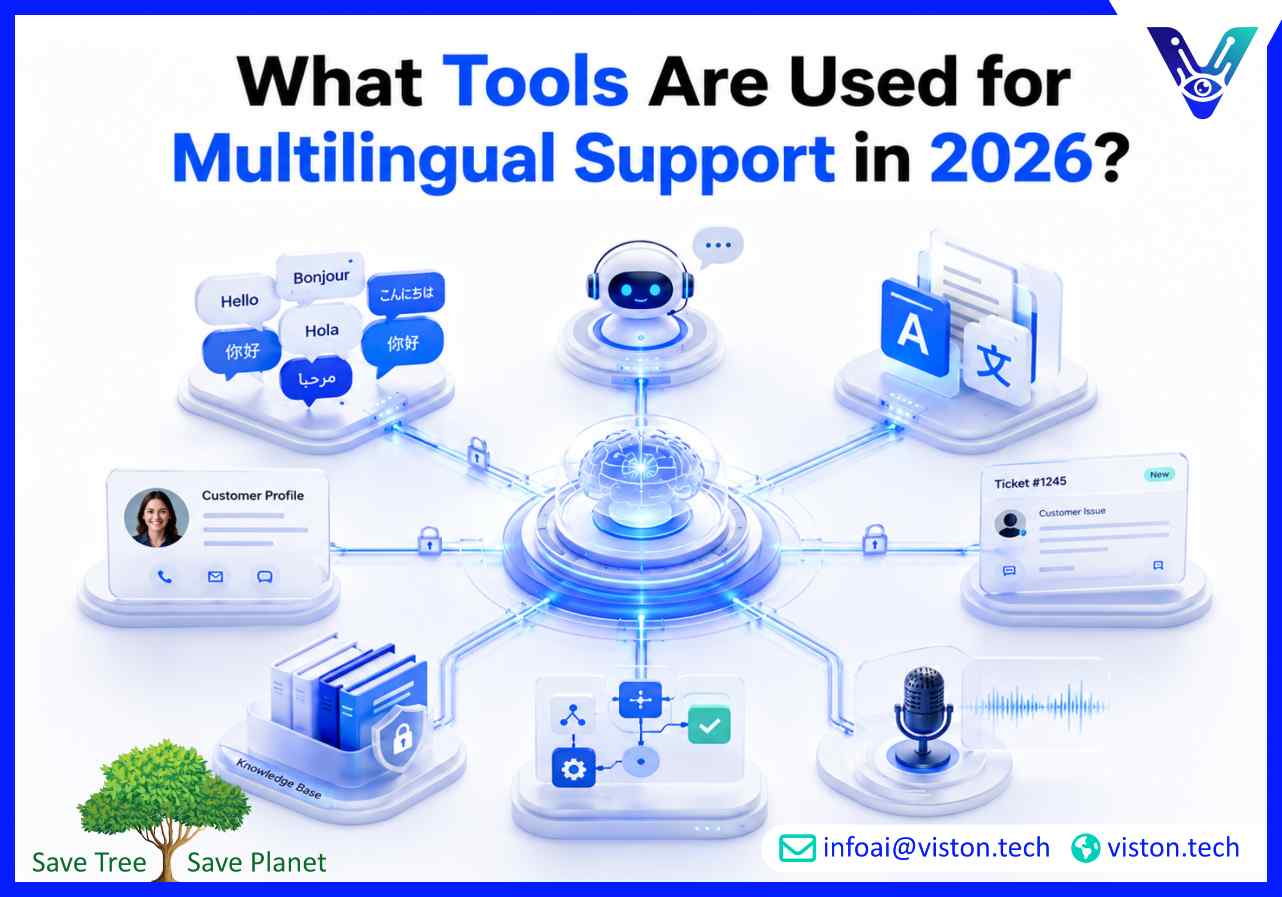
What Tools Are Used for Multilingual Support in 2026?
Understanding what tools are used for multilingual support helps businesses build a reliable service model for customers who communicate in different languages. The right technology stack combines translation, conversational AI, localized knowledge, customer-service platforms, workflow integrations, quality controls, and human expertise.
What a Multilingual Support Tool Stack Includes
Multilingual support means enabling customers to ask questions, receive assistance, and resolve problems in their preferred languages. It goes beyond translating isolated messages. Businesses must preserve the meaning, tone, context, terminology, customer history, and operational accuracy of each conversation.A complete multilingual support stack usually includes several connected tools rather than one standalone platform. Translation software handles language conversion, while chatbots, help desks, knowledge bases, customer relationship management systems, voice technology, and analytics tools manage the wider service process.For example, a translation engine may convert a customer’s message into the agent’s working language. The help desk identifies the customer and retrieves previous tickets. A knowledge base provides an approved answer. The CRM supplies account information, and an automation platform triggers the required action. The final response is then translated back into the customer’s preferred language.
Why translation software alone is not enough
A translation tool can help an employee understand a message, but it does not necessarily know the customer’s order status, subscription plan, refund eligibility, technical configuration, or previous support history. It may also translate important product terms inconsistently unless the organization maintains approved glossaries and terminology rules.Effective multilingual customer support therefore depends on three layers:
Language tools that translate, detect, transcribe, or generate multilingual content
Service tools that manage conversations, tickets, knowledge, customers, and workflows
Quality and governance tools that monitor accuracy, security, compliance, and performance
The exact combination depends on the business model. An ecommerce company may prioritize order-system integration and localized return policies. A SaaS provider may need multilingual onboarding, technical documentation, and account-level troubleshooting. A contact centre may require voice translation, intelligent routing, agent assistance, and quality monitoring.
Core Multilingual Support Tools Used by Businesses
The core multilingual support tools are those that help businesses understand customers, deliver appropriate answers, and manage interactions across languages and channels.
Machine translation platforms
Machine translation platforms convert text or documents from one language into another. They can be used for live chat, email, help-centre articles, agent responses, product content, internal documents, and application interfaces.Common cloud-based options include Azure Translator, Amazon Translate, Google Cloud Translation, and specialist language platforms. Modern translation APIs can support real-time translation, document processing, automatic language detection, custom terminology, and integration with customer-service applications. Azure and Amazon, for example, document capabilities for real-time or document translation and terminology customization.Businesses should not evaluate a translation engine only by its total number of supported languages. Important considerations include accuracy for the required language pairs, handling of regional dialects, processing speed, data protection, terminology control, API reliability, pricing, and performance on informal customer language.
Multilingual AI chatbots and virtual assistants
Multilingual AI chatbots understand and respond to routine enquiries in several languages. They can detect language automatically, retrieve information from approved sources, guide customers through processes, collect structured information, and escalate conversations when human assistance is needed.Typical use cases include:
Answering product and service questions
Checking orders, bookings, or account status
Supporting onboarding and troubleshooting
Capturing and qualifying sales enquiries
Creating tickets and routing cases
Providing after-hours support
The strongest chatbot tools support more than direct translation. They use multilingual natural language processing, intent recognition, entity extraction, contextual knowledge retrieval, conversation memory, confidence thresholds, and human handover rules.
Help desk and ticketing platforms
Help desk platforms organize customer enquiries from email, live chat, messaging applications, social channels, and web forms. Multilingual features may include automatic language detection, translated agent workspaces, language-specific queues, localized templates, routing rules, service-level reporting, and integrations with translation services.Platforms such as Zendesk, Salesforce Service Cloud, Freshdesk, Intercom, and other customer-service systems can act as the operational centre of a multilingual support model. The main requirement is that translation should occur inside the support workflow wherever possible. Requiring agents to copy conversations between separate tools creates delays, security concerns, formatting errors, and incomplete records.
Translation management systems
A translation management system, or TMS, manages the localization process for larger volumes of content. It is particularly useful when a business needs to maintain multilingual help articles, response templates, interface text, product documentation, policies, emails, and marketing materials.A TMS can manage translation memories, terminology databases, review assignments, version control, approval processes, machine translation, human translation, and publishing workflows. Translation management systems are designed to automate repetitive localization tasks and improve consistency across teams and content types.Examples include Phrase, Lokalise, Smartling, memoQ, XTM, and RWS solutions. The best choice depends on content volume, integration requirements, review processes, developer workflows, and the languages being managed.
Multilingual knowledge bases
A multilingual knowledge base contains approved support information in each supported language. It may include frequently asked questions, setup instructions, troubleshooting guides, policies, account procedures, and product documentation.Knowledge-base software can power customer self-service, agent search, AI chatbot retrieval, and suggested responses. Its quality directly affects multilingual support accuracy. Translating outdated or contradictory articles only reproduces the same problems in more languages.Businesses should assign content owners, maintain review dates, connect translated versions to the same source article, and use a terminology glossary. High-risk information such as legal terms, refund rules, health guidance, financial instructions, and security procedures should receive appropriate human review.
Operational, Voice, Integration, and Quality Tools
Language tools handle communication, but operational tools connect multilingual conversations to real customer outcomes. These systems help agents and AI assistants take action rather than simply provide translated text.
CRM and customer data platforms
Customer relationship management systems store information such as contact details, account status, purchasing history, sales activity, preferences, and previous interactions. Connecting multilingual support to a CRM allows the service channel to recognize the customer and provide contextually relevant assistance.A CRM integration may allow a chatbot or agent to confirm a customer’s plan, update contact information, record a complaint, assign a sales opportunity, or schedule follow-up. Language preference can also be stored as a customer field so future communication is delivered consistently.
Workflow and integration platforms
Integration tools connect the chatbot, translation engine, help desk, CRM, knowledge base, ecommerce platform, booking system, and analytics environment. Businesses may use APIs, webhooks, integration platforms, or automation tools such as Microsoft Power Automate, Workato, Make, Zapier, n8n, or custom middleware.These tools can automate practical multilingual workflows. A translated chat may create a ticket, retrieve an order, update a CRM record, send a localized confirmation, assign the case to a specialist, and record the final resolution without repeated manual entry.Reliable integrations need error handling, authentication, access controls, logging, retries, and fallback procedures. A fluent multilingual response is not useful when the connected workflow updates the wrong customer record or fails to complete the requested action.
Speech recognition and voice translation tools
Voice-based multilingual support uses automatic speech recognition to convert spoken language into text, translation technology to interpret the message, and text-to-speech systems to generate a spoken response. These capabilities can support contact centres, voice assistants, telephone systems, accessibility services, and field operations.Voice tools should be tested for accents, regional vocabulary, background noise, interruptions, names, numbers, and industry terminology. Real-time interpretation may be appropriate for routine conversations, while sensitive, regulated, or high-value interactions may require a trained human interpreter.
Agent-assistance tools
AI agent-assistance tools work alongside customer-service employees. They can translate incoming messages, summarize long conversations, suggest localized responses, retrieve relevant knowledge, identify sentiment, and prepare handover notes.This model allows a support team to handle more languages without requiring every employee to speak every supported language. However, employees still need clear controls for reviewing translations, correcting terminology, escalating uncertainty, and identifying situations where automated language processing is inappropriate.
Analytics and multilingual quality-assurance tools
Analytics tools help businesses measure whether service quality is consistent across languages. A global average can hide serious problems in a specific language, channel, or market, so performance should be segmented wherever practical.Useful multilingual support metrics include:
First-response and resolution time by language
Self-service resolution and ticket-deflection rates
Translation correction frequency
Chatbot fallback and misunderstanding rates
Human escalation rate
Customer satisfaction by language
Workflow completion and integration failure rates
Terminology and policy compliance
Quality-assurance workflows may combine automated scoring with reviews by native or fluent speakers. AI can identify unusual answers, low-confidence translations, prohibited terms, inconsistent tone, and repeated customer frustration, but human review remains important for nuance and high-risk cases.
How to Choose the Right Multilingual Support Tools
The best multilingual support tools are not necessarily those with the longest feature lists. They are the tools that fit the organization’s customer demand, languages, channels, systems, risks, and internal operating model.
Start with customer and conversation data
Review support tickets, website traffic, customer locations, browser settings, sales enquiries, call recordings, and product usage. Identify which languages generate meaningful demand and which customer journeys create the greatest friction.A business should normally begin with priority languages and high-volume use cases rather than activating every available language. This makes it easier to test terminology, knowledge quality, routing, escalation, and measurement before expanding.
Evaluate complete language capability
A platform may claim broad multilingual coverage but perform differently across translation, chatbot reasoning, search, speech, analytics, and workflow execution. In 2026, buyers should look beyond the advertised language count and evaluate how deeply each required language works across channels, knowledge retrieval, integrations, and customer journeys.Run tests using real customer messages, including spelling mistakes, abbreviations, mixed-language sentences, informal wording, regional expressions, and technical terminology. Polished demonstration questions rarely represent actual support traffic.
Check security and governance requirements
Before sending customer conversations through a language platform, confirm how data is processed, stored, retained, encrypted, and accessed. Review regional hosting needs, subprocessors, audit logs, authentication methods, permission controls, and options for excluding sensitive information.Organizations operating in regulated environments should also define which conversations require human review, which data may be translated externally, and which actions an AI assistant is permitted to complete.
Plan human escalation from the beginning
No multilingual support tool should be expected to resolve every enquiry. Escalation should be available for complaints, payment disputes, legal matters, account security, safety issues, unusual technical problems, vulnerable customers, and low-confidence translations.The receiving employee should see the original message, translated version, detected language, conversation history, customer record, attempted resolution, and reason for escalation. This avoids forcing customers to restart the conversation.
How Viston AI Supports a Connected Multilingual Support Tool Stack
Viston AI is relevant to businesses evaluating multilingual support tools because its published service portfolio includes Multilingual AI Chatbot Support, language translation services, NLP and text analysis, voice-enabled AI assistants, enterprise chatbots, automation, and business-system integration.These capabilities address an important practical requirement: multilingual support tools must work together. A chatbot needs access to approved knowledge. Translation needs terminology controls. Customer conversations may need to connect with CRM, help desk, ecommerce, booking, or internal workflow systems. Complex or uncertain cases must be transferred to human teams with useful context.Viston AI can support organizations that need to design multilingual conversational experiences around selected languages, channels, and business processes. Relevant work may include language-aware intent handling, knowledge integration, workflow automation, chatbot deployment, NLP configuration, voice assistance, system connectivity, testing, monitoring, and ongoing optimization.This approach is useful for companies that want more than a separate translation application. By treating multilingual support as a connected service environment, businesses can improve consistency, reduce repetitive work, preserve operational context, and measure performance across languages. The appropriate design still depends on customer demand, risk level, existing technology, and the complexity of each service journey.
Frequently Asked Questions
What are the main tools used for multilingual support?
The main tools include machine translation platforms, multilingual AI chatbots, help desk software, translation management systems, localized knowledge bases, CRM platforms, voice technology, workflow integration tools, and quality analytics.
Can Google Translate or similar tools manage business support?
General translation tools can help with simple messages, but business support usually requires terminology control, customer context, secure integrations, approved knowledge, conversation records, workflow automation, and human escalation.
Do multilingual chatbots translate every conversation into English?
Not always. Some systems translate through a central working language, while others process and answer the customer directly in the selected language. The design depends on the model, language coverage, knowledge architecture, and agent workflow.
What is the difference between a translation tool and a TMS?
A translation tool converts text between languages. A translation management system coordinates the wider localization process, including translation memories, terminology, assignments, approvals, version control, reporting, and publishing.
How should a business test multilingual support software?
Test it with real customer enquiries across priority languages, channels, accents, terminology, and workflows. Measure response accuracy, resolution, escalation, customer satisfaction, translation corrections, security, and integration reliability.
Can Viston AI integrate multilingual support with existing systems?
Viston AI’s service portfolio includes multilingual chatbot support, translation, NLP, automation, and enterprise system integration. These capabilities are relevant to connecting language experiences with knowledge, customer data, and operational workflows.
Conclusion
Knowing what tools are used for multilingual support makes it easier to build a service model that is accurate, scalable, and operationally useful. Most businesses need a connected combination of translation technology, AI chatbots, help desk software, localized knowledge, CRM data, workflow automation, voice capabilities, and quality monitoring. The right multilingual support tools should be selected according to real language demand, customer journeys, security requirements, and integration needs. Viston AI offers relevant multilingual AI, NLP, voice, automation, and integration capabilities for organizations seeking a structured approach to serving customers across languages.