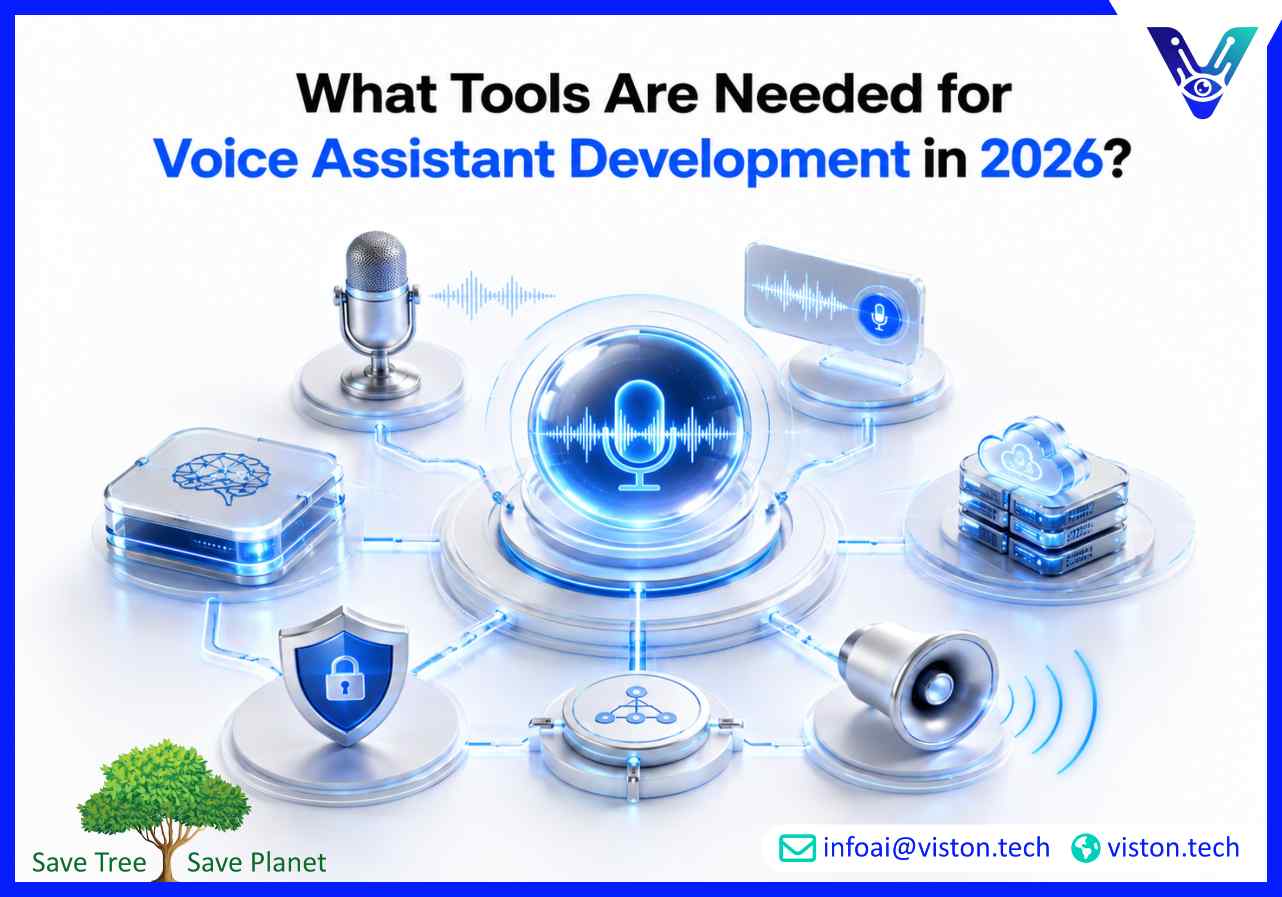
What Tools Are Needed for Voice Assistant Development in 2026?
Choosing the right voice assistant development tools determines whether a voice experience feels natural, responds quickly, understands real users, and connects reliably with business systems. In 2026, building Voice-Enabled Assistants requires more than speech recognition. Businesses need a coordinated stack covering audio processing, conversational intelligence, integrations, testing, security, deployment, and continuous improvement.
Core Tools Needed for Voice Assistant Development
A production-ready voice assistant is usually built from several specialist components rather than one standalone tool. Each component handles a different stage of the conversation, from detecting speech to completing an action and speaking the response.
Voice activity detection tools
Voice activity detection, commonly called VAD, identifies when a person starts and stops speaking. It helps the assistant separate speech from silence, reduce unnecessary audio processing, and respond without awkward delays.Effective VAD is especially important for telephone calls, mobile applications, smart devices, vehicles, noisy workplaces, and customer service environments. Poor speech detection can cause the assistant to interrupt users, miss the beginning of a sentence, or wait too long before responding.
Wake-word detection tools
Hands-free assistants may require wake-word technology that activates the system after a phrase such as a brand name or custom command. Wake-word engines must be lightweight, responsive, and resistant to accidental activation.Organizations should consider whether wake-word processing will happen on the device or in the cloud. On-device processing can support faster activation, offline functionality, reduced bandwidth use, and stronger privacy controls for always-listening applications.
Automatic speech recognition tools
Automatic speech recognition, or ASR, converts spoken audio into text that the assistant can process. Common options include cloud speech APIs, open-source speech models, self-hosted engines, and domain-specific recognition systems.An ASR tool should be evaluated for:
Accuracy across accents, dialects, and speaking styles
Streaming transcription and response latency
Background-noise handling
Multilingual and language-detection support
Recognition of names, product terms, abbreviations, and industry vocabulary
Speaker identification or diarization where required
Data residency, retention, and deployment options
Word error rate can provide a useful technical benchmark, but it should not be the only selection criterion. A voice assistant may have a reasonable transcript while still misunderstanding the customer’s actual goal. Testing should therefore include task completion, intent accuracy, and performance in realistic acoustic conditions.
Natural language understanding and language model tools
After speech is transcribed, the assistant must understand what the user wants. This layer may use traditional natural language understanding, a large language model, intent classification, entity extraction, retrieval-augmented generation, or a combination of these approaches.Intent tools identify goals such as booking an appointment, checking an order, reporting a problem, or requesting account information. Entity extraction identifies important details such as dates, locations, product names, reference numbers, and quantities.Large language models can support more flexible conversations, but they need controlled prompts, trusted knowledge sources, permission rules, tool-use restrictions, and clear escalation boundaries. Business-critical assistants should not rely on unrestricted generation when accuracy or compliance matters.
Text-to-speech tools
Text-to-speech, or TTS, converts the assistant’s response into spoken audio. Modern TTS platforms can provide natural voices, multiple languages, adjustable pace, pronunciation controls, streaming output, and different voice styles.Businesses should select a voice that is clear, appropriate for the brand, and easy to understand over the intended channel. A voice that sounds impressive through headphones may perform differently over a compressed telephone connection.TTS evaluation should cover pronunciation, emotional consistency, interruptions, response speed, multilingual quality, number reading, names, dates, currencies, and specialist terminology. Organizations using custom or cloned voices should also establish appropriate consent, governance, and usage controls.
Conversation, Orchestration, and Integration Tools
The speech components allow the assistant to hear and speak, but orchestration tools determine what happens between those stages. They coordinate dialogue, business rules, knowledge retrieval, external APIs, and human handovers.
Conversation orchestration frameworks
Conversation orchestration tools manage the flow of each interaction. They maintain context, decide which action to take, call approved tools, handle errors, and determine when the assistant should ask a question or transfer the conversation.Teams may use dedicated conversational AI frameworks, voice-agent platforms, agent orchestration libraries, or custom application logic. The appropriate choice depends on the complexity of the use case, desired level of control, deployment model, available engineering skills, and integration requirements.A strong orchestration layer should support:
Multi-turn conversation context
Interruptions and natural turn-taking
Deterministic business rules
API and function calling
Fallback and recovery flows
Human escalation with conversation context
Session management and user authentication
Versioning, testing, and auditability
Real-time audio transport tools
Voice assistants need a reliable way to stream audio between users and the application. Web-based and mobile experiences commonly use real-time communication technologies such as WebRTC or WebSockets. Telephone assistants may use Session Initiation Protocol, telephony APIs, contact-center platforms, or carrier infrastructure.The transport layer affects latency, audio quality, call control, interruption handling, recording, scaling, and regional availability. Businesses should test the complete audio path rather than measuring individual AI services in isolation.
Knowledge base and retrieval tools
Voice-Enabled Assistants often need access to product documentation, policies, support articles, account information, or internal procedures. Retrieval tools help the assistant find relevant information from approved sources instead of relying entirely on a language model’s general knowledge.A retrieval stack may include document-processing tools, embedding models, vector databases, enterprise search, content permissions, metadata filtering, and reranking systems. The knowledge base should have clear ownership, update processes, access controls, and source-of-truth rules.Retrieval quality matters because voice interactions leave users less time to inspect or compare information. Responses should be brief, accurate, and suitable for listening rather than copied directly from long documents.
Business system integration tools
A useful business voice assistant should often do more than answer questions. It may need to retrieve an order, create a ticket, update a CRM record, schedule an appointment, verify an account, process a request, or notify an employee.Integration tools can include REST or GraphQL APIs, webhooks, integration platforms, message queues, workflow automation tools, databases, and custom middleware. Typical connections include:
CRM and sales platforms
Helpdesk and contact-center systems
ERP and order-management software
Scheduling and calendar platforms
Payment and billing systems
Identity and access management services
Knowledge bases and document repositories
Analytics and reporting platforms
Every integration should include validation, timeout handling, retry rules, logging, authorization, and a safe fallback. The assistant must never claim that an action has been completed when the connected system has failed.
Development, Testing, Security, and Monitoring Tools
Prototyping a voice assistant can be relatively straightforward. Operating one reliably across real customers, languages, channels, and business processes requires a broader engineering toolset.
Programming languages and development environments
Python is commonly used for machine learning, natural language processing, backend services, and rapid experimentation. JavaScript or TypeScript is frequently used for web interfaces, real-time applications, APIs, and server-side orchestration. Mobile or embedded assistants may also require platform-specific languages and software development kits.Developers need source control, collaborative repositories, package management, local testing environments, API clients, debugging tools, and secure secret management. Container technologies can help standardize development and deployment across different environments.
Conversation design and prototyping tools
Voice conversation design should happen before full engineering begins. Teams need tools for mapping user intents, creating sample dialogues, defining prompts, documenting edge cases, and testing alternative wording.A voice interface cannot display a long menu or page of instructions. Designers must create concise prompts, confirm important information, handle corrections, and allow users to interrupt naturally. Prototypes should be tested with spoken conversations rather than reviewed only as written scripts.
Automated and human testing tools
Voice assistant testing should cover the full conversation, not just individual components. A complete test suite may include recorded audio samples, synthetic speech, live user testing, load tests, API simulations, regression testing, and adversarial inputs.Important test scenarios include:
Different accents, languages, ages, and speaking speeds
Background noise and weak connections
Interruptions, hesitation, and users changing their minds
Ambiguous requests and missing information
Incorrect account details or unavailable services
Integration failures and delayed APIs
Sensitive, abusive, urgent, or high-risk conversations
Human handover and after-hours routing
Teams should also test whether the assistant completes the intended business task. A technically accurate transcript is not useful when the workflow fails or the user is routed incorrectly.
Monitoring and analytics tools
Voice assistants need ongoing observability after deployment. Monitoring tools should track latency, transcription quality, fallback rate, task completion, escalation, API errors, call outcomes, customer satisfaction, and operating costs.Conversation analytics can reveal misunderstood phrases, missing intents, knowledge gaps, poor prompts, and repeated integration failures. Dashboards should connect technical metrics with business outcomes such as resolved enquiries, completed bookings, qualified leads, reduced handling time, or successful self-service interactions.
Security and privacy tools
Voice data can contain names, account information, financial details, health information, and other sensitive content. Development therefore requires encryption, identity verification, role-based access controls, audit logs, secure key management, data-loss prevention, and configurable retention policies.Businesses must know where audio, transcripts, model inputs, and logs are stored. They should also determine whether service providers use customer conversations for model training and whether that use can be disabled.Privacy controls should be designed into the system from the beginning. Recording notices, consent, redaction, deletion processes, regional data requirements, and human access to conversation logs should all be addressed before production deployment.
How to Choose the Right Voice Assistant Development Stack
There is no single voice assistant development stack that suits every business. A retail order-status assistant, healthcare scheduling service, internal employee assistant, and outbound sales agent will have different accuracy, risk, integration, and compliance requirements.
Begin with the business use case
Define the specific tasks the assistant will perform, who will use it, which channels it must support, and what successful completion means. Starting with a narrow, high-value workflow makes it easier to select tools and measure results.For example, an appointment assistant may prioritize calendar integration, date recognition, confirmation, and reminder workflows. A customer support assistant may require deeper knowledge retrieval, sentiment handling, ticket creation, and reliable escalation.
Set a realistic latency target
Voice interactions become frustrating when users experience long silences between turns. Latency comes from audio transport, speech recognition, language processing, knowledge retrieval, API calls, and speech synthesis.Teams should measure end-to-end response time and support streaming wherever appropriate. Faster components are valuable, but response quality, security, and reliability should not be sacrificed simply to reduce a small amount of delay.
Compare modular and speech-to-speech architectures
A modular architecture combines separate VAD, ASR, language, orchestration, and TTS components. It offers flexibility, component-level monitoring, provider choice, and clearer control over text-based business logic.Real-time speech-to-speech systems can create more fluid conversations by processing and generating audio directly. They may handle interruptions, tone, and conversational rhythm more naturally, but businesses still need controls for knowledge, integrations, logging, permissions, and predictable actions.The best architecture depends on whether the priority is natural conversation, deterministic workflow execution, deployment control, auditability, or a combination of these factors.
Evaluate total operating requirements
Tool selection should account for more than API pricing. Total cost includes audio processing, model usage, telephony, infrastructure, integration development, testing, monitoring, security, support, and ongoing optimization.Businesses should also evaluate vendor reliability, service limits, regional availability, multilingual performance, data policies, portability, and the effort required to replace a component later. A modular design can reduce dependency on a single provider, although it may require more engineering and operational management.
How Viston AI Supports Voice Assistant Development
Viston AI’s service portfolio includes Voice-Enabled Assistants, enterprise AI chatbots, multilingual support, natural language processing, business system integration, AI agent development, and automation workflows. These capabilities align with the main layers required to develop practical business voice experiences.Voice assistant development requires coordination between speech technologies, conversational logic, enterprise data, APIs, workflow rules, and user experience design. Viston AI can support organizations that need these components brought together around a defined business process rather than implemented as disconnected tools.This approach is relevant for businesses planning voice-based customer support, appointment scheduling, lead qualification, internal assistance, information retrieval, service routing, or workflow automation. The assistant can be designed around the systems employees and customers already use, including CRM, helpdesk, knowledge, and operational platforms.Viston AI’s broader conversational AI capabilities are also useful when a business needs multilingual interactions, contextual responses, human escalation, or coordinated voice and text channels. By treating Voice-Enabled Assistants as integrated business systems, organizations can focus on reliability, scalability, security, and measurable task completion instead of deploying a voice interface that operates in isolation.
Frequently Asked Questions
What are the essential tools for building a voice assistant?
The essential tools include voice activity detection, speech-to-text, natural language understanding or language models, conversation orchestration, text-to-speech, real-time audio transport, business system integrations, testing tools, security controls, and performance monitoring.
Do businesses need to build speech recognition from scratch?
No. Most businesses use an existing cloud API, commercial platform, open-source model, or self-hosted speech engine. The main task is selecting and configuring a solution that meets the required accuracy, latency, language, security, and deployment needs.
Which programming language is best for voice assistant development?
Python is widely used for AI, NLP, backend processing, and prototypes, while JavaScript or TypeScript is common for real-time web applications and APIs. The right language depends on the chosen platforms, integrations, engineering expertise, and deployment environment.
Are no-code tools enough for voice assistant development?
No-code and low-code tools can be effective for prototypes and focused workflows. Complex enterprise deployments usually require custom integrations, security configuration, testing, monitoring, and engineering support beyond what a basic visual builder provides.
Can a voice assistant work offline?
Yes, when wake-word detection, speech recognition, language processing, and speech synthesis are deployed on the device or local infrastructure. Offline development requires suitable models, sufficient device resources, and a plan for synchronizing data when connectivity returns.
Can Viston AI help select and integrate voice assistant tools?
Viston AI provides Voice-Enabled Assistants and related conversational AI, NLP, multilingual, integration, and automation services. These capabilities are relevant to businesses that need help designing a suitable technology stack and connecting the assistant to operational systems.
Conclusion
Understanding what tools are needed for voice assistant development helps businesses plan beyond a basic speech demo. A reliable solution requires speech detection, ASR, conversational intelligence, TTS, orchestration, integrations, testing, monitoring, and security working as one system. The right tools depend on the use case, languages, channels, risk level, latency expectations, and existing business platforms. Organizations investing in Voice-Enabled Assistants should begin with a clearly defined workflow and select components based on measurable performance. Viston AI offers relevant voice, conversational AI, multilingual, and integration capabilities for businesses building practical voice-driven experiences.