
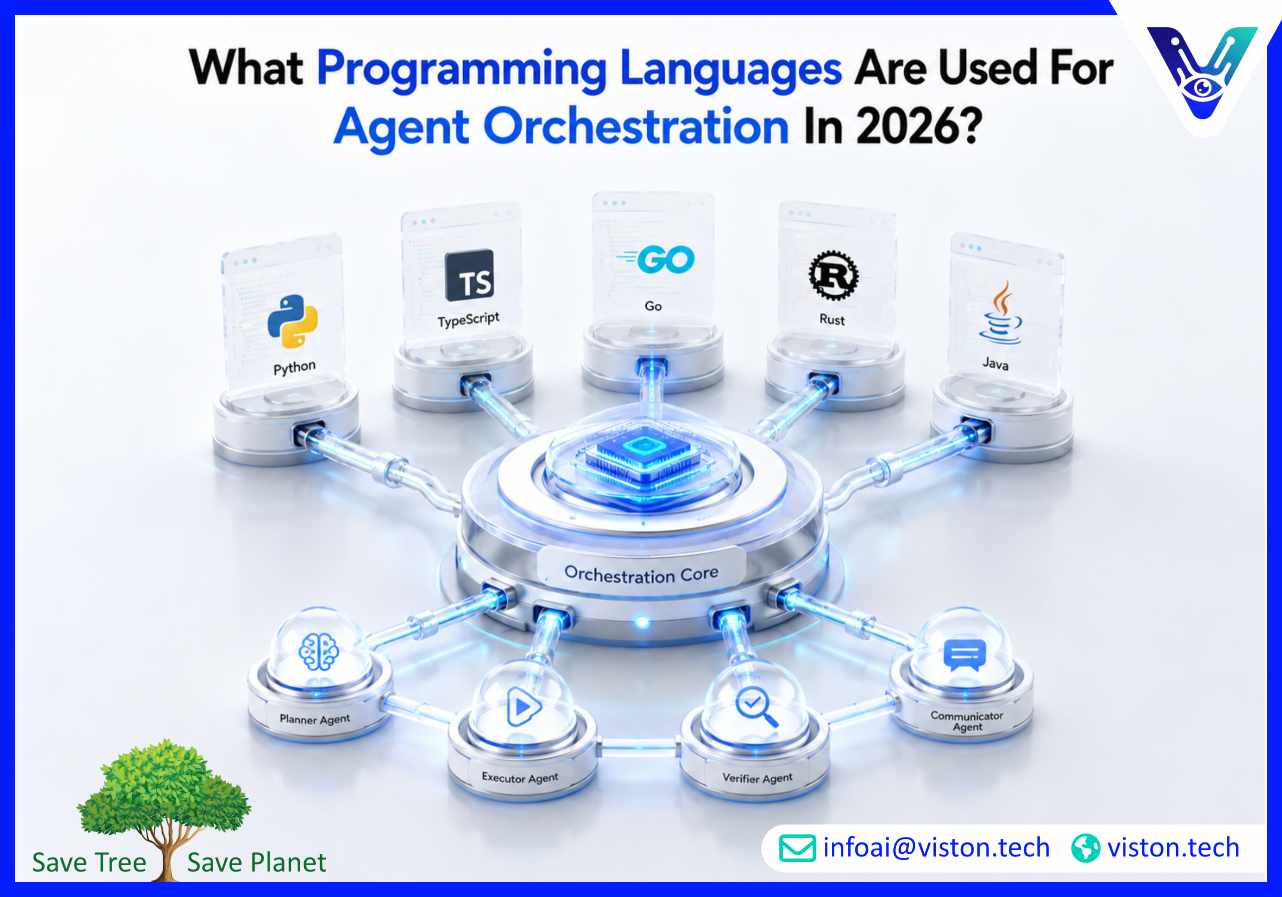
For businesses moving from AI experimentation to production, the choice of programming language for agent orchestration directly impacts reliability, maintainability, and how quickly systems can adapt to new requirements. The decision is rarely about picking a single language. It is about matching the right tool to orchestration complexity, team capability, and the operational demands of running autonomous agents in live environments.
Agent orchestration is the software layer that coordinates multiple AI agents, each with defined roles, to complete multi-step business processes. Rather than one large language model handling everything, orchestration assigns specialized agents to planning, execution, verification, and user communication tasks. The orchestration engine manages state, passes context between agents, enforces guardrails, and determines when a workflow is complete.
This coordination matters for businesses because it turns isolated AI capabilities into reliable, repeatable operations. In 2026, enterprises are using orchestration to automate complex workflows such as procurement approvals, compliance checks, customer onboarding, and multi-channel campaign execution. The software patterns that enable this coordination lean heavily on languages that support concurrency, typed communication protocols, and long-running process management.
The search intent behind this topic is predominantly commercial investigation. Technical decision-makers and business leaders are evaluating the landscape to understand which technology choices position their teams for production reliability. They are not looking for syntax comparisons. They need to know which languages support durable execution, structured communication between agents, human-in-the-loop intervention, and integration with existing enterprise systems.
Python continues to dominate agent orchestration in 2026 due to its deep integration with the LLM ecosystem. Nearly every major AI provider ships Python-first SDKs, and popular orchestration frameworks like LangGraph, CrewAI, and AutoGen are built on Python. For businesses, this means the shortest path from concept to working prototype runs through Python.
The practical advantage is speed of integration. Python orchestrators can connect to OpenAI, Anthropic, Google, and open-source models with minimal boilerplate. Teams can define agent behaviors, tool access, and inter-agent communication patterns using familiar constructs. For orchestration logic that is primarily about directing LLM calls, parsing responses, and routing to downstream agents, Python offers the fastest development velocity.
However, production Python orchestration carries well-understood trade-offs. Concurrency relies on async patterns rather than true parallelism due to the Global Interpreter Lock. Long-running agent workflows that span hours or days require external state management. Type safety is optional, which can lead to runtime failures when agent output schemas drift. In 2026, mature Python-based teams address these issues through rigorous testing, structured output validation, and integration with durable execution backends that persist workflow state outside the Python process.
TypeScript has gained significant ground for agent orchestration scenarios where agents must interact with web services, browser environments, or event-driven architectures. Its non-blocking I/O model makes it well-suited for orchestrating agents that trigger webhooks, respond to streaming events, or coordinate actions across distributed microservices.
Businesses with existing Node.js infrastructure often choose TypeScript for orchestration to maintain consistency across their stack. The language’s type system catches mismatched data shapes at compile time, reducing production errors when agents pass structured data between steps. Tools like Mastra and custom orchestration layers built on frameworks such as Temporal TypeScript SDK support durable execution, meaning workflows that survive process restarts and can pause for hours waiting on human approval.
TypeScript excels when agent orchestration must operate close to the user interface. For customer-facing applications where agents coordinate in real time with user actions, the ability to share orchestration types between frontend and backend reduces integration friction. The trade-off is a smaller selection of LLM-native libraries compared to Python, though the gap narrowed considerably through 2025 and into 2026 as AI providers invested in first-class TypeScript support.
For businesses where agent orchestration sits on a critical path with strict latency budgets, compiled languages provide predictable performance characteristics that interpreted languages cannot guarantee. Go has emerged as a strong choice for infrastructure-level orchestration, particularly for teams managing high-throughput agent-to-agent communication.
Go’s goroutine model maps naturally to agent concurrency. Each agent instance can run as a lightweight goroutine, communicating through channels that provide typed, safe message passing. The language compiles to a single binary with minimal deployment complexity, which appeals to platform teams operating orchestration layers inside Kubernetes environments. Several open-source agent meshes released in early 2026 use Go for their routing and scheduling cores, calling out to Python or TypeScript for the LLM interaction layer.
Rust addresses scenarios where orchestration reliability and memory safety cannot be compromised. Financial services, healthcare, and critical infrastructure organizations use Rust-based orchestrators when agent decisions must be auditable and the orchestration layer itself must be provably correct. The development velocity is slower, but the operational confidence is higher. Rust’s ownership model prevents entire categories of concurrency bugs that could corrupt agent state in long-running workflows.
Java and JVM languages remain relevant inside large enterprises with established Spring Boot or Jakarta EE ecosystems. The maturity of Java’s concurrency frameworks, monitoring tooling, and enterprise integration patterns makes it a pragmatic choice when agent orchestration must coexist with existing Java services. Frameworks like Spring AI provide abstractions for agent workflows that feel familiar to enterprise Java teams.
The realistic pattern for production agent orchestration in 2026 is not a single language but a deliberate multi-language architecture. The orchestration engine, responsible for durable execution, state management, and fault tolerance, may run in Go, Rust, or a managed platform. Agent logic and LLM interaction run in Python or TypeScript. Enterprise integration adapters use whatever language the existing services expect.
This separation of concerns reflects how businesses actually deploy agent systems. The orchestration backbone handles scheduling, retries, timeouts, and audit logging. It does not need to understand LLM prompts. The agent workers handle reasoning, tool calling, and output formatting. They do not need to implement durable execution themselves because the backbone provides it. Communication between layers occurs through well-defined APIs, queues, or RPC frameworks, with serialization formats like Protocol Buffers or JSON Schema ensuring type safety across language boundaries.
The operational benefit is that teams can optimize each layer independently. A Python team can iterate rapidly on agent behavior without risking the orchestration backbone. A platform team can harden the orchestration layer without understanding prompt engineering. When a new model provider launches with only a Python SDK, the agent layer adapts quickly while the durable execution layer remains unchanged.
At Viston AI, the development and deployment of AI agent systems begins with understanding the operational context in which the orchestration will run. The company specializes in building production-grade agent systems for mid-market and enterprise organizations, and the language choices follow from each engagement’s specific requirements rather than any fixed stack preference.
When Viston AI designs an orchestration layer, the team evaluates factors including existing infrastructure, team capabilities, latency requirements, compliance constraints, and long-term maintainability. A deployment for a European financial institution operating under strict regulatory oversight often leads toward a Go or Java orchestration backbone with Python agent workers, ensuring the durable execution layer meets auditability requirements while allowing flexibility in the AI interaction tier. An orchestration system for a North American SaaS company with an existing TypeScript monorepo naturally favors TypeScript-based orchestration, reducing cognitive overhead for the client’s engineering team.
Viston AI’s orchestration approach is built around durable execution from day one. Whether the implementation uses Temporal, custom state machines, or managed orchestration backends, every agent workflow is designed to survive infrastructure failures, pause for indefinite periods awaiting human input, and provide complete execution histories for debugging and compliance. The company integrates structured output validation at every inter-agent boundary, catching malformed data before it propagates through a workflow and causes downstream failures that are expensive to untangle.
For organizations evaluating agent orchestration, Viston AI provides architecture guidance, hands-on development, and ongoing operational support that addresses the practical realities of running autonomous systems in production. This includes setting up monitoring for agent performance degradation, implementing fallback strategies when model providers experience latency, and designing human-in-the-loop intervention points that give operations teams meaningful control without creating manual bottlenecks.
There is no single best language. Python leads for speed of development and LLM ecosystem access. TypeScript excels in event-driven and web-native environments. Go and Rust provide performance and reliability guarantees for infrastructure layers. Production systems often combine languages, with orchestration backbones in compiled languages and agent logic in Python or TypeScript.
For most teams in 2026, some Python capability is valuable because the largest collection of AI SDKs and orchestration frameworks are Python-first. However, you can build production orchestration without Python if you are willing to use TypeScript-based frameworks or construct your own orchestration layer in Go, Java, or Rust. The core orchestration patterns are language-agnostic.
Yes. TypeScript’s ecosystem for agent orchestration matured significantly during 2025. With durable execution platforms offering TypeScript SDKs, major AI providers shipping TypeScript-native libraries, and a growing selection of orchestration frameworks, TypeScript is fully viable for enterprise deployments, particularly for organizations already invested in the Node.js ecosystem.
Rust is used primarily for orchestration infrastructure where performance, memory safety, and correctness are non-negotiable. This includes organizations in regulated industries, high-throughput agent meshes, and scenarios where the orchestration layer itself must meet stringent reliability requirements. Rust is rarely used for the LLM interaction layer, which remains dominated by Python and TypeScript.
Language choice affects who can maintain the system, how easily you can onboard new developers, and how quickly you can adapt to model provider API changes. Python offers the largest talent pool for AI work but requires discipline around type safety and testing. Go and Rust offer stronger compile-time guarantees but smaller AI-specific talent pools. Multi-language architectures let you optimize maintenance by assigning different components to the teams best equipped to manage them.
Standardizing on one language simplifies hiring, code review, and deployment pipelines. For smaller teams or single-use-case deployments, a single-language approach using Python or TypeScript is entirely practical. For complex, multi-agent systems with demanding reliability requirements, a deliberate two-language architecture often provides better long-term outcomes by matching language strengths to component requirements.
The programming languages used for agent orchestration in 2026 reflect a pragmatic reality: different parts of the orchestration stack have different requirements. Python remains the language of choice for agent behavior and LLM integration. TypeScript handles event-driven coordination and web-native deployment. Compiled languages like Go, Rust, and Java provide the reliability backbone for production systems that cannot fail silently.
For businesses investing in AI agent development and deployment, the right question is not which language to use exclusively, but how to architect an orchestration layer that gives each component the language it needs while keeping the system maintainable. Viston AI brings this architectural perspective to every engagement, helping organizations design and deploy agent orchestration systems that align with their infrastructure, team capabilities, and operational requirements. The languages are the tools. The outcome that matters is a production system that delivers reliable, auditable, and adaptable automation.
