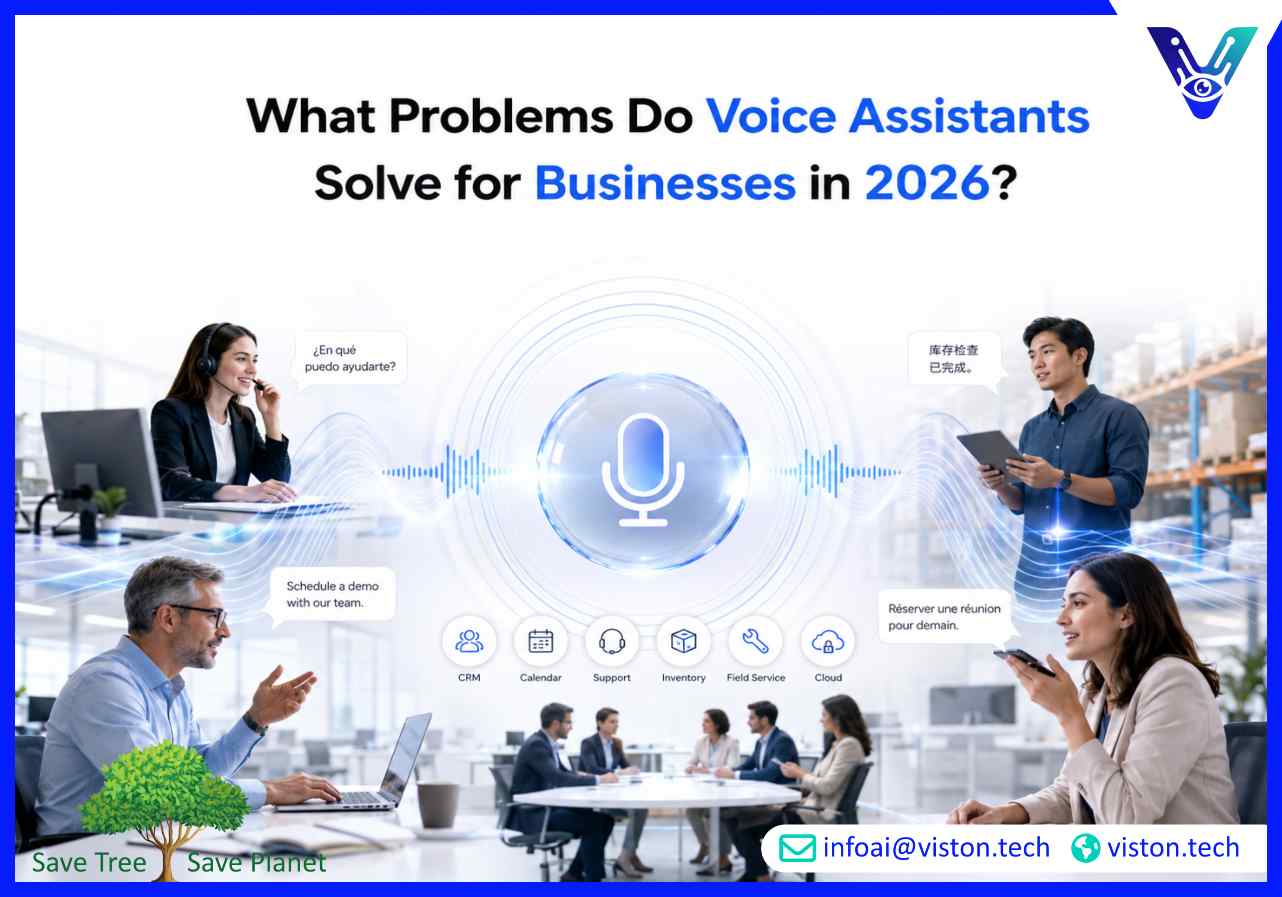
What Problems Do Voice Assistants Solve for Businesses in 2026?
Understanding what problems voice assistants solve helps business leaders separate useful automation from novelty. Modern voice-enabled assistants can remove customer-service bottlenecks, simplify hands-free work, improve access to information, and connect spoken requests with real business systems. Their value depends on suitable use cases, reliable integrations, and clear human handover rules.
What Problems Do Voice Assistants Solve in Customer Service?
One of the clearest business uses for voice assistants is handling repetitive, high-volume customer requests. Traditional phone support often forces customers through rigid menus, long queues, and repeated identity checks before they reach the right person. A well-designed voice assistant can understand a request in natural language, retrieve relevant information, complete routine tasks, or route the conversation with context.
Long wait times and limited service hours
Customers may need help outside normal working hours, during seasonal peaks, or when contact centres are already overloaded. Voice assistants can provide immediate support for approved use cases without requiring every interaction to enter a live-agent queue. Common examples include checking an order, confirming an appointment, reporting a service issue, requesting account information, or finding a policy.This does not mean every call should be automated. Complex complaints, sensitive situations, exceptions, and high-risk decisions still require people. The goal is to resolve predictable requests while preserving human capacity for work that needs empathy, investigation, or authority.
Repetitive questions and inconsistent answers
Support teams often answer the same questions across phone, website, mobile app, and messaging channels. Voice-enabled assistants can use an approved knowledge base to provide consistent answers about products, delivery, opening hours, eligibility, troubleshooting, and next steps. When content is governed properly, updates can be reflected across many conversations rather than relying on every agent to remember every change.
Poor call routing and repeated explanations
Basic interactive voice response systems ask callers to select from fixed menus. Conversational voice AI can identify intent from spoken language, collect essential details, and send the request to the correct team. A strong handover includes the transcript, customer context, detected intent, completed verification steps, and actions already attempted. This reduces the need for customers to repeat themselves.
High-volume transactional work
Voice assistants can complete structured tasks when connected securely to CRM, booking, order, payment, helpdesk, or account systems. They can schedule appointments, create tickets, update contact details, check delivery status, record a meter reading, qualify an enquiry, or trigger a follow-up. The business benefit comes from completing the workflow, not merely answering the call.
How Voice Assistants Solve Operational and Employee Workflow Problems
Voice assistants are also useful inside organizations. They can reduce the friction involved in searching systems, recording information, or completing tasks when employees are mobile, wearing protective equipment, using tools, or working in environments where screens are inconvenient.
Hands-busy and eyes-busy work
Warehouse staff, field technicians, clinicians, engineers, inspectors, and maintenance teams may need information while continuing a physical task. A voice interface can guide a checklist, retrieve instructions, confirm an item, log an observation, or move a workflow to the next step. This can be more practical than stopping work to type into a device.For safety-critical environments, voice automation should be designed carefully. The assistant must confirm important values, handle background noise, recognize uncertainty, and avoid presenting unverified guidance as fact. Human approval should remain mandatory for decisions that affect safety, diagnosis, compliance, or significant financial outcomes.
Slow access to internal knowledge
Employees often lose time searching policy documents, service manuals, product catalogues, intranets, and ticket histories. A voice-enabled assistant can act as a conversational access layer over approved company knowledge. An employee can ask a direct question and receive a concise answer, a source reference, or the next required step.The quality of this experience depends on content ownership. Outdated or conflicting documents create unreliable answers. Businesses need defined sources of truth, access controls, version management, and a process for correcting knowledge gaps discovered through real conversations.
Manual data capture and delayed updates
Operational information is often written down and entered later, creating delays and errors. Voice assistants can capture structured data during the task and update the relevant system. A field engineer might dictate an inspection result, a warehouse worker might confirm stock movement, or a sales representative might record meeting notes and create a follow-up action.Reliable implementation requires validation. Names, numbers, addresses, product codes, and dates should be repeated or displayed for confirmation where errors would matter. The assistant should also record who made the update, when it occurred, and which system accepted the change.
Fragmented systems and workflow switching
Employees frequently move between CRM, ERP, helpdesk, scheduling, inventory, and collaboration tools to complete one request. An integrated voice assistant can orchestrate approved actions across these systems through APIs and workflow automation. This gives employees a simpler way to start routine processes.
How Voice Assistants Address Accessibility, Language, and Experience Gaps
Voice can make digital services easier for people who find typing, reading dense interfaces, or navigating complex menus difficult. It also supports situations where the user wants a faster, more natural way to interact. However, voice should expand access rather than become the only option.
Complex interfaces and digital friction
A customer may know what they want but not where to find it in an app or website. Asking a question such as “When will my order arrive?” or “Can I move my appointment to Friday?” is often simpler than navigating several screens. Voice assistants translate that request into an intent, collect missing information, and connect it to a defined workflow.
Accessibility barriers
Voice interaction can help users with limited mobility, temporary injuries, low vision, or difficulty using a keyboard or touchscreen. It may also support older users and people with lower digital confidence. Inclusive design still requires alternatives such as touch, text, keypad input, captions, or human support because speech is not suitable for every user or environment.
Multilingual service demand
Organizations serving several markets may struggle to provide consistent phone support across languages, accents, and time zones. Multilingual voice assistants can handle defined requests in supported languages and transfer more complex conversations to suitable teams. Effective deployment requires more than translation: terminology, pronunciation, regional expressions, code-switching, and cultural expectations must be tested with real users.
Impersonal or rigid automated experiences
Older voice menus force users into predetermined choices. Modern conversational systems can maintain context across multiple turns, ask clarifying questions, and allow corrections. For example, a caller can change a date, add a detail, or return to an earlier point without restarting the entire interaction.Natural conversation should not be confused with pretending the system is human. In 2026, responsible implementations clearly identify the assistant as AI, explain recording or data use where required, and provide an accessible path to a person. Transparency supports trust and helps users make informed choices.
Which Business Problems Should Not Be Solved by Voice Assistants Alone?
Voice assistants are most effective when the task is frequent, structured, measurable, and supported by reliable data. They are less suitable as the sole channel for ambiguous, emotional, regulated, or high-consequence decisions. A strong business case begins by defining boundaries.
Situations requiring human judgment
Serious complaints, vulnerable customers, legal disputes, clinical decisions, unusual financial requests, fraud concerns, and complex negotiations need appropriate human oversight. Voice AI can collect preliminary information or summarize the issue, but it should not block escalation or make decisions beyond its approved authority.
Processes built on poor data
A voice interface cannot repair inaccurate product records, conflicting policies, broken APIs, or poorly designed workflows. It may expose those weaknesses more quickly. Before deployment, businesses should review knowledge quality, system permissions, identity checks, exception handling, and ownership of each automated action.
Use cases without measurable outcomes
“Adding voice” is not a business objective. Teams should connect the project to specific outcomes such as shorter queue times, higher self-service completion, fewer repeated contacts, faster data capture, improved appointment attendance, or reduced manual processing. Useful measures include task completion rate, first-contact resolution, escalation rate, recognition errors, average response latency, customer satisfaction, workflow success, and human handover quality.
Deployments without privacy and security controls
Voice interactions may contain personal, financial, health, employment, or biometric information. Businesses should minimize collection, obtain appropriate consent, encrypt data, restrict access, set retention rules, redact sensitive information where practical, and maintain audit logs. Authentication must match the risk of the action; recognizing a voice is not automatically sufficient proof of identity.Testing should include accents, speech differences, noise, interruptions, ambiguous requests, and attempts to manipulate the assistant. Continuous monitoring is necessary as policies, integrations, and user behaviour change.
How Viston AI Helps Businesses Solve Practical Problems with Voice-Enabled Assistants
Viston AI provides Voice-Enabled AI Assistants designed around speech recognition, natural language processing, multi-turn dialogue, speech synthesis, enterprise integration, analytics, and ongoing model operations. This service alignment is relevant to businesses that want voice interactions to complete useful work rather than operate as an isolated conversational layer.Its approach connects voice assistants with business platforms and custom APIs so the system can retrieve information, update records, trigger workflows, and transfer conversations with context. The company also presents multilingual capability, real-time performance monitoring, role-based access, auditability, personal-data controls, and human intervention points as parts of enterprise delivery.These capabilities can support customer service, appointment management, employee helpdesks, order enquiries, field operations, knowledge access, and other structured voice workflows across industries. A practical engagement should begin with discovery: identify high-volume problems, map the current process, define the source of truth, establish security requirements, and agree on measurable success criteria.Viston AI’s delivery model also includes data preparation, model selection, integration testing, deployment, monitoring, and continuous optimization. That lifecycle matters because voice performance depends on real accents, terminology, background conditions, changing knowledge, and system reliability. For organizations evaluating Voice-Enabled Assistants, the strongest fit is a use case with clear user value, dependable integrations, controlled risk, and a defined route to human support.
Frequently Asked Questions
What is the main problem a voice assistant solves?
A voice assistant reduces friction between a spoken request and a business action. It can answer routine questions, retrieve information, complete structured tasks, or route a user to the right person without requiring complex menus or manual data entry.
Can voice assistants reduce customer support workload?
Yes, when they handle frequent and predictable requests such as order tracking, appointment changes, account enquiries, basic troubleshooting, and ticket creation. Workload reduction should be measured alongside resolution quality, satisfaction, and escalation outcomes.
Are voice assistants useful outside customer service?
Yes. They can support warehouse operations, field service, inspections, employee helpdesks, internal knowledge search, sales administration, scheduling, and hands-free data capture. The assistant must integrate with the systems used to complete each workflow.
What are the biggest limitations of voice assistants?
Common limitations include background noise, accents, ambiguous language, outdated knowledge, weak integrations, privacy risk, and poor exception handling. They also cannot replace human judgment in every situation, so clear escalation rules are essential.
How should a business choose a voice assistant use case?
Prioritize a process that is high-volume, repetitive, clearly defined, supported by reliable data, and easy to measure. Start with a controlled pilot, test with representative users, monitor failures, and expand only after the workflow performs reliably.
Can Viston AI build voice assistants that connect with business systems?
Viston AI positions its Voice-Enabled AI Assistants around enterprise integration, conversational AI, multilingual support, analytics, governance, and continuous optimization. This makes the service relevant to organizations that need spoken interactions connected to operational workflows and data.
Conclusion
What problems do voice assistants solve? They reduce service delays, automate routine conversations, simplify hands-free work, improve access to business knowledge, support multilingual interactions, and connect spoken requests with operational systems. Their value is strongest when the workflow is structured, the data is reliable, and success is measured through completed outcomes. Voice-Enabled Assistants should complement people rather than remove human judgment from sensitive situations. Viston AI offers relevant technical and delivery capabilities for organizations planning integrated voice automation with appropriate governance, testing, monitoring, and escalation.