
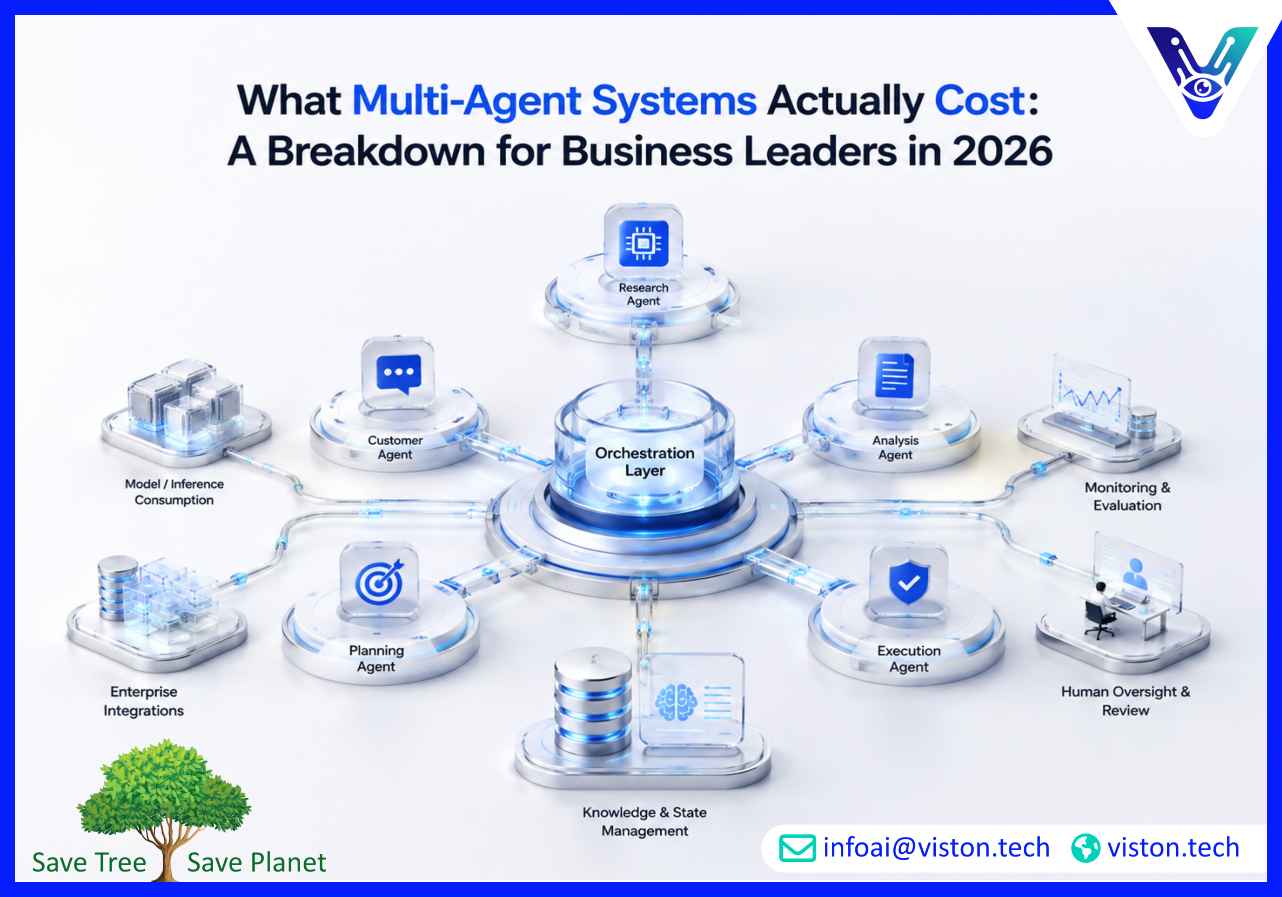
Multi-agent systems have moved from research labs into production environments, and with that shift comes a practical question every business leader eventually asks: what does it actually cost to build, run, and scale one? The answer is rarely a single number. Costs depend on architecture decisions, infrastructure choices, team composition, and whether you buy orchestration capabilities or build them from scratch. This breakdown gives you a clear, honest view of the cost categories you’ll encounter when planning a multi-agent system.
Three years ago, most multi-agent system budgets were experimental line items. Companies allocated funds to explore what autonomous agent teams could do, often without hard ROI expectations. That era is over. In 2026, multi-agent deployments carry the same scrutiny as any enterprise software investment. CFOs want line-item clarity. Procurement teams need vendor comparison frameworks. Engineering leaders must justify build-versus-buy decisions with defensible numbers.
The cost conversation has matured for good reason. Inference costs have dropped significantly since 2024, but they haven’t disappeared. Agent-to-agent communication creates compounding token usage that surprises teams who only modeled single-agent interactions. Orchestration layers add their own compute overhead. And the human oversight necessary for reliable operation represents an ongoing operational expense that many initial budgets missed entirely.
Understanding where costs concentrate helps you avoid the most common budgeting mistakes: underestimating integration complexity, overlooking monitoring and observability expenses, and failing to account for the iterative refinement cycles that production systems demand.
Every agent in your system consumes tokens when it reasons, plans, calls tools, and communicates with other agents. In a single-agent setup, you pay for one chain of reasoning. In a multi-agent system with five specialized agents collaborating on a task, the token multiplier can reach 5x to 12x depending on how frequently agents exchange context, verify each other’s outputs, or escalate decisions.
Model selection drives a significant portion of this cost. Running all agents on a frontier model like GPT-4o or Claude Opus produces the highest per-task cost but often delivers the most reliable agent-to-agent coordination. A tiered approach, where specialized sub-agents use smaller, task-optimized models while an orchestrator agent uses a frontier model for planning and arbitration, can reduce inference costs by 40% to 60% without meaningful performance degradation in well-defined workflows.
Self-hosted open-weight models eliminate per-token API charges but introduce GPU compute costs, infrastructure management overhead, and latency considerations that affect total cost of ownership differently at different scales. The break-even point between API-based and self-hosted approaches typically sits between 50 million and 200 million tokens per month, depending on your GPU utilization rates and whether you can share infrastructure across workloads.
Orchestration is the layer that manages agent lifecycles, task routing, state persistence, conversation memory, tool execution permissions, and failure recovery. Whether you build orchestration in-house or adopt a platform, it represents an unavoidable infrastructure cost category.
Self-built orchestration requires engineering time for state management, queue systems, retry logic, prompt templating, agent registration, and inter-agent communication protocols. Teams typically underestimate this by a factor of two to three. What starts as a simple message-passing system grows to include authentication between agents, versioning for agent capabilities, audit logging for compliance, and circuit breakers that prevent cascading failures when one agent produces unexpected output.
Platform-based orchestration shifts the cost from engineering time to subscription or usage-based pricing, often with additional charges for managed vector storage, evaluation tooling, and observability dashboards. The total platform cost for a mid-complexity multi-agent system handling 10,000 to 50,000 tasks per month typically ranges from $3,000 to $15,000 monthly, depending on agent count, tool integration volume, and data retention requirements.
Agents produce business value by interacting with your existing systems: CRMs, ERPs, databases, APIs, document repositories, and communication platforms. Every integration requires development, testing, authentication management, and ongoing maintenance as those systems evolve.
For a multi-agent system connecting to five enterprise systems, expect integration development costs between $40,000 and $120,000 depending on system complexity, API maturity, and whether you need bidirectional data flow. Maintenance costs add roughly 15% to 20% of the initial build cost annually as APIs change, authentication methods update, and agent tool definitions require adjustment.
The less visible integration cost comes from degraded system performance when integrations aren’t robust. An agent that fails to retrieve customer data mid-task doesn’t just stop working, it may produce incorrect output that requires human correction downstream, creating costs that appear in your operations budget rather than your engineering budget.
Single-agent monitoring is straightforward by comparison. You trace one reasoning chain, evaluate one output, and log one set of tool calls. Multi-agent monitoring means tracing conversations between agents, understanding where handoffs introduced errors, detecting when agents loop or deadlock, and evaluating both individual agent performance and overall system outcomes.
Observability tooling for multi-agent systems has matured considerably since 2024, but it remains a meaningful cost category. Purpose-built platforms for agent observability typically charge per trace or per logged event. A system processing 50,000 agent interactions monthly with full tracing enabled can generate $2,000 to $5,000 in observability costs alone.
Evaluation costs compound this. Testing a multi-agent system requires scenarios that exercise agent collaboration patterns, not just single-agent accuracy. Organizations running thorough evaluation suites before each deployment update report spending $1,500 to $4,000 monthly on evaluation runs, with costs scaling with the breadth of test scenarios and the models used for automated evaluation.
Most production multi-agent systems in 2026 include human review steps for high-stakes decisions, edge cases, or compliance-required approvals. The cost of this human oversight is rarely modeled during the planning phase but frequently becomes the largest operational line item.
A multi-agent system handling 20,000 tasks per month with a 15% human review rate requires roughly 120 to 180 hours of reviewer time monthly, assuming five to eight minutes per review. At fully loaded labor costs, this represents $8,000 to $18,000 monthly for a single workflow. Systems that reduce review rates through better agent reliability directly lower this cost, creating a clear ROI case for investment in evaluation, prompt engineering, and fine-tuning.
Cost optimization often introduces latency. Routing tasks through smaller models, adding verification agents, or implementing multi-step human review all add seconds or minutes to task completion. For internal automation use cases, this tradeoff is often acceptable. For customer-facing applications, latency directly impacts experience and conversion.
The business cost of latency depends on your use case, but organizations running customer-facing multi-agent systems report that every additional second of response time beyond expectations measurably reduces task completion rates. Budgeting for the infrastructure necessary to maintain target latency levels, rather than optimizing purely for lowest per-task cost, prevents the hidden cost of poor user experience from eroding the system’s business value.
Agents need access to current, accurate information about your business rules, policies, product details, and process exceptions. Maintaining this knowledge base as your business changes represents an ongoing operational cost that grows with system complexity.
Organizations with mature multi-agent deployments typically assign 0.5 to 2.0 full-time equivalent roles to knowledge management: updating agent guidelines, reviewing conversation logs for knowledge gaps, and coordinating with subject matter experts across departments. Without this investment, agent accuracy degrades over time as business reality drifts away from the static knowledge provided during initial deployment.
Multi-agent orchestration is the control layer that determines how agents discover each other, share context, manage task handoffs, resolve conflicts, and maintain coherent state across multi-step processes. The quality of orchestration directly affects every cost category described above.
Well-designed orchestration reduces unnecessary agent-to-agent communication, preventing token waste from agents re-explaining context that was already shared. It manages state efficiently, minimizing the prompt size needed for each agent to understand its current task. It implements intelligent routing so that specialized agents handle tasks within their capability boundaries, reducing the failure-and-retry cycles that multiply inference costs.
Poor orchestration, whether self-built without sufficient investment or adopted from an immature platform, creates costs through inefficiency rather than line items. Agents repeat work. Context gets lost between handoffs. Tasks route to agents unsuited for them, producing outputs that require expensive human correction. These costs are harder to measure but frequently larger than the visible infrastructure expenses.
Organizations evaluating orchestration approaches should assess not just the direct platform or engineering cost, but the system-wide efficiency impact. An orchestration layer that costs more monthly but reduces inference spend by 30% and human review time by 20% may produce lower total cost of ownership than a cheaper alternative that leaves those inefficiencies unaddressed.
For planning purposes, multi-agent systems in 2026 typically fall into three cost tiers, excluding initial integration development which varies significantly by enterprise environment.
Simple systems with two to three agents handling structured, well-defined workflows like document classification and routing, basic customer inquiry triage, or internal data retrieval tasks typically incur monthly operational costs between $5,000 and $15,000. This includes inference, orchestration infrastructure, basic monitoring, and limited human review.
Moderate-complexity systems with four to seven agents managing multi-step processes with conditional logic, such as procurement approvals, claims processing with document verification, or technical support diagnosis, range from $15,000 to $45,000 monthly. The increase comes from higher token consumption through agent collaboration, more sophisticated orchestration requirements, expanded integration maintenance, and greater human review volume.
Complex systems with eight or more agents handling ambiguous, high-variability tasks like strategic analysis, multi-stakeholder project coordination, or regulatory compliance across jurisdictions can exceed $60,000 monthly in operational costs. These systems require substantial investment in evaluation infrastructure, knowledge management, and specialized human oversight to maintain reliability at scale.
Viston AI provides multi-agent orchestration designed for organizations that need reliable, observable, and cost-efficient coordination across agent teams. The company’s orchestration platform addresses the cost drivers that most directly impact total system ownership: inference efficiency, integration management, and operational oversight.
In practice, this means Viston AI handles agent lifecycle management, state persistence, inter-agent communication protocols, and failure recovery, reducing the engineering investment organizations would otherwise need to build and maintain these capabilities internally. The platform includes tool integration management that simplifies connecting agents to existing enterprise systems, addressing one of the more significant implementation cost categories through standardized connectors and authentication handling.
For business leaders evaluating multi-agent system costs, Viston AI’s approach focuses on the operational expense side of the equation. By managing the orchestration layer, the platform helps organizations avoid the common pattern of underestimating ongoing engineering requirements, monitoring complexity, and the hidden costs of unreliable agent coordination. The company works with enterprises deploying multi-agent systems across operational workflows, supporting the reliability and governance expectations that production environments demand.
For most production deployments, the largest operational cost is inference, the token consumption from agent reasoning, tool use, and inter-agent communication. However, when human review is factored in for high-stakes workflows, labor costs for oversight often match or exceed inference costs. Organizations should model both categories carefully rather than focusing on infrastructure costs alone.
Orchestration platforms reduce cost primarily by minimizing wasteful agent interactions, managing context efficiently so prompts remain concise, routing tasks to appropriate agents on the first attempt, and providing observability that helps teams identify and eliminate inefficiency patterns. The engineering time saved by not building orchestration internally is an additional cost avoidance, though platform fees partially offset this saving.
The answer depends on your monthly token volume, latency requirements, and available infrastructure engineering capacity. Below roughly 50 million tokens per month, API-based services typically cost less when accounting for GPU infrastructure and management overhead. Above 200 million tokens monthly, self-hosting often becomes cost-advantageous, particularly if you can share GPU resources across multiple workloads and have the engineering team to manage model serving.
Plan for 20% to 30% of initial build cost annually for maintenance, covering integration updates, knowledge base management, prompt refinement, evaluation suite expansion, and agent capability adjustments as business requirements evolve. Systems that interact with frequently updated external APIs or operate in rapidly changing business environments may require maintenance budgets at the higher end of this range.
The factors with the greatest budget impact are agent count, the complexity of agent-to-agent interaction patterns, human review requirements, and the maturity of your evaluation and monitoring practices. Organizations that invest early in robust evaluation and observability typically maintain better cost control because they can identify and address inefficiency before it compounds across the system.
Compare the fully loaded operational cost of the multi-agent system, including inference, orchestration, integration maintenance, monitoring, and human oversight, against the cost of the manual or single-agent alternative. Calculate the time saved per task, multiply by task volume, and value that time at fully loaded labor cost. Include accuracy improvements that reduce error-correction work. If the multi-agent system reduces total cost while maintaining or improving quality, it is likely cost-effective for that use case.
A realistic cost breakdown of multi-agent systems must account for inference, orchestration infrastructure, integration development, monitoring and evaluation, human oversight, and ongoing knowledge management. The organizations that achieve the strongest ROI are those that model these costs honestly during planning, invest in orchestration quality to reduce system-wide inefficiency, and build the operational discipline to maintain agent performance as business conditions change. Multi-agent orchestration, when implemented with attention to these cost dynamics, helps organizations move beyond experimental deployments into production systems that deliver measurable business value.
