
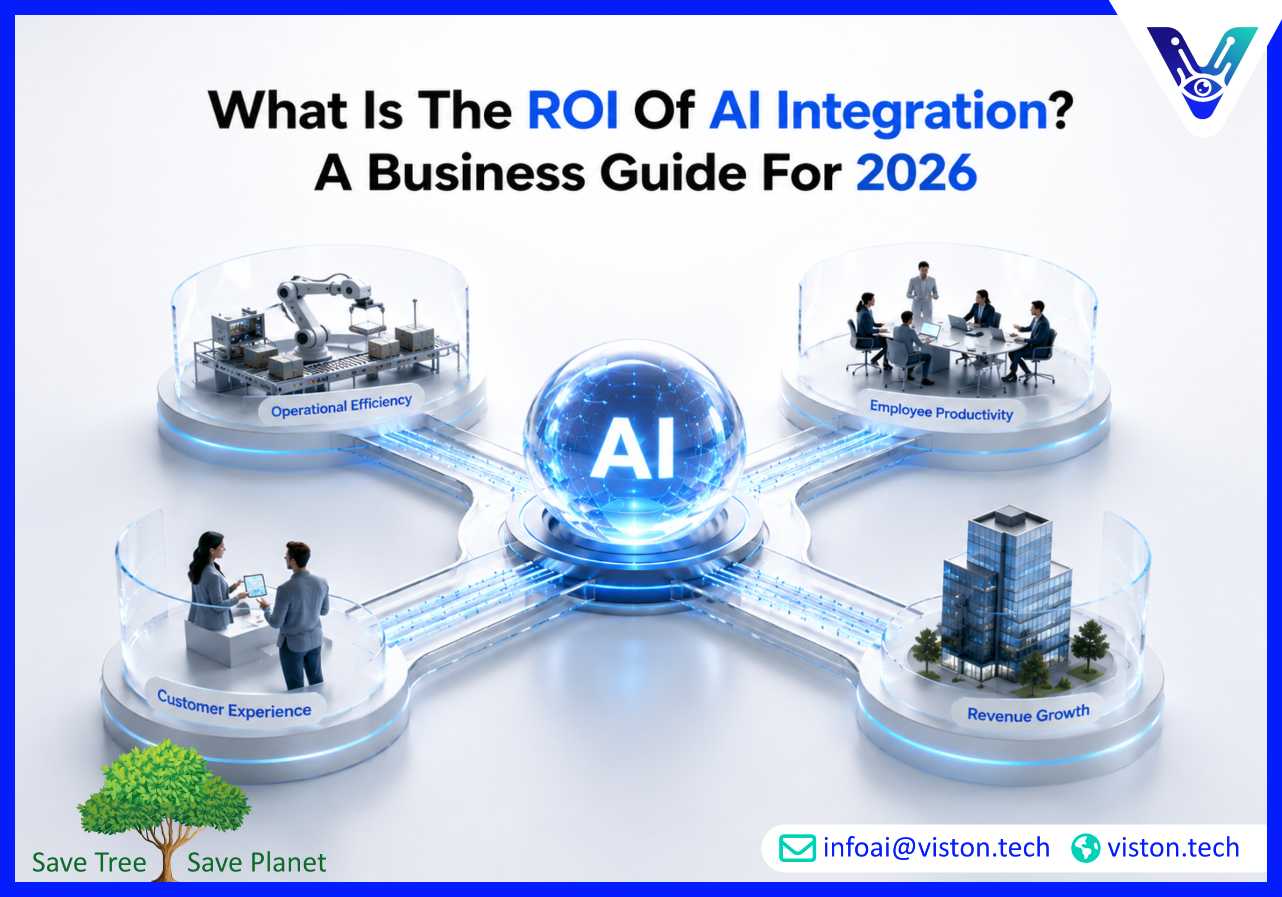
As AI adoption accelerates across industries, business leaders are asking a critical question: what is the ROI of AI integration? While artificial intelligence offers significant opportunities for automation, efficiency, and growth, the true value comes from successfully integrating AI into existing business processes, systems, and workflows.
ROI, or Return on Investment, measures the value a business receives compared to the cost of implementation. In the context of AI integration, ROI goes beyond simple cost savings. It includes productivity improvements, faster decision-making, increased revenue opportunities, improved customer experiences, and operational scalability.
AI integration involves connecting AI agents, automation systems, business applications, databases, CRMs, customer service platforms, and workflows into a coordinated operating environment. When properly implemented, businesses can achieve measurable improvements across multiple departments.
Unlike standalone AI tools, integrated AI solutions generate value by becoming part of everyday operations rather than remaining isolated experiments.
One of the fastest sources of ROI comes from reducing repetitive manual work. AI agents can automate tasks such as data entry, document processing, customer inquiries, lead qualification, scheduling, reporting, and workflow coordination.
This allows employees to focus on higher-value activities while reducing processing times and operational bottlenecks.
AI integration helps teams access information faster, automate administrative work, and streamline collaboration across systems. Employees spend less time searching for data, transferring information between applications, or performing repetitive tasks.
Even modest productivity gains across large teams can produce substantial financial returns over time.
Integrated AI systems can improve response times, personalize customer interactions, automate support processes, and provide consistent service across channels.
Better customer experiences often lead to higher retention rates, increased customer lifetime value, and stronger brand loyalty.
AI can analyze large volumes of business data and provide actionable insights in real time. Decision-makers gain faster access to information that supports forecasting, risk management, resource allocation, and strategic planning.
Organizations that make faster, data-driven decisions often gain competitive advantages in rapidly changing markets.
AI integration can support sales teams through lead scoring, customer intelligence, automated follow-ups, personalized recommendations, and pipeline optimization.
By helping businesses identify opportunities more efficiently, AI can contribute directly to revenue generation.
Not every AI initiative delivers the same return. Several factors influence whether an integration project generates strong business value.
The highest ROI typically comes from automating high-volume, repetitive, and business-critical workflows. Companies that start with clearly defined use cases often achieve faster results than those pursuing broad, undefined AI projects.
AI must connect effectively with existing business systems to create value. Poor integrations can lead to data silos, workflow disruptions, and limited adoption.
Successful projects focus on seamless connections between AI agents and business platforms such as CRM systems, ERP solutions, customer support software, analytics tools, and internal databases.
AI systems depend on reliable data. Organizations with well-structured, accessible, and accurate information typically achieve better results than businesses struggling with fragmented or inconsistent data sources.
Technology alone does not generate ROI. Employees must understand how to use AI effectively within their workflows. Training, governance, and adoption planning play significant roles in long-term success.
Organizations evaluating AI integration often measure success using a combination of financial and operational metrics.
The most successful organizations establish clear baseline measurements before implementation, allowing them to accurately assess performance improvements after deployment.
Many businesses initially experiment with standalone AI applications. While these tools can provide value, their impact is often limited because they operate separately from core business processes.
AI integration services focus on embedding AI directly into workflows where business outcomes are created. Instead of requiring employees to switch between systems, integrated AI becomes part of daily operations.
This creates stronger adoption, more consistent usage, and greater opportunities for measurable business impact.
In 2026, organizations increasingly recognize that integration—not simply AI access—is what determines long-term ROI.
For organizations exploring AI integration, achieving a strong return on investment requires more than implementing AI tools. It requires a strategic approach to workflow design, system connectivity, automation planning, governance, and scalability.
Viston AI provides Agent Integration Services that help businesses connect AI agents with existing systems, workflows, and operational processes. This enables organizations to move beyond isolated automation projects and create coordinated AI-driven workflows that support measurable business objectives.
By focusing on integration architecture, workflow orchestration, business process optimization, and practical implementation, Viston AI helps organizations identify high-value opportunities where AI can generate meaningful operational improvements. Whether the goal is automation, productivity enhancement, customer service optimization, or workflow transformation, effective integration is often the foundation of sustainable ROI.
A good ROI depends on the business objective, implementation scope, and industry. Many organizations focus on measurable improvements in productivity, operational efficiency, customer satisfaction, and revenue generation rather than a single financial benchmark.
Some workflow automation projects produce measurable results within weeks, while larger enterprise initiatives may take several months. The timeline depends on complexity, adoption, and integration requirements.
Customer support, sales operations, document processing, data management, workflow automation, and employee productivity initiatives often produce strong returns because they involve repetitive and high-volume activities.
Common reasons include poor workflow selection, lack of integration, inadequate data quality, weak governance, unrealistic expectations, and limited employee adoption.
Yes. Small and medium-sized businesses can often realize significant benefits by automating repetitive tasks, improving customer service, and streamlining operations without requiring large-scale enterprise deployments.
Viston AI’s Agent Integration Services help businesses design, integrate, and deploy AI-powered workflows that connect systems, automate processes, and support measurable business outcomes.
The ROI of AI integration is driven by how effectively artificial intelligence becomes part of everyday business operations. Organizations that focus on workflow automation, system connectivity, productivity improvements, and operational efficiency often achieve the strongest results. Rather than viewing AI as a standalone technology investment, businesses should approach it as an integrated capability that supports measurable outcomes across departments. Through specialized Agent Integration Services, Viston AI helps organizations build AI-powered workflows that deliver practical business value, scalability, and long-term return on investment.
