
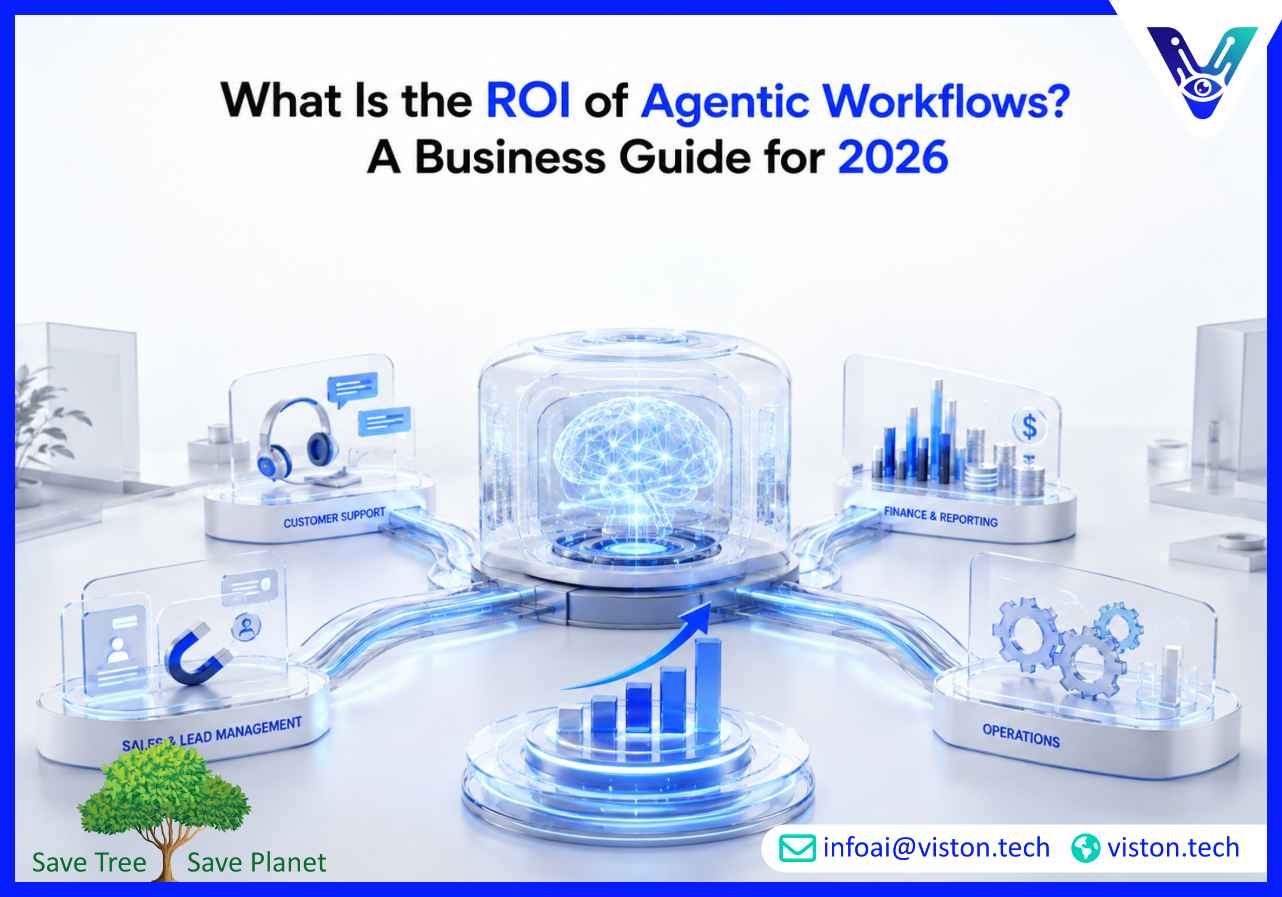
As businesses face increasing pressure to improve productivity, reduce operational costs, and scale efficiently, agentic AI workflows are emerging as a practical solution. Unlike traditional automation systems that follow predefined rules, agentic workflows can analyze information, make decisions, coordinate tasks, and adapt to changing conditions. Understanding the return on investment (ROI) of agentic workflows is becoming a critical priority for organizations evaluating AI-driven transformation initiatives in 2026.
Agentic AI workflows are intelligent process frameworks powered by AI agents capable of executing multi-step tasks with varying levels of autonomy. These systems combine reasoning, planning, memory, tool usage, and workflow orchestration to complete business objectives with minimal human intervention.
Traditional automation focuses on repetitive actions. Agentic workflows focus on outcomes. They can interpret goals, gather data, make decisions, coordinate across systems, and continuously optimize processes.
Common business applications include:
The value of agentic workflows comes from their ability to reduce manual effort while improving speed, consistency, and decision quality.
ROI is not limited to direct cost savings. Modern organizations evaluate agentic workflow investments using a combination of financial, operational, and strategic performance indicators.
One of the most immediate benefits comes from reducing time spent on repetitive and administrative tasks. Employees can focus on higher-value activities while AI agents handle routine operations.
Examples include:
Organizations often recover hundreds or thousands of employee hours annually through workflow automation.
Agentic systems operate continuously without fatigue, enabling faster task completion and increased throughput.
Productivity gains often include:
Manual processes introduce costly mistakes. Agentic workflows help standardize execution and reduce inconsistencies.
Reduced errors can lead to:
ROI is also driven by revenue expansion. Agentic workflows can improve customer engagement, increase lead conversion rates, and identify new business opportunities.
Revenue-related benefits may include:
While ROI varies by organization, certain operational areas consistently generate strong returns from agentic workflow implementations.
Sales teams spend significant time on administrative activities. Agentic workflows can automate lead qualification, CRM updates, prospect research, and follow-up communications.
Benefits include:
AI agents can resolve routine inquiries, gather information, escalate complex issues, and support customers around the clock.
Expected ROI drivers include:
Financial departments frequently handle repetitive workflows involving data collection, validation, reconciliation, and reporting.
Agentic workflows can:
HR teams can benefit from automated onboarding, candidate screening, employee support, and document management.
Results often include:
Not every implementation delivers identical results. Several factors determine whether organizations achieve strong returns from their investment.
High-volume, repetitive, and decision-intensive processes generally provide the strongest ROI opportunities.
Organizations should prioritize workflows that:
AI agents depend on accurate and accessible data. Poor data quality can reduce effectiveness and limit ROI.
Successful organizations invest in:
ROI increases when workflows connect seamlessly with existing business systems.
Common integrations include:
Technology alone does not guarantee results. Employees must understand how to collaborate effectively with AI systems.
Organizations that invest in training and adoption programs typically realize greater long-term returns.
Businesses evaluating AI investments often use a structured ROI framework.
Measure existing expenses associated with the workflow, including:
Determine potential reductions in:
Assess opportunities for:
Implementation costs may include:
Organizations can then compare projected benefits against total investment costs to estimate ROI.
The AI landscape has matured significantly. Businesses are no longer experimenting solely for innovation purposes. They expect measurable operational and financial outcomes.
Several trends are driving higher ROI expectations:
Organizations now expect AI initiatives to demonstrate clear business value within defined timelines.
For organizations exploring the ROI potential of agentic workflows, implementation quality plays a significant role in determining outcomes. Viston AI specializes in Agentic AI Workflows designed to help businesses automate complex operational processes while maintaining scalability, reliability, and governance.
Rather than focusing solely on automation, Viston AI develops workflow ecosystems where intelligent agents can collaborate across systems, analyze information, execute tasks, and support business objectives. This approach allows organizations to move beyond simple task automation toward outcome-driven operational transformation.
Businesses often face challenges such as disconnected systems, manual bottlenecks, inconsistent processes, and growing operational costs. Through customized workflow design, system integration, AI orchestration, and process optimization, Viston AI helps organizations address these challenges in a structured and measurable way.
Its capabilities are particularly relevant for companies seeking to improve productivity, streamline internal operations, enhance customer experiences, and scale without proportionally increasing headcount. As organizations continue investing in AI-driven transformation initiatives throughout 2026, specialized implementation expertise becomes increasingly important for achieving sustainable ROI.
Many organizations fail to achieve expected results because of avoidable implementation mistakes.
AI cannot fix fundamentally broken workflows. Process optimization should occur before automation.
Without oversight, organizations may face compliance, security, or quality challenges.
Successful projects define measurable business goals before implementation begins.
Disconnected systems can create workflow inefficiencies and limit performance gains.
The most successful implementations combine AI capabilities with human expertise and oversight.
ROI varies depending on the process being automated, implementation quality, and business objectives. Organizations often realize benefits through cost savings, productivity improvements, error reduction, and revenue growth.
Many organizations begin seeing measurable operational improvements within months, particularly when automating high-volume workflows with clear performance metrics.
Yes. Modern AI platforms make agentic workflows accessible to businesses of various sizes. Smaller organizations can often achieve significant efficiency gains by automating resource-intensive processes.
Sales, customer support, finance, operations, HR, marketing, and IT departments frequently achieve strong ROI due to their reliance on repetitive and data-intensive workflows.
Viston AI provides Agentic AI Workflow solutions focused on workflow design, system integration, intelligent automation, AI orchestration, and operational optimization to help organizations achieve measurable business outcomes.
Process selection is often the most important factor. Organizations achieve the strongest returns when they target workflows that consume significant time, involve multiple systems, and directly impact business performance.
Understanding the ROI of agentic workflows is essential for organizations evaluating AI investments in 2026. While financial savings remain important, the true value often extends beyond cost reduction to include productivity gains, operational agility, improved customer experiences, and scalable business growth. When implemented strategically, Agentic AI Workflows can transform how organizations operate and compete. Businesses seeking to maximize these outcomes can benefit from experienced implementation partners such as Viston AI, whose expertise in intelligent workflow orchestration helps organizations convert AI potential into measurable business results.
