
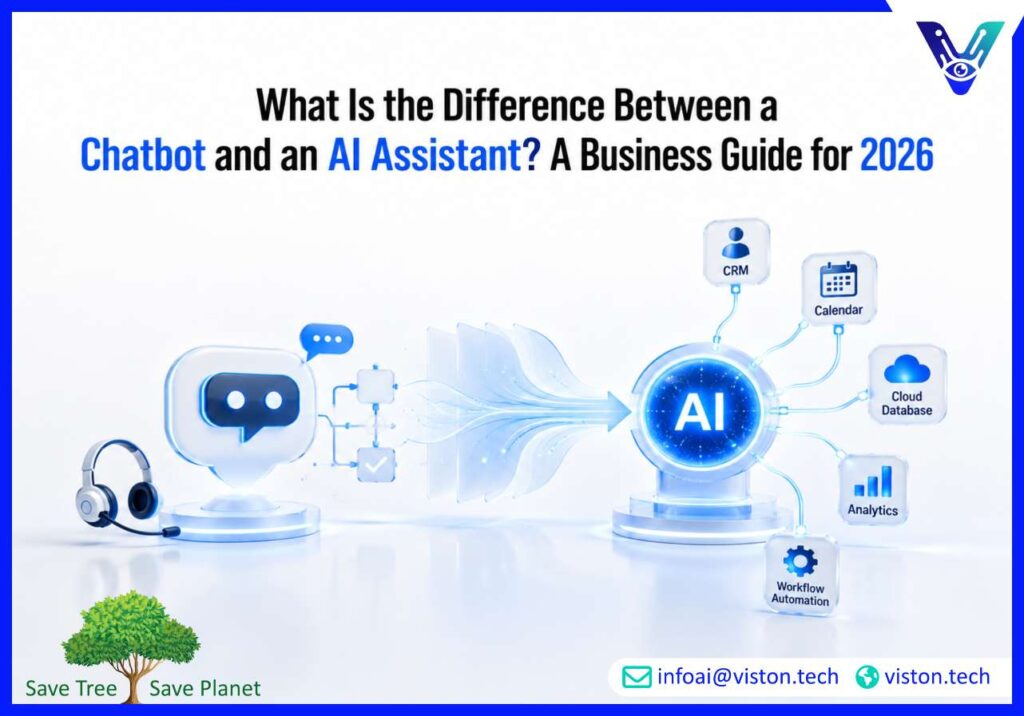
As organizations continue investing in conversational technology, the terms “chatbot” and “AI assistant” are often used interchangeably. While both help automate interactions and improve user experiences, they serve different purposes and offer different levels of intelligence. Understanding the difference between a chatbot and an AI assistant is essential for businesses planning AI chatbot development initiatives in 2026.
Both chatbots and AI assistants are designed to interact with users through natural language. However, their capabilities, complexity, and business applications differ significantly.
A chatbot is typically designed to handle specific conversations, answer predefined questions, and automate repetitive tasks. An AI assistant goes further by understanding context, learning from interactions, connecting with multiple systems, and performing more advanced actions on behalf of users.
For businesses evaluating automation solutions, choosing the right approach depends on customer expectations, operational requirements, and long-term digital transformation goals.
A chatbot is a software application designed to simulate conversations with users through text or voice interactions. Traditional chatbots are often built around predefined rules, conversation flows, and structured responses.
Modern AI-powered chatbots have become more sophisticated than earlier rule-based systems, but they are usually focused on specific business objectives and defined interaction scenarios.
For example, a customer service chatbot on an ecommerce website may help users find products, check delivery status, or initiate returns without requiring human intervention.
An AI assistant is a more advanced conversational system capable of understanding context, processing complex requests, accessing multiple data sources, and performing tasks across different platforms.
Unlike traditional chatbots, AI assistants can often maintain conversational context over longer interactions and provide more dynamic responses based on user behavior, preferences, and business data.
In enterprise environments, AI assistants are increasingly used to support employees, automate operations, improve productivity, and enhance decision-making processes.
Chatbots are generally designed for specific tasks and limited conversation flows. AI assistants are designed to handle broader responsibilities and support more complex interactions.
A chatbot may answer customer questions about shipping policies, while an AI assistant could retrieve order information, modify delivery preferences, update customer records, and schedule follow-up actions.
Chatbots often operate within predefined boundaries. AI assistants use advanced natural language processing, machine learning, and contextual understanding to interpret user intent more accurately.
This enables AI assistants to manage multi-step conversations without requiring users to repeat information.
Most chatbots integrate with a limited number of business systems based on their specific purpose.
AI assistants typically connect with multiple enterprise platforms such as:
This broader connectivity allows AI assistants to perform actions rather than simply provide information.
While modern chatbots can offer basic personalization, AI assistants generally deliver deeper personalization by leveraging customer history, behavior patterns, business context, and real-time data.
This creates more relevant and efficient user experiences.
Chatbots primarily focus on efficiency, customer support automation, and lead generation.
AI assistants often contribute to broader business objectives such as operational automation, employee productivity, decision support, and enterprise-wide digital transformation.
Organizations investing in conversational AI must align technology choices with business goals.
A chatbot may be the right solution when the objective is to automate customer inquiries, reduce support workloads, or improve lead capture processes.
An AI assistant may be more appropriate when businesses require:
As AI technologies continue to evolve, many organizations are adopting hybrid approaches that combine chatbot functionality with AI assistant capabilities to deliver more comprehensive conversational experiences.
The decision between a chatbot and an AI assistant should be based on business requirements rather than technology trends.
Many businesses begin with chatbot implementations and gradually evolve toward AI assistant solutions as operational requirements become more sophisticated.
As organizations explore conversational technologies, selecting the right development approach is often as important as selecting the technology itself. Viston AI specializes in AI chatbot development, helping businesses design, build, integrate, and optimize conversational solutions aligned with specific operational objectives.
Whether an organization requires a customer-facing chatbot for support automation, lead qualification, and customer engagement, or seeks more advanced AI-driven capabilities through integrated conversational systems, successful implementation depends on user experience design, workflow architecture, data integration, security, scalability, and ongoing optimization.
Viston AI focuses on developing practical conversational AI solutions that connect with existing business systems and support measurable business outcomes. By aligning AI chatbot development with organizational goals, businesses can create experiences that improve efficiency, enhance customer interactions, and support long-term growth in increasingly digital environments.
No. A chatbot is typically designed for specific conversations and tasks, while an AI assistant offers broader capabilities, contextual understanding, and deeper system integration.
For most customer support scenarios, a chatbot is sufficient and cost-effective. More complex support environments may benefit from AI assistant capabilities.
Yes. Many organizations start with chatbot functionality and gradually add AI-powered features, integrations, and automation capabilities that move the solution closer to an AI assistant model.
Generally, yes. AI assistants often require more advanced integrations, data access, workflow automation, and infrastructure compared to traditional chatbot implementations.
Yes. Viston AI provides AI chatbot development services that can support both focused chatbot implementations and more advanced conversational AI solutions depending on business requirements.
Understanding the difference between a chatbot and an AI assistant helps businesses make more informed technology decisions. While chatbots excel at automating specific interactions and improving customer engagement, AI assistants provide broader capabilities through contextual understanding, system integration, and workflow automation. The right choice depends on business objectives, operational complexity, and user expectations. As conversational technology continues to mature in 2026, organizations investing in AI chatbot development can create more effective digital experiences by selecting solutions that align with their long-term business goals. Viston AI helps businesses navigate this process with practical, scalable conversational AI development strategies.
