
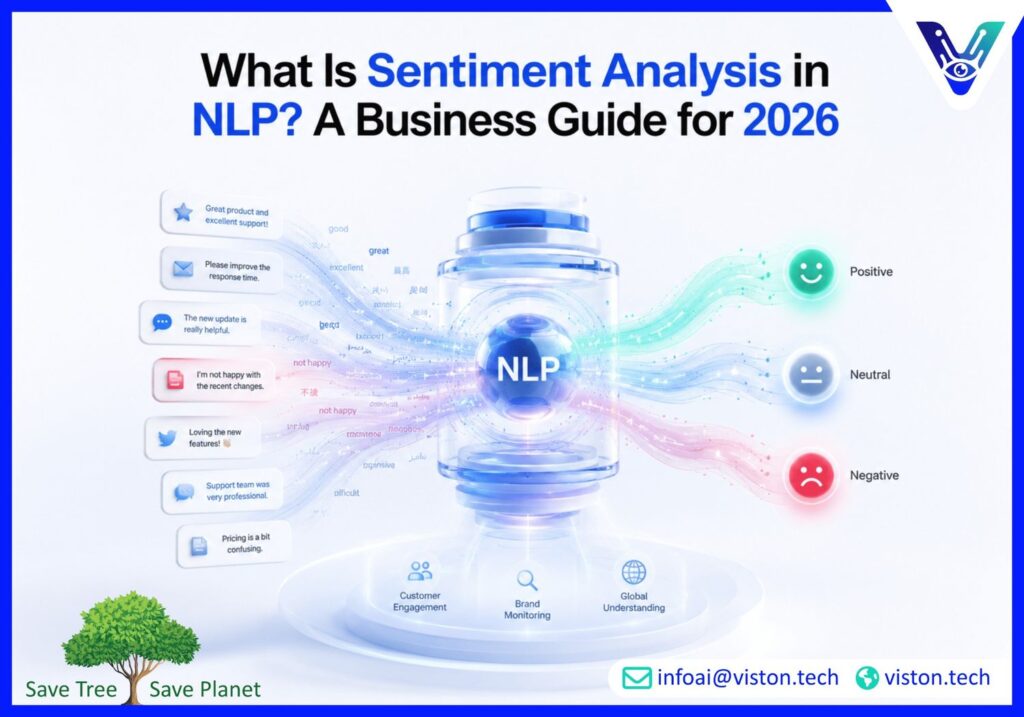
Customer opinions are generated every day through reviews, surveys, social media posts, support tickets, emails, and online discussions. For businesses, understanding this feedback at scale is increasingly important. Sentiment analysis in NLP helps organizations automatically identify emotions, opinions, and attitudes within text data, enabling faster and more informed business decisions.
Sentiment analysis is a Natural Language Processing (NLP) technique used to determine the emotional tone or opinion expressed in written text. It helps systems analyze whether content conveys positive, negative, or neutral sentiment.
Using machine learning, linguistic rules, and AI-powered language models, sentiment analysis can process large volumes of text far more efficiently than manual review.
Businesses commonly apply sentiment analysis to understand customer perceptions, evaluate brand reputation, and identify emerging trends across multiple communication channels.
A sentiment analysis system typically follows several steps:
Modern NLP solutions can go beyond simple positive or negative classifications by detecting emotions such as satisfaction, frustration, excitement, concern, or disappointment.
As organizations collect increasing amounts of customer feedback, manually reviewing every interaction becomes impractical. Sentiment analysis helps businesses transform unstructured text into actionable insights.
Organizations can quickly identify recurring issues, customer preferences, and service gaps without manually reading thousands of comments or messages.
By understanding customer sentiment in real time, support teams can prioritize urgent cases and respond more effectively to customer concerns.
Businesses can track public perception across social media, reviews, forums, and digital platforms to identify reputation risks before they escalate.
Sentiment trends often reveal valuable information about products, services, pricing strategies, and customer expectations.
Sentiment analysis has become one of the most widely adopted Natural Language Processing solutions across industries.
Businesses can analyze survey responses, reviews, and feedback forms to understand overall customer satisfaction and identify improvement opportunities.
Marketing teams use sentiment analysis to track brand mentions, campaign performance, and customer reactions across social platforms.
NLP systems can automatically detect frustrated customers and route conversations to appropriate support agents for faster resolution.
Organizations can analyze reviews and customer comments to identify strengths, weaknesses, and areas for product improvement.
Companies use sentiment analysis to understand customer opinions about competitors, industry trends, and changing consumer preferences.
While sentiment analysis technology has advanced significantly, businesses should be aware of certain limitations.
Modern AI-powered NLP solutions address many of these challenges through advanced language models, domain-specific training, and continuous optimization.
Sentiment analysis delivers the greatest value when integrated into broader Natural Language Processing solutions. Organizations often combine sentiment analysis with conversational AI, text classification, entity recognition, semantic search, and intelligent document processing to create comprehensive language intelligence platforms.
Effective NLP solutions help businesses collect data from multiple sources, process large volumes of text, identify sentiment patterns, generate actionable insights, and integrate findings with existing business systems. This enables decision-makers to move beyond simple feedback collection and create measurable improvements in customer engagement, service quality, and operational performance.
As AI technologies continue to evolve in 2026, businesses increasingly seek NLP solutions that provide scalability, accuracy, security, and seamless integration with existing workflows. Sentiment analysis remains one of the most valuable applications for organizations looking to better understand customers and make data-driven decisions.
Sentiment analysis is a Natural Language Processing technique that identifies and classifies emotions, opinions, and attitudes expressed in text as positive, negative, or neutral.
Businesses commonly analyze customer reviews, surveys, social media posts, emails, support tickets, chat conversations, and online comments.
Accuracy depends on data quality, model training, industry context, and language complexity. Modern AI-powered NLP systems generally provide significantly higher accuracy than traditional rule-based approaches.
Retail, healthcare, finance, technology, education, telecommunications, hospitality, and customer service organizations frequently use sentiment analysis to improve customer experiences and business performance.
Yes. Many modern Natural Language Processing solutions support multilingual sentiment analysis, allowing businesses to analyze customer feedback across global markets.
Sentiment analysis in NLP enables businesses to understand customer opinions, emotions, and experiences at scale. As organizations continue generating large volumes of unstructured data, manually analyzing feedback becomes increasingly difficult. Natural Language Processing solutions provide an efficient way to transform text into actionable insights, helping businesses improve customer experiences, monitor brand reputation, and make more informed decisions. In 2026, sentiment analysis remains one of the most practical and valuable applications of NLP for organizations seeking data-driven growth and stronger customer relationships.
