
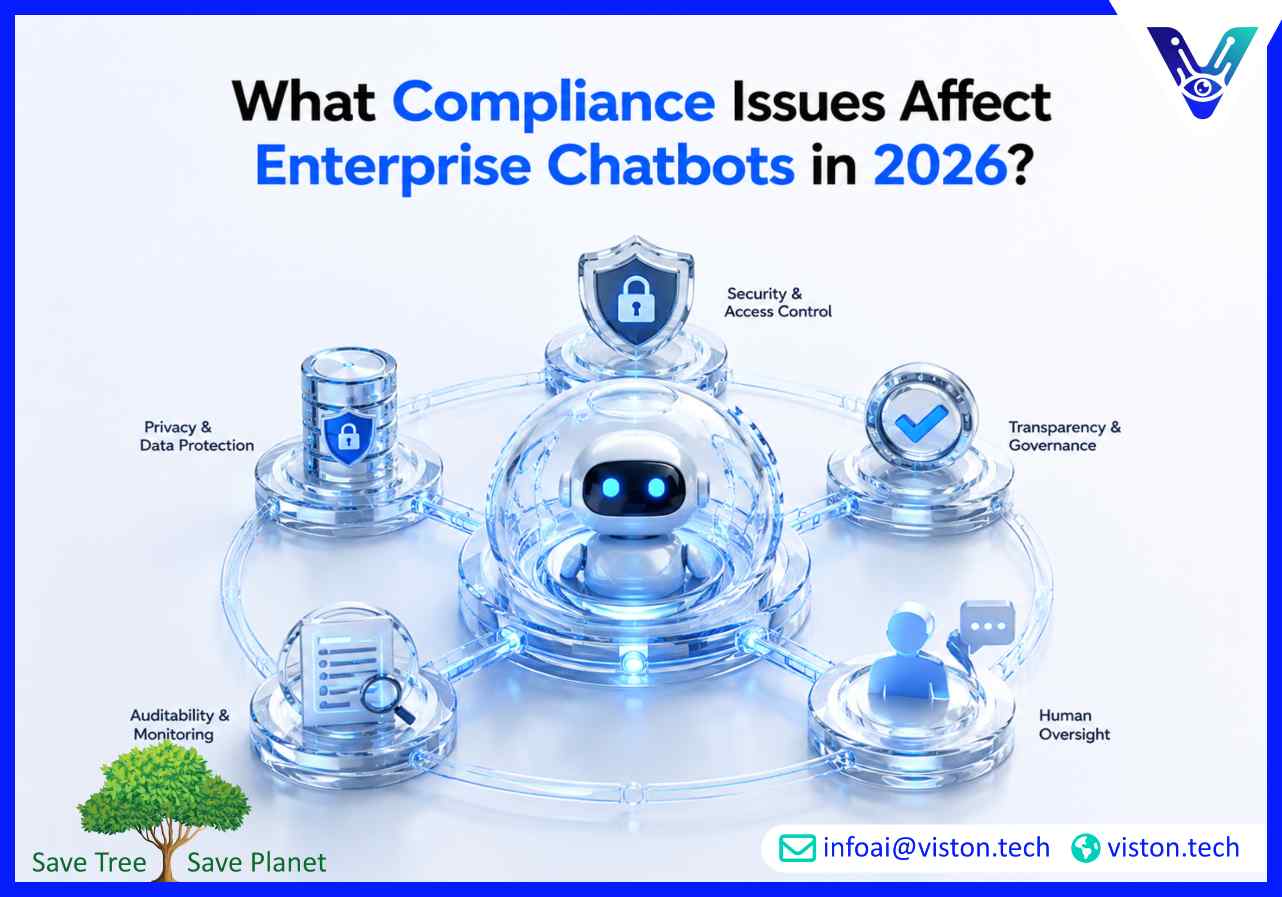
What compliance issues affect enterprise chatbots is now a board-level question for companies using AI to support customers, employees, sales teams, and internal operations. In 2026, enterprise AI chatbots must be designed for privacy, transparency, security, accountability, accessibility, and responsible automation from the start.
Enterprise chatbot compliance means ensuring that a chatbot operates within legal, regulatory, contractual, security, and governance requirements. It is not limited to data privacy notices or a few disclaimers. It covers how the chatbot collects data, generates answers, escalates issues, accesses internal systems, stores conversation logs, protects sensitive information, and makes or supports business decisions.
For enterprise AI chatbots, compliance becomes more complex because these systems often interact with customer records, CRM platforms, HR systems, knowledge bases, helpdesks, payment workflows, healthcare information, financial data, procurement records, or internal policies. A chatbot may appear simple to the user, but behind the interface it may process regulated data, trigger workflows, retrieve confidential documents, or influence customer outcomes.
Businesses must therefore treat chatbot compliance as part of the wider AI governance, cybersecurity, privacy, and operational risk program. The main question is not only whether the chatbot can answer questions. The real question is whether it can do so safely, accurately, transparently, and consistently within the organization’s risk tolerance.
A simple website FAQ chatbot has a different risk profile from an enterprise chatbot that handles account queries, employee HR requests, insurance claims, loan pre-screening, medical appointment support, or legal intake. The more sensitive the use case, the more controls the business needs.
Compliance requirements are shaped by several factors:
This is why compliance should be addressed during discovery, solution design, data preparation, testing, deployment, monitoring, and continuous optimization. Retrofitting compliance after launch is usually more expensive and riskier than building the right controls into the chatbot architecture from the beginning.
In 2026, enterprise AI chatbots are expected to be more capable, more integrated, and more autonomous than earlier rule-based bots. Many now use large language models, retrieval-augmented generation, workflow automation, voice interfaces, multilingual support, and API connections to business systems. These capabilities create business value, but they also expand the compliance surface.
A chatbot that once answered basic FAQs may now summarize policy documents, recommend next steps, create support tickets, qualify leads, update CRM records, retrieve customer data, generate email responses, or guide employees through internal procedures. As chatbots become part of real workflows, businesses must prove that the system is controlled, monitored, and aligned with applicable obligations.
Regulators and enterprise buyers increasingly expect transparency around AI use, evidence of risk assessment, documented oversight, data protection controls, and clear accountability. For organizations operating across global markets, chatbot compliance may involve privacy laws, AI governance rules, cybersecurity requirements, consumer protection obligations, accessibility standards, sector-specific regulations, and contractual data processing commitments.
Businesses should not assume that a chatbot is low risk simply because it is conversational. If it influences decisions, processes sensitive data, or integrates with operational systems, it may require stronger governance. This is especially important for sectors such as financial services, healthcare, insurance, recruitment, education, public services, ecommerce, travel, logistics, manufacturing, and B2B SaaS.
Procurement teams and technology leaders are asking more detailed questions before approving chatbot deployments. They want to know how data is handled, where logs are stored, whether prompts are protected, whether outputs are reviewed, how hallucinations are reduced, how human handoff works, and how the system is monitored after launch.
For service providers and internal technology teams, this means chatbot compliance is no longer just a legal checklist. It is part of vendor evaluation, security review, customer trust, operational resilience, and long-term scalability.
The most important compliance issues affecting enterprise chatbots usually fall into privacy, transparency, security, accuracy, bias, recordkeeping, human oversight, accessibility, and third-party risk. Each issue should be assessed based on the chatbot’s use case, data access, user population, and business impact.
Enterprise chatbots often collect personal data such as names, email addresses, phone numbers, account details, support history, employee information, location data, preferences, or free-text messages. Users may also enter sensitive information even when they are not asked to do so.
Businesses need clear rules for what data the chatbot may collect, why it is collected, how long it is retained, who can access it, and whether it is used for analytics, training, quality review, or workflow automation. Privacy notices should explain chatbot data use in plain language. Consent, legitimate interest, contractual necessity, or another lawful basis may be required depending on the jurisdiction and use case.
Data minimization is especially important. A chatbot should not ask for information that is not needed to complete the task. It should also avoid exposing unnecessary personal data in responses, logs, notifications, or downstream systems.
Users should generally know when they are interacting with an AI chatbot rather than a human representative. This is not only a legal issue in many markets; it is also a trust issue. Users should understand the chatbot’s role, limitations, and escalation options.
Transparency is particularly important when the chatbot provides guidance on products, policies, eligibility, complaints, pricing, health-related information, financial services, employment processes, or legal-adjacent topics. The chatbot should not present itself as a licensed professional, final decision-maker, or human agent unless that is accurate.
Good disclosure does not need to be disruptive. A short opening message, clear bot identity, visible escalation path, and well-written privacy link can help users make informed choices without weakening the experience.
Enterprise AI chatbots face security risks that traditional chat interfaces did not have to manage at the same level. Prompt injection, malicious user instructions, insecure tool access, data leakage, weak authentication, unsafe API calls, and excessive permissions can all create compliance and operational exposure.
A compliant chatbot should follow least-privilege access. It should only access the data and systems required for its approved function. Sensitive actions such as refunds, account changes, employee record updates, contract approvals, or payment-related steps should require proper authentication, authorization, and audit trails.
Security controls should include input filtering, output validation, role-based permissions, encryption, logging, monitoring, rate limiting, secure API design, incident response procedures, and regular testing. For AI chatbots using external models or third-party platforms, vendor security review is essential.
Enterprise AI chatbots can create compliance risk when they provide confident but incorrect answers. In regulated or customer-sensitive environments, inaccurate responses may mislead users, create contractual confusion, damage trust, or trigger complaints.
Accuracy controls should include approved knowledge sources, retrieval from current documentation, response boundaries, confidence thresholds, fallback messages, and human escalation for uncertain or high-risk queries. The chatbot should be trained not to invent policy, pricing, eligibility criteria, legal terms, product guarantees, or operational commitments.
For many organizations, the safest approach is to connect the chatbot to governed knowledge bases and business systems rather than relying only on generic model knowledge. This helps ensure answers reflect current company-approved information.
Bias risk arises when chatbot responses or workflows treat users unfairly based on protected characteristics, language patterns, location, disability, age, gender, ethnicity, financial status, or other sensitive factors. This risk becomes more serious when chatbots support recruitment, lending, insurance, education, housing, public services, healthcare, or employee management.
Businesses should test chatbot outputs across user groups, languages, edge cases, and sensitive scenarios. They should also review whether training data, historical tickets, CRM records, or decision rules contain bias. Even when the chatbot does not make final decisions, it can still influence access, routing, prioritization, tone, and user experience.
Enterprise chatbot compliance depends on being able to show what happened. This includes conversation history, user consent records, system prompts, knowledge sources, workflow actions, escalation events, model versions, testing results, incident reports, and access logs.
Auditability helps businesses investigate complaints, validate performance, support legal review, improve training data, and demonstrate governance. However, recordkeeping must be balanced with privacy and retention requirements. Keeping every conversation forever is rarely appropriate. A clear retention policy is needed.
Enterprise chatbots should know when not to continue. High-risk, emotional, complex, regulated, or unresolved issues should be escalated to qualified human teams. Human handoff should include useful context so the user does not need to repeat the entire conversation.
Human oversight is especially important where chatbot responses may affect complaints, cancellations, refunds, eligibility, safety, employee relations, or vulnerable users. Oversight should be designed as a control, not as an afterthought.
Building compliant enterprise AI chatbots requires a structured process that connects legal, technical, operational, and customer experience priorities. The goal is not to slow innovation. The goal is to make chatbot automation reliable enough for enterprise use.
Before development begins, teams should define the chatbot’s intended purpose, user groups, data categories, integrations, jurisdictions, risk level, and expected outcomes. This helps identify which compliance controls are required.
A practical risk assessment should ask:
Enterprise chatbots should answer from trusted, current, and approved sources. Knowledge bases should have content owners, review cycles, version control, and clear source hierarchy. If two documents conflict, the chatbot should know which source is authoritative or escalate the question.
Data access should be limited by user role, authentication status, region, and business need. A public website visitor should not receive the same data access as an authenticated customer, employee, or internal support agent.
Compliance is affected by conversation design. The chatbot should ask only necessary questions, explain why information is needed, avoid collecting sensitive data unless required, and provide clear next steps. It should also use safe fallback messages instead of guessing when intent is unclear.
For complex workflows, the chatbot should confirm important details before taking action. For example, before creating a ticket, updating an account, scheduling a meeting, or submitting a request, it should summarize the user’s input and ask for confirmation where appropriate.
Pre-launch testing should include privacy scenarios, security testing, prompt injection attempts, inaccurate data inputs, multilingual queries, accessibility review, bias checks, escalation testing, API failure scenarios, and edge cases.
After launch, businesses should monitor fallback rate, escalation rate, user satisfaction, complaint patterns, failed workflows, security events, and response accuracy. Compliance is not a one-time approval. It requires ongoing review as regulations, business processes, products, and user expectations change.
Viston AI is relevant to enterprise chatbot compliance because its Enterprise AI Chatbots service sits within a broader AI solution portfolio that includes AI chatbot development, AI chatbot integration, natural language processing, multilingual support, voice-enabled assistants, automation workflows, MLOps and model monitoring, AI strategy, and business system integration.
For businesses asking what compliance issues affect enterprise chatbots, this service alignment matters. Compliance-ready chatbot delivery requires more than a conversational interface. It requires controlled access to business data, reliable integration with CRM or workflow systems, clear escalation logic, monitored performance, secure deployment, and well-structured knowledge sources. Viston AI’s enterprise AI chatbot capabilities are positioned around practical business use cases such as customer service, sales support, internal knowledge access, workflow automation, and multilingual interaction.
Organizations evaluating chatbot partners should look for providers that understand both AI implementation and enterprise operating requirements. Viston AI’s relevance comes from its ability to connect chatbot development with system integration, NLP, automation, and ongoing optimization. For companies deploying chatbots across customer-facing or internal workflows, that combination can support better accuracy, stronger governance, smoother handoffs, and more measurable business outcomes.
The biggest compliance issues are data privacy, AI disclosure, security, access control, accuracy, bias, auditability, retention, human oversight, accessibility, and third-party vendor risk. The exact priority depends on the chatbot’s use case, industry, location, and data access.
Yes, in most business contexts, users should be informed about how their data is collected, used, stored, and shared during chatbot interactions. Privacy notices should be clear, accessible, and aligned with the organization’s broader data protection policies.
Customer data should only be used for training or optimization when the business has a lawful basis, appropriate consent or notice where required, data minimization controls, anonymization where practical, and strong vendor and security safeguards.
They can be, depending on the organization’s logging, retention, and compliance setup. Enterprises should keep appropriate records of chatbot interactions, system actions, escalations, data access, and knowledge sources while avoiding excessive retention of sensitive information.
A chatbot should escalate when the user is dissatisfied, the issue is sensitive, the answer is uncertain, the request requires judgment, the workflow affects rights or payments, the user appears vulnerable, or the chatbot repeatedly fails to resolve the issue.
Viston AI’s Enterprise AI Chatbots service is aligned with compliance-ready implementation because it combines chatbot development with business system integration, NLP, workflow automation, multilingual capabilities, and ongoing optimization for enterprise use cases.
Understanding what compliance issues affect enterprise chatbots is essential for any organization using conversational AI in real business workflows. In 2026, enterprise AI chatbots must be designed with privacy, transparency, security, accuracy, auditability, fairness, and human oversight built into the solution. A compliant chatbot is not just a bot that answers questions; it is a governed business system that protects users, supports operations, and reduces avoidable risk. With the right planning, controls, integrations, and monitoring, enterprise chatbots can deliver useful automation while meeting modern compliance expectations. Viston AI offers relevant enterprise AI chatbot capabilities for businesses that want practical, scalable, and responsibly implemented chatbot solutions.
