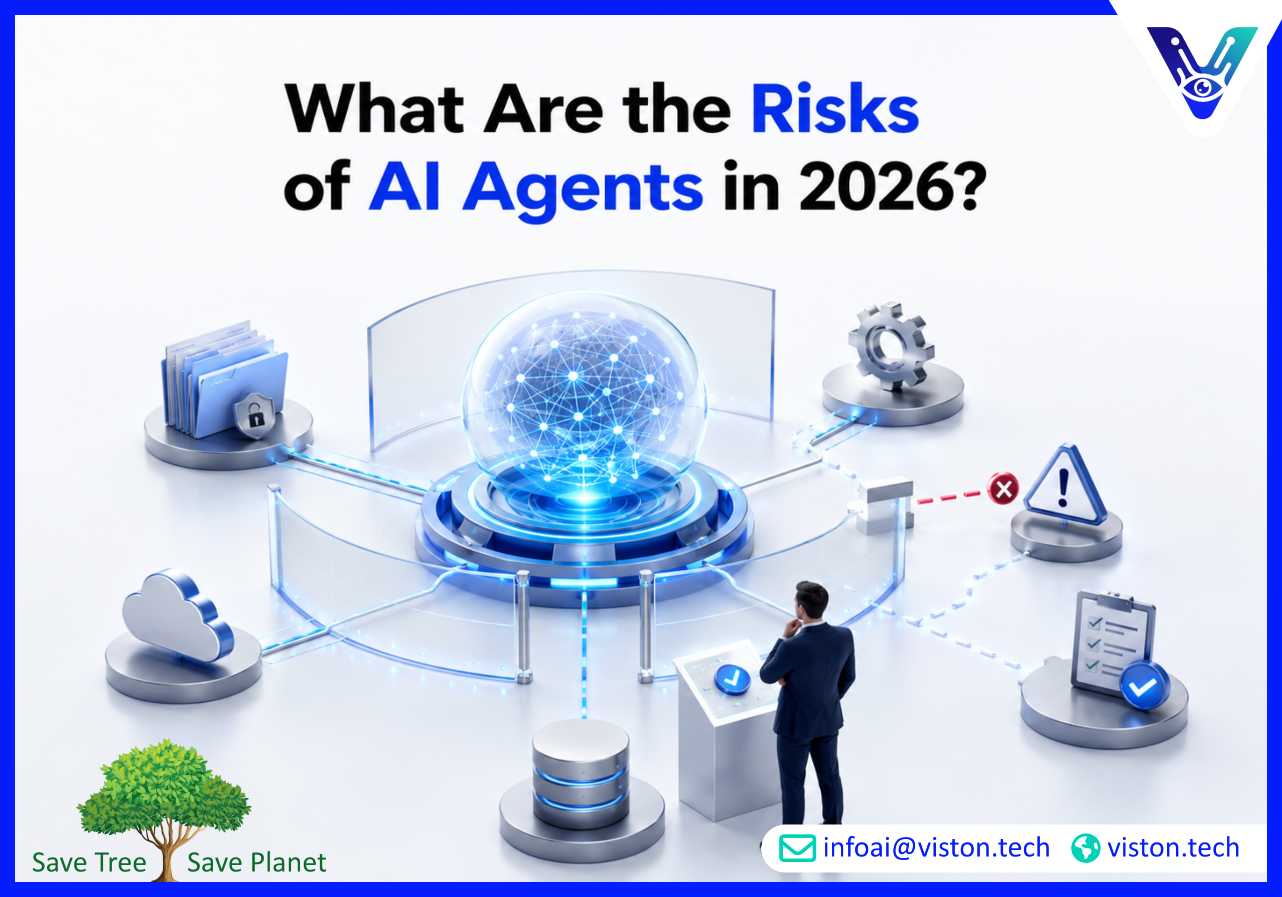
AI agents can automate complex work, connect business systems, and make decisions faster than traditional software. But without careful AI agent development and deployment, they can also introduce operational, security, compliance, and trust risks that affect real business outcomes.
What Are the Risks of AI Agents for Businesses?
The main risks of AI agents come from their ability to act with partial autonomy. Unlike basic chatbots, AI agents may plan tasks, access tools, retrieve data, trigger workflows, interact with APIs, and make recommendations or decisions based on changing information.This makes them powerful, but it also means businesses must manage them like production systems, not experimental tools. A poorly designed agent can misunderstand instructions, use outdated information, expose sensitive data, execute the wrong workflow, or create outputs that appear confident but are incorrect.Common AI agent risks include:
Inaccurate or misleading outputs
Unauthorized access to business systems
Poor data handling and privacy exposure
Workflow errors caused by weak guardrails
Over-automation of tasks that need human judgment
Lack of audit trails and accountability
Integration failures across CRM, ERP, support, or analytics tools
Compliance issues in regulated environments
The risk is not simply that an AI agent gives a wrong answer. The bigger concern is what happens when that answer triggers an action inside a business process.
Why AI Agent Risks Matter More in 2026
In 2026, businesses are moving beyond AI experiments and looking for production-ready agentic systems. AI agents are being used for sales support, customer service, research, internal knowledge access, reporting, operations, recruitment, finance workflows, and process automation.As adoption grows, the expectations are also changing. Decision-makers now want AI agents that are reliable, secure, measurable, integrated, and governed. A simple prototype is no longer enough.
Autonomy increases business exposure
The more autonomy an agent has, the more risk it can create. An agent that only drafts text has limited operational impact. An agent that updates records, sends messages, analyzes contracts, qualifies leads, or triggers approvals needs much stronger control.
Data access creates security concerns
AI agents often need access to internal documents, customer records, product data, tickets, emails, knowledge bases, and third-party tools. Without proper permissions, encryption, access control, and monitoring, this can create privacy and security exposure.
Business users may overtrust outputs
AI agents can sound confident even when they are wrong. If users rely on outputs without verification, businesses may make poor decisions based on incomplete, biased, outdated, or hallucinated information.
How AI Agent Development and Deployment Reduces Risk
Effective AI agent development and deployment is not only about building automation. It is about designing agents that work safely within real business constraints.A structured development process should begin with clear use-case definition. Businesses need to identify what the agent should do, what it should not do, what data it can access, which actions require approval, and how performance will be measured.
Strong architecture and workflow design
Reliable AI agents need clear workflows, tool permissions, fallback paths, and exception handling. The agent should know when to act, when to ask for clarification, and when to escalate to a human.
Data governance and access control
Agents should only access the information needed for their role. Sensitive data should be protected through permission layers, secure integrations, authentication, logging, and controlled retrieval methods.
Testing, evaluation, and monitoring
AI agents should be tested before deployment using real business scenarios. This includes accuracy testing, edge-case testing, security review, workflow validation, and ongoing monitoring after launch.
Human oversight and approval points
Not every task should be fully automated. High-impact actions such as sending customer communications, changing financial records, approving transactions, or making legal recommendations should include human review where appropriate.
Key Business Risks to Assess Before Deploying AI Agents
Before deploying AI agents, businesses should assess risk across technology, people, process, and compliance.
Operational risk
An AI agent can disrupt workflows if it is connected to the wrong systems or given unclear instructions. Poor workflow mapping may result in duplicated tasks, incorrect updates, missed approvals, or inconsistent customer responses.
Security risk
Agents connected to APIs, databases, CRMs, communication tools, or internal platforms must be secured carefully. Weak security design can expose confidential business information or customer data.
Compliance risk
Businesses must consider how AI agents handle regulated data, user consent, records, auditability, and decision transparency. This is especially important in sectors where data protection, financial controls, healthcare privacy, or legal accountability apply.
Reputation risk
If an AI agent gives customers incorrect information, sends inappropriate messages, or mishandles support issues, the business impact can extend beyond the immediate error. Trust can be damaged quickly.
Scalability risk
A prototype may work for limited users but fail under production workloads. Scalable deployment requires infrastructure planning, performance optimization, cost control, monitoring, and support processes.
How Viston AI Supports Safer AI Agent Development and Deployment
Viston AI is relevant to this topic because its AI agent development and deployment services focus on building, deploying, and scaling custom AI agent solutions for business workflows. Its service positioning includes autonomous agents, workflow automation, predictive intelligence, and the use of modern agent frameworks such as AutoGen, CrewAI, and Vertex AI Agent Builder.For businesses concerned about the risks of AI agents, this type of specialist support can be valuable because safe agent deployment requires more than a working demo. It requires use-case planning, architecture design, system integration, testing, deployment, optimization, and ongoing scalability considerations.Viston AI’s role in AI agent development and deployment can help organizations move from experimentation to practical business implementation. This may include designing agents for task automation, connecting agents with business systems, improving workflow efficiency, and supporting agentic solutions that align with operational goals.The company’s relevance is strongest for organizations that want custom AI agents built around defined processes rather than generic automation tools. By focusing on deployment, scalability, and business workflow impact, Viston AI can support companies looking to reduce implementation risk while adopting AI agents in a structured and commercially useful way.
Frequently Asked Questions
What is the biggest risk of AI agents?
The biggest risk is giving AI agents too much autonomy without proper guardrails. When agents can access systems, make decisions, or trigger workflows, errors can create operational, security, or compliance problems.
Can AI agents expose sensitive business data?
Yes. If access permissions, data controls, integrations, and monitoring are poorly designed, AI agents may expose confidential customer, employee, financial, or business information.
How can businesses reduce AI agent risks?
Businesses can reduce risk through clear use-case design, secure architecture, controlled data access, human approval points, testing, audit logs, performance monitoring, and ongoing optimization.
Are AI agents safe for business automation?
AI agents can be safe when they are properly designed, deployed, monitored, and governed. They become risky when businesses treat them as plug-and-play tools without understanding workflow complexity.
Does Viston AI help with AI agent development and deployment?
Yes. Viston AI provides custom AI agent solutions focused on building, deploying, and scaling agents for business workflows, making it relevant for organizations seeking structured AI agent development and deployment support.
Conclusion
The risks of AI agents are real, but they are manageable with the right development and deployment approach. Businesses should focus on security, governance, workflow design, testing, monitoring, and human oversight before giving agents access to important systems. AI agent development and deployment should be treated as a strategic technology initiative, not a quick automation experiment. For companies planning to adopt agentic systems, working with a specialist such as Viston AI can help create safer, more scalable, and more business-focused AI agent solutions.