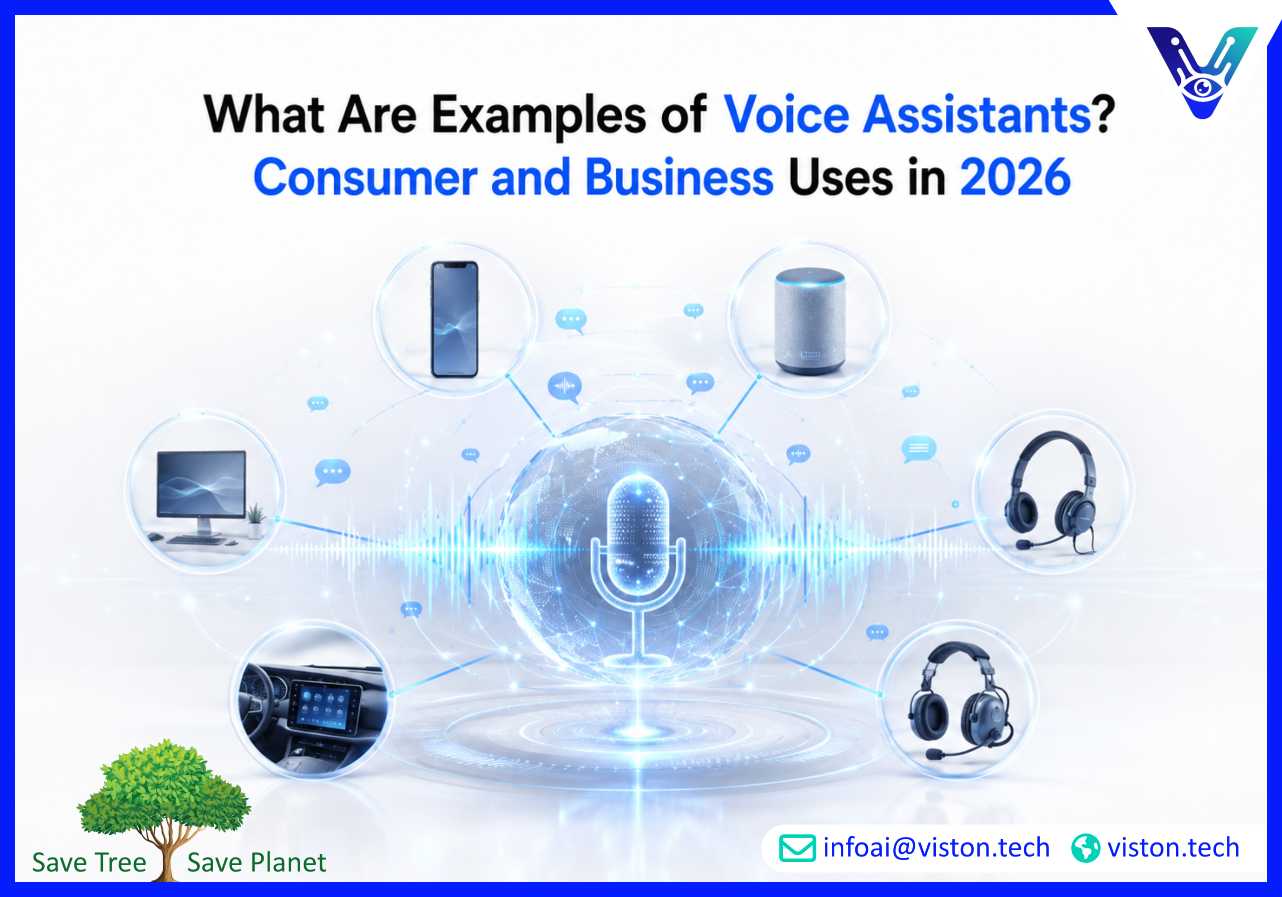
What Are Examples of Voice Assistants? Consumer and Business Uses in 2026
Examples of voice assistants range from Siri, Alexa, Gemini, ChatGPT Voice, Copilot Voice, and Bixby to custom AI agents that answer business calls, schedule appointments, support employees, and complete workflows. Understanding these different categories helps organizations identify where voice-enabled assistants can improve accessibility, service delivery, and operational efficiency.
What Voice Assistants Are and How They Work
A voice assistant is software that receives spoken input, interprets the user’s intention, generates an appropriate response, and may take an action. Some assistants operate mainly on consumer devices, while others are designed for contact centers, business applications, vehicles, healthcare systems, or internal company workflows.Traditional voice assistants were largely command-based. Users followed predictable patterns such as asking for the weather, setting a timer, playing music, or switching on a connected device. Modern voice-enabled assistants can support more natural conversations, remember context within an interaction, ask follow-up questions, retrieve information from approved systems, and complete multi-step tasks.
Core technologies behind a voice assistant
Most voice assistants combine several technologies:
Automatic speech recognition: Converts spoken audio into text or structured language data.
Natural language understanding: Identifies the user’s intent, entities, meaning, and conversational context.
Language models or dialogue systems: Determine the most useful response or next action.
Text-to-speech technology: Converts the response into natural-sounding audio.
Business integrations: Connect the assistant to calendars, CRM platforms, ticketing tools, databases, payment systems, knowledge bases, or other applications.
Conversation analytics: Tracks accuracy, completion rates, escalation patterns, user sentiment, latency, and failed interactions.
A simple voice assistant may only answer predefined questions. A more advanced solution can verify a customer, retrieve an order, book an appointment, create a support case, update a CRM record, or transfer the conversation to a human with the relevant context attached.
Voice assistants, voice bots, and voice agents
These terms are often used interchangeably, but they can describe different levels of capability. A voice assistant usually helps a user through spoken interaction. A voice bot commonly handles a defined conversational process, such as answering support calls. A voice agent may have broader autonomy, including the ability to reason across multiple steps, use connected tools, and complete approved actions.For businesses, the label matters less than the actual operating design. The important questions are what the system can access, what actions it can perform, when it must request confirmation, and when it should transfer control to a human.
Popular Examples of Voice Assistants in 2026
The most recognizable examples of voice assistants are built into smartphones, speakers, computers, televisions, vehicles, and AI applications. Each assistant is designed around a particular ecosystem and set of user needs.
Apple Siri and Siri AI
Siri is Apple’s voice assistant across devices such as the iPhone, iPad, Mac, Apple Watch, AirPods, HomePod, and supported vehicle systems. Users can make calls, send messages, set reminders, request directions, control applications, and manage everyday tasks through spoken instructions.In 2026, Apple introduced a more conversational generation of Siri built around Apple Intelligence. The updated assistant is designed to understand broader context, work across Apple products, use onscreen information, and provide more personalized assistance while maintaining Apple’s privacy-focused approach.
Amazon Alexa and Alexa+
Alexa is Amazon’s cloud-based voice service and is widely associated with Echo speakers, Fire TV devices, smart home equipment, and third-party products. Common uses include playing media, managing household devices, creating lists, checking information, and accessing voice applications.Alexa+ expands the experience toward more conversational and task-oriented assistance. It can support planning, research, household coordination, and interactions that continue across compatible devices and web interfaces. Alexa is also relevant to companies developing voice-enabled products because Amazon provides tools for integrating Alexa capabilities into devices and branded experiences.
Google Gemini and Gemini for Home
Gemini supports spoken conversations on compatible mobile devices and can act as a voice-based AI assistant for research, planning, learning, writing support, and general questions. Gemini Live enables more natural, free-flowing conversations in which users can interrupt, add information, or change direction during the exchange.Google is also extending Gemini into connected-home experiences. Gemini for Home is designed to support smart home control, media discovery, reminders, calendars, household organization, and general information through compatible speakers and displays.
ChatGPT Voice
ChatGPT Voice allows users to speak with ChatGPT and receive spoken responses. It is useful for brainstorming, language practice, step-by-step explanations, interview preparation, accessibility, learning, and hands-free research.Unlike older command-based assistants, a generative voice interface can maintain a longer conversational thread and adapt its answer to follow-up questions. Its suitability for business use still depends on governance, data controls, integrations, and whether the underlying system has access to approved company information.
Microsoft Copilot Voice
Copilot Voice enables users to speak with Microsoft Copilot and hear responses in real time. It is available across supported browsers, computers, tablets, and mobile devices. Typical uses include asking questions, exploring ideas, preparing content, learning a subject, and receiving spoken guidance.Voice capabilities are also appearing in workplace-oriented Microsoft environments. For example, Microsoft 365 Copilot can support voice conversations grounded in information the user is permitted to access. Microsoft also provides tools for configuring voice agents in contact-center environments.
Samsung Bixby
Bixby is Samsung’s virtual assistant for compatible phones, tablets, watches, televisions, appliances, and connected devices. It is particularly useful for device control, application actions, routines, and SmartThings-based home automation.A user might ask Bixby to activate a phone setting, take a screenshot, change a television channel, adjust an air conditioner, or switch off connected lights. Its close integration with Samsung hardware makes it an example of an ecosystem-specific voice assistant.
Specialized voice assistants
Some assistants are designed for a particular profession rather than general consumer use. Microsoft Dragon Copilot, for example, supports healthcare professionals with clinical documentation, information retrieval, and task automation. Automotive voice systems help drivers control navigation, communication, media, and vehicle functions without relying on a touchscreen.These specialized systems demonstrate that the most valuable voice assistant is not always the one with the broadest general knowledge. In a business setting, domain accuracy, workflow access, security, and safe operating boundaries are often more important.
Examples of Voice Assistants Used by Businesses
Business voice assistants are usually developed around a defined customer journey or operational process. They may answer inbound calls, place approved outbound calls, support employees, or provide a voice interface inside a product.
Customer service voice assistants
A customer service assistant can answer common questions, identify why a person is calling, retrieve account information, provide order updates, guide troubleshooting, and create support tickets. It can also recognize when the issue is too complex, sensitive, or urgent for automation and transfer the caller to an appropriate employee.A well-designed handover includes the caller’s verified details, the detected intent, a conversation summary, actions already attempted, and any relevant system records. This prevents the customer from repeating the entire issue.
Appointment and reservation assistants
Healthcare providers, repair businesses, hospitality companies, property firms, and professional service organizations can use voice assistants to book, confirm, reschedule, or cancel appointments. The assistant can check live availability, collect required details, send confirmations, and update the scheduling platform.This type of assistant is especially useful outside normal working hours, when missed calls might otherwise become lost revenue or delayed service.
Sales and lead qualification assistants
A sales voice assistant can respond to initial inquiries, ask qualification questions, record the buyer’s requirements, identify urgency, book a consultation, and create or update a lead in the CRM. It may also route high-value or complex opportunities directly to a sales representative.The assistant should be designed around the company’s actual qualification criteria. Collecting a name and phone number is not enough if the sales team also needs information about company size, use case, expected timeline, technical requirements, or purchasing authority.
Internal employee assistants
Employees can use voice interfaces to search internal knowledge, request IT assistance, check policies, create tasks, retrieve operational updates, or complete routine administrative processes. A warehouse worker might request inventory information hands-free, while a field technician could record an inspection note without stopping to type.Internal voice assistants require strong identity management and role-based access. The system must ensure that employees only receive information and perform actions permitted by their position.
Retail, hospitality, and smart-environment assistants
Retail voice assistants can help shoppers locate products, check availability, request product information, or access loyalty services. Hotels can provide room-based assistants for amenity requests, local information, lighting, temperature control, and service coordination.In these environments, the assistant should provide a clear privacy notice and avoid retaining unnecessary audio or personal information. It must also offer an easy route to a staff member when the request cannot be handled reliably.
Industrial and hands-free operational assistants
Manufacturing, logistics, maintenance, and field-service teams can use voice assistants where typing is slow or impractical. Workers may ask for equipment instructions, record status updates, confirm checklist items, retrieve inventory data, or report faults.These deployments need robust speech recognition for background noise, specialized terminology, accents, and safety-critical instructions. High-risk actions should require confirmation or human approval rather than being performed from a single spoken command.
How Businesses Should Evaluate Voice-Enabled Assistants
Reviewing examples of voice assistants is useful, but a familiar brand name does not automatically make a platform suitable for a specific business process. Organizations should evaluate a solution against the intended workflow, operating environment, data sensitivity, and expected outcomes.
Conversation quality and recognition accuracy
The assistant should understand natural phrasing, interruptions, accents, domain terminology, names, numbers, and background noise. Testing should include real users and realistic conditions rather than only scripted demonstrations.Businesses should also examine how the assistant handles uncertainty. A reliable system asks for clarification, confirms important details, or transfers the interaction instead of guessing.
Integration with business systems
A voice assistant becomes operationally valuable when it can work with the systems that hold relevant information. Depending on the use case, this may include CRM, ERP, helpdesk, scheduling, ecommerce, payments, identity management, or knowledge platforms.Integration design should cover data validation, duplicate prevention, permissions, API failures, audit logs, and what happens when a connected system is unavailable.
Security, privacy, and responsible operation
Businesses should define what audio and transcripts are stored, how long they are retained, who can access them, and whether sensitive information is redacted. User consent, regional privacy obligations, authentication, encryption, and role-based controls should be considered before deployment.The assistant should also have clear restrictions for regulated, financial, medical, legal, or safety-related conversations. Human oversight remains important where the outcome could materially affect a person or organization.
Performance measurement
Useful metrics include task completion rate, intent recognition accuracy, first-contact resolution, escalation rate, average response latency, abandonment rate, customer satisfaction, workflow success, and system update accuracy.These measures should be reviewed by use case. A low escalation rate is not automatically positive if callers receive incomplete answers. Similarly, fast responses are not valuable when the assistant misunderstands the request.
How Viston AI Supports Practical Voice Assistant Development
Viston AI provides Voice-Enabled Assistants as part of its conversational AI service portfolio. Its published capabilities cover speech recognition, natural language processing, speech synthesis, multi-turn conversation management, multilingual interaction, analytics, LLMOps, and integration with enterprise systems.This service is relevant to businesses that need more than a generic consumer assistant. A custom deployment can be designed around specific customer journeys, internal processes, terminology, access permissions, escalation rules, and business applications. Potential use cases include customer service automation, appointment handling, lead qualification, employee support, knowledge access, and hands-free operational workflows.Viston AI also describes integration capabilities for CRM, ERP, service management, workforce, and custom API environments. This matters because voice automation should not operate as an isolated conversation layer. It needs reliable access to approved data and controlled methods for recording outcomes or triggering actions.Its approach also includes monitoring and continuous optimization, allowing teams to review intent distribution, completion rates, escalation patterns, sentiment, and model performance. For organizations considering voice-enabled assistants, this combination of conversation design, system integration, governance, and ongoing performance management provides a practical foundation for building an assistant around measurable business needs.
Frequently Asked Questions
What are the most common examples of voice assistants?
Common examples include Apple Siri, Amazon Alexa, Google Gemini, ChatGPT Voice, Microsoft Copilot Voice, and Samsung Bixby. Businesses also use custom voice agents for customer service, appointments, sales qualification, employee support, and operational workflows.
Is a voice assistant the same as a chatbot?
Not exactly. A chatbot usually communicates through text, while a voice assistant accepts spoken input and provides audio responses. Many modern conversational AI systems support both channels and use the same knowledge, workflows, and integrations.
Can a business build its own voice assistant?
Yes. A custom voice assistant can be developed using speech recognition, natural language processing, language models, text-to-speech technology, business APIs, and workflow automation. The design should include security controls, fallback handling, human escalation, testing, and performance monitoring.
What tasks can a business voice assistant perform?
It can answer questions, identify caller intent, retrieve approved information, book appointments, qualify leads, create tickets, update CRM records, guide troubleshooting, record field notes, or transfer conversations to employees with context.
Are voice assistants always connected to the internet?
Many assistants rely on cloud services for language processing and data access. However, certain functions such as wake-word detection, basic commands, or device control may operate locally. Hybrid and edge-based designs can reduce latency and support privacy or availability requirements.
What should a company look for in a voice assistant provider?
Evaluate expertise in speech recognition, conversational design, system integration, security, multilingual support, analytics, testing, escalation design, and ongoing optimization. The provider should be able to connect technical capabilities to a clearly defined business process.
Conclusion
Examples of voice assistants include well-known consumer tools such as Siri, Alexa, Gemini, ChatGPT Voice, Copilot Voice, and Bixby, as well as specialized systems for healthcare, contact centers, sales, employee support, and hands-free operations. For businesses, the strongest voice-enabled assistants are designed around a specific workflow, connected to trusted systems, governed appropriately, and measured through real outcomes. Viston AI’s voice assistant development capabilities are relevant to organizations seeking a custom, integrated approach rather than a standalone voice interface.