
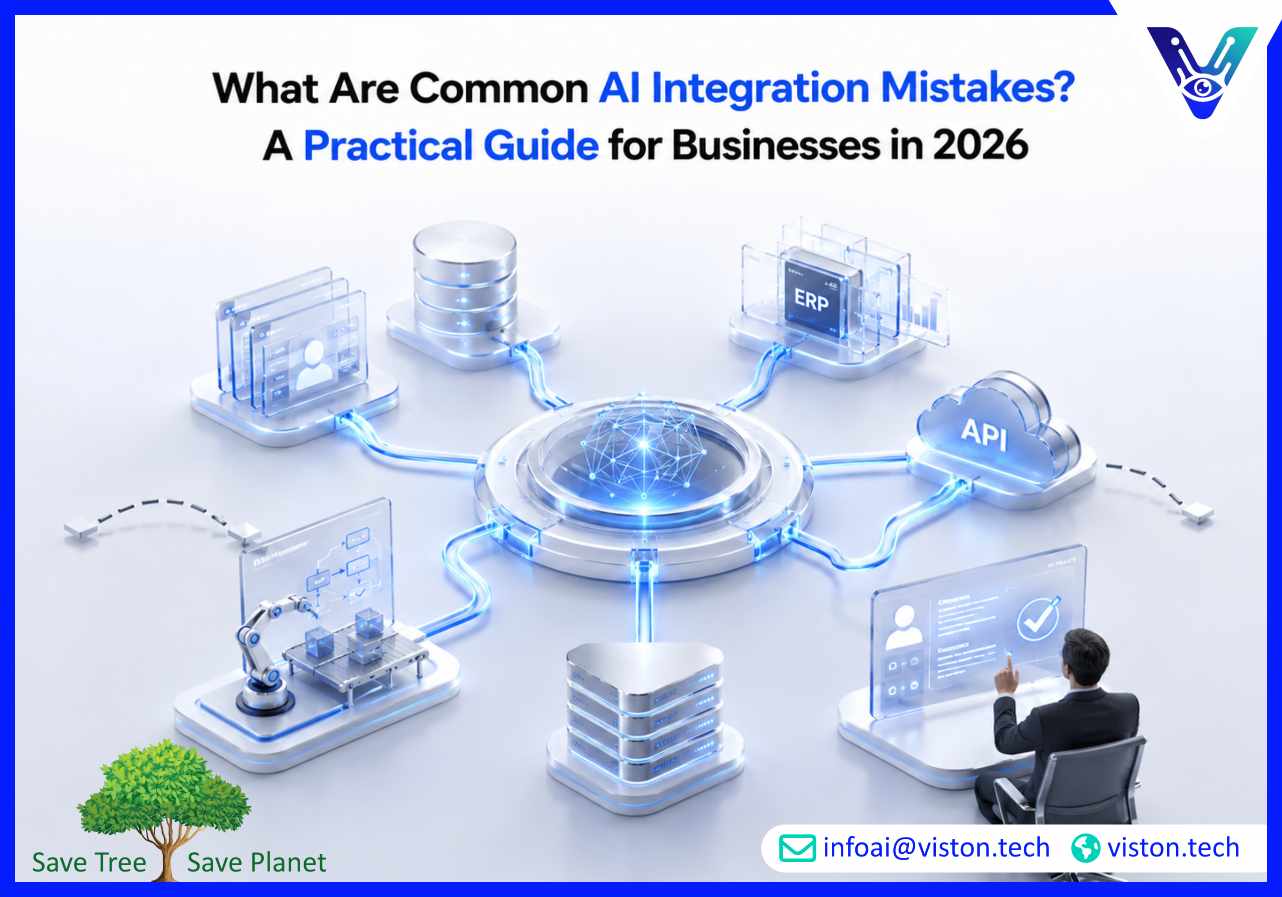
AI integration offers significant opportunities for automation, efficiency, and business growth. However, many organizations struggle to achieve expected outcomes because they focus on technology alone rather than implementation strategy. Understanding common AI integration mistakes can help businesses avoid costly delays, operational disruptions, and underperforming AI initiatives in 2026.
AI integration is not simply about connecting an AI model to existing software. Successful implementation requires alignment between business processes, data quality, security requirements, workflows, and operational objectives.
Many organizations invest heavily in AI technologies but underestimate the complexity of integrating AI agents, automation workflows, APIs, enterprise systems, and human processes. As AI adoption accelerates, businesses that avoid common integration mistakes are more likely to achieve measurable returns on their investment.
In 2026, organizations increasingly rely on AI agents that interact with CRM systems, ERP platforms, customer support tools, databases, communication platforms, and internal knowledge systems. Without proper planning, these integrations can create more problems than they solve.
One of the most common mistakes is selecting AI tools before identifying the business problem they are intended to solve.
Organizations often become focused on the latest AI models, agent frameworks, or automation platforms without clearly defining:
AI integration projects should begin with business goals such as reducing support response times, improving lead qualification, automating document processing, or enhancing operational efficiency.
AI systems depend on accurate and accessible data. Many businesses attempt AI integration without addressing underlying data issues.
Common data-related problems include:
Even advanced AI agents will produce unreliable results if the information they access is inaccurate or fragmented.
Many organizations treat AI as an isolated application rather than part of a broader business ecosystem.
Successful AI integration requires careful planning around:
Without a structured integration architecture, AI solutions often become difficult to scale, maintain, and govern.
Businesses sometimes assume AI can fully replace human decision-making. In reality, many business processes still require human judgment, approvals, and exception handling.
High-risk activities such as financial transactions, compliance decisions, customer disputes, and sensitive communications often benefit from human-in-the-loop controls.
Organizations that eliminate oversight too early may face increased operational and reputational risks.
AI systems frequently access sensitive business information, customer records, operational data, and proprietary knowledge.
Common security mistakes include:
Security and governance should be embedded into AI integration planning from the beginning rather than added after deployment.
Beyond technical considerations, operational issues often contribute to failed AI projects.
AI initiatives frequently involve IT teams, operations departments, management, compliance teams, and end users. When key stakeholders are excluded from planning, implementation gaps often emerge.
Organizations sometimes deploy AI solutions without defining responsibility for monitoring, maintenance, optimization, and governance. Clear ownership is essential for long-term success.
Large-scale enterprise transformations can be tempting, but overly ambitious AI integration projects often struggle with complexity.
A phased approach allows businesses to:
Employees must understand how AI impacts their workflows and responsibilities. Poor communication and inadequate training can reduce adoption and limit business value.
Successful AI integration requires both technical implementation and organizational readiness.
Organizations can significantly improve outcomes by following proven integration practices.
Establish measurable goals before implementation begins. Metrics may include productivity improvements, reduced processing times, lower operational costs, improved customer satisfaction, or increased workflow accuracy.
Focus on processes where AI can create meaningful business impact rather than attempting to automate every task simultaneously.
Design integrations that support future growth, additional AI capabilities, and evolving business requirements.
Continuous monitoring helps identify performance issues, security concerns, workflow bottlenecks, and optimization opportunities.
Human oversight remains valuable for managing exceptions, reviewing critical decisions, and ensuring accountability.
The most effective AI integrations combine automation with appropriate operational controls.
Many of the challenges associated with AI implementation stem from poor integration planning rather than limitations in AI technology itself.
Agent Integration Services help businesses connect AI agents with operational systems, APIs, databases, CRMs, ERP platforms, communication tools, and workflow environments. The objective is to create reliable and scalable AI-driven processes that align with business requirements.
Professional integration services typically focus on:
This structured approach helps organizations avoid many of the common mistakes that lead to failed AI initiatives.
As businesses expand their use of AI agents and workflow automation, successful implementation increasingly depends on effective integration. Viston AI provides Agent Integration Services designed to help organizations connect AI capabilities with existing business systems and operational processes.
Its approach focuses on practical implementation rather than isolated AI deployment. This includes evaluating integration requirements, designing workflows, connecting enterprise systems, implementing governance controls, and supporting scalable AI operations.
For organizations adopting AI-driven automation, agent orchestration, customer service workflows, internal productivity solutions, or operational automation, Viston AI helps bridge the gap between AI technology and real-world business execution.
By emphasizing structured integration, security, workflow reliability, and measurable business outcomes, organizations can reduce implementation risks and maximize the value of their AI investments.
The most common mistake is implementing AI without first defining clear business objectives. Organizations should focus on solving specific operational challenges rather than adopting AI solely because it is available.
AI systems rely on accurate and consistent data. Poor-quality data can lead to incorrect outputs, unreliable automation, and poor decision-making.
Not always. Many business processes benefit from human review, particularly when decisions involve compliance, finance, customer relationships, or operational risk.
Organizations should focus on workflow analysis, integration architecture, governance, security, stakeholder involvement, and phased implementation strategies.
Agent Integration Services help businesses connect AI agents with enterprise systems, workflows, APIs, and operational processes to ensure reliable and scalable implementation.
Yes. Viston AI’s Agent Integration Services support businesses with integration planning, workflow design, system connectivity, governance implementation, and scalable AI deployment strategies.
Understanding common AI integration mistakes is essential for organizations seeking successful AI adoption in 2026. Challenges such as poor planning, weak data management, inadequate security controls, lack of governance, and disconnected workflows can significantly reduce the value of AI investments. A structured approach that combines clear business objectives, strong integration architecture, human oversight, and ongoing monitoring creates a stronger foundation for success. For businesses implementing AI agents and automation solutions, Agent Integration Services can help reduce risks and ensure AI becomes a productive part of everyday operations. Viston AI supports this process through practical integration expertise that connects AI capabilities with real business outcomes.
