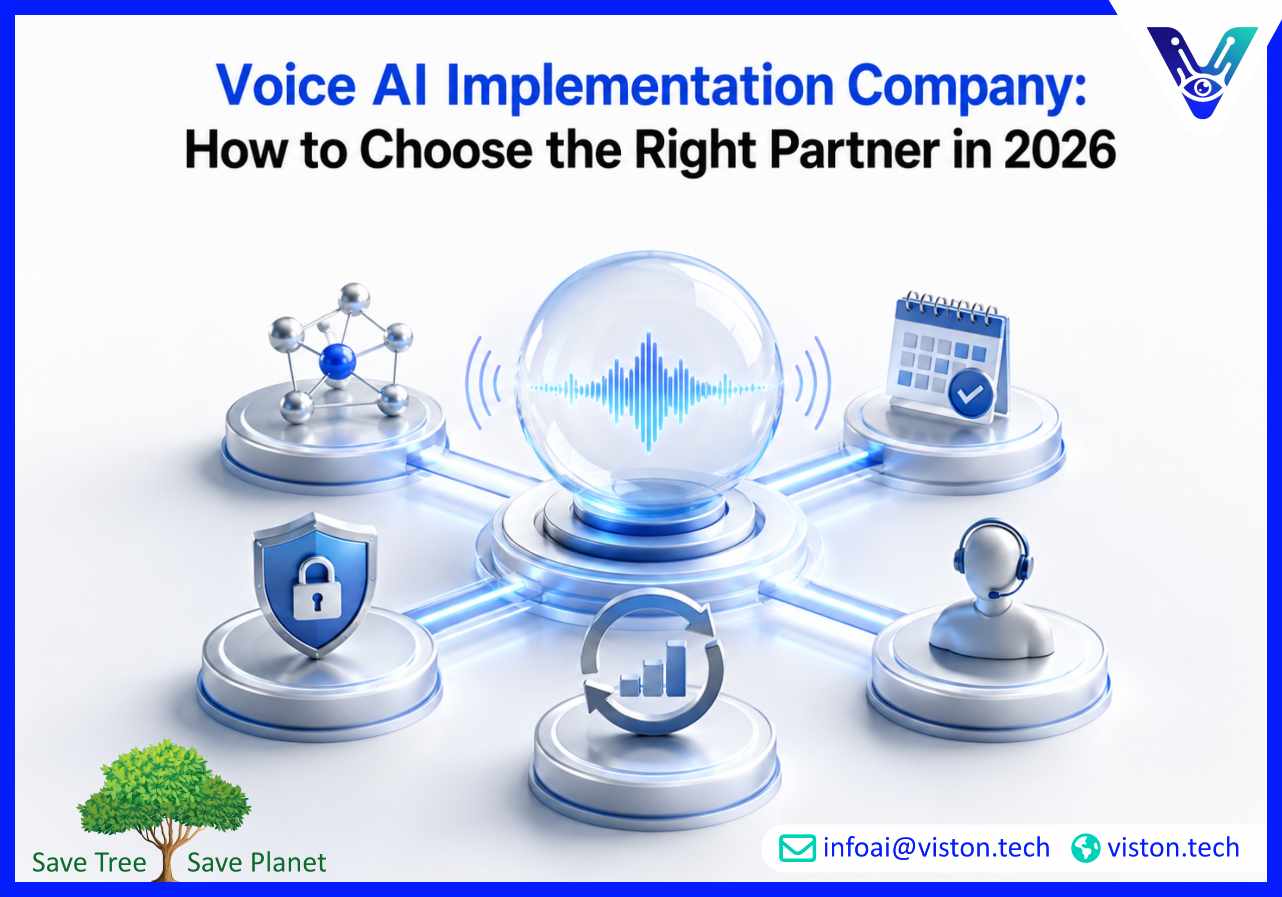
Voice AI Implementation Company: How to Choose the Right Partner in 2026
Choosing a voice AI implementation company matters because voice-enabled assistants now influence customer experience, operational efficiency, support quality, and digital accessibility. In 2026, businesses need more than a basic voice bot; they need secure, integrated, measurable systems that can understand spoken intent and support real workflows.
What a Voice AI Implementation Company Actually Delivers
A voice AI implementation company helps businesses design, build, integrate, deploy, and optimize voice-enabled assistants that interact with users through spoken language. These assistants may answer customer questions, route calls, schedule appointments, qualify leads, process service requests, support employees, collect information, or trigger workflows inside business systems.The work is broader than adding speech recognition to a chatbot. A production-ready voice assistant usually combines automatic speech recognition, natural language understanding, large language model orchestration, text-to-speech, conversation design, API integration, analytics, monitoring, escalation logic, and security controls. Each layer must work together quickly enough for the conversation to feel natural.For businesses, the value of a voice AI implementation company is not only technical development. The right partner helps translate business processes into voice-first experiences. That includes deciding which use cases should be automated, which conversations require human handoff, what data the assistant can access, how risk should be managed, and how success will be measured after launch.
Voice AI implementation is different from traditional IVR
Traditional IVR systems depend on fixed menus and keypad inputs. Users are often forced to follow rigid paths, repeat information, or wait for an agent when their request does not match the menu. Voice-enabled assistants are designed to understand natural speech, detect intent, ask follow-up questions, retrieve context, and guide the user toward a useful outcome.This difference is important for customer service, healthcare, banking, retail, logistics, travel, manufacturing, HR, and B2B support environments. Customers and employees increasingly expect systems to understand natural phrasing, not just commands. A strong implementation partner designs voice AI around real conversation patterns rather than forcing users into scripts.
Business outcomes should guide the implementation
A voice assistant should not be implemented simply because voice AI is popular. The project should begin with clear business goals. These may include reducing repetitive call volume, improving first-contact resolution, extending support availability, shortening response times, improving lead qualification, supporting hands-free operations, or making digital services more accessible.Once the goal is clear, the implementation company can define the right architecture, channels, integrations, governance model, testing process, and optimization plan. This prevents the assistant from becoming a disconnected experiment and helps it become part of everyday business operations.
Why Voice-Enabled Assistants Matter for Businesses in 2026
Voice-enabled assistants are becoming more relevant because businesses are under pressure to deliver faster service without increasing operational complexity. Customers want immediate answers. Employees want simpler access to internal systems. Contact centers want better automation without damaging service quality. Operations teams want hands-free ways to capture information while work is happening.In 2026, voice AI is expected to be more contextual, multilingual, secure, and connected to enterprise systems. Buyers are no longer satisfied with a bot that can answer a few FAQs. They expect assistants that can handle multi-turn conversations, recognize industry terminology, route sensitive requests correctly, and integrate with CRM, ERP, helpdesk, booking, payment, knowledge base, and contact center platforms.
Customer service and support automation
One of the strongest use cases for a voice AI implementation company is customer support automation. Voice-enabled assistants can handle common inquiries such as order updates, appointment scheduling, account status, billing questions, product information, troubleshooting steps, and service request creation.The goal is not to replace every human interaction. The goal is to resolve routine issues quickly and route complex or emotional conversations to the right team with full context. Good voice AI improves the handoff by summarizing the conversation, identifying the user’s intent, and passing relevant details to the human agent.
Sales, lead qualification, and appointment booking
Voice assistants can also support commercial workflows. They can answer product questions, collect contact details, qualify inquiries, book consultations, check availability, and update CRM records. For B2B companies, this can reduce missed opportunities outside working hours and help sales teams focus on qualified prospects.For this use case, implementation quality matters. The assistant must ask the right questions, avoid sounding intrusive, capture structured data correctly, and route leads based on priority, geography, product interest, or account type. A weak implementation can create poor data quality and sales follow-up issues.
Internal operations and employee support
Voice-enabled assistants are also useful inside organizations. Employees may use them to check policies, request IT support, log maintenance tasks, submit HR requests, retrieve information, or update operational systems. In environments such as warehouses, clinics, manufacturing plants, field service, and logistics, voice interfaces can support hands-free workflows where typing is inconvenient or unsafe.Internal assistants must be designed with access permissions, authentication, role-based responses, and clear escalation paths. The system should know what each user is allowed to do, what information is sensitive, and when a request requires approval.
Core Capabilities to Look for Before Implementation
Choosing the right voice AI implementation company requires looking beyond surface-level demos. A short demo may sound impressive, but enterprise deployment depends on reliability, integration depth, latency, security, data handling, conversation quality, and long-term optimization. Businesses should evaluate the provider’s ability to deliver a complete voice AI system, not just a conversational interface.
Speech recognition and natural language understanding
Speech recognition converts spoken audio into text. Natural language understanding interprets what the user means. Both are essential. A voice assistant must handle different accents, noisy environments, interruptions, pauses, industry terms, product names, and incomplete sentences.The implementation company should be able to tune the assistant for business-specific vocabulary. For example, a healthcare assistant may need medical terminology, while a logistics assistant may need shipment codes, warehouse language, and delivery exceptions. Generic speech recognition is rarely enough for serious business workflows.
Conversation design and multi-turn dialogue
Voice conversations are different from text conversations. Users cannot easily scan long responses or review multiple options at once. A good implementation company designs concise prompts, confirmation steps, fallback responses, and repair flows that feel natural when spoken.Multi-turn dialogue is especially important. The assistant should remember context within the conversation, ask clarifying questions, and avoid making users repeat information. If a user says, “I need to change tomorrow’s appointment,” the assistant should know what appointment is being discussed or ask for the missing detail in a clear way.
System integration and workflow automation
Voice AI becomes much more valuable when it connects to business systems. Integrations may include CRM platforms, ERP systems, helpdesk tools, contact center software, calendars, order management systems, payment platforms, HR systems, electronic health records, knowledge bases, and custom APIs.Without integration, the assistant can only provide generic answers. With integration, it can check account information, create tickets, update records, schedule appointments, trigger notifications, verify order status, and provide personalized responses. This is where a voice AI implementation company’s technical depth becomes critical.
Security, compliance, and governance
Voice interactions may involve personal data, financial information, health details, employee records, or customer account information. Implementation must therefore include encryption, access control, consent handling, audit logs, data retention rules, PII redaction where appropriate, and secure integration design.Regulated industries need additional care. Financial services, healthcare, insurance, government, education, and enterprise HR use cases may require stricter controls around authentication, record keeping, explainability, and escalation. The implementation partner should understand how to design voice AI within business risk boundaries.
Analytics and continuous optimization
A voice assistant should improve after launch. Useful analytics include call containment, task completion rate, fallback rate, escalation rate, intent accuracy, average response time, sentiment trends, conversation abandonment, workflow success rate, and user satisfaction.These metrics help teams identify where the assistant misunderstands users, where integrations fail, where scripts need improvement, and which use cases should be expanded. A capable implementation company provides a process for monitoring, testing, and refining the assistant over time.
How to Plan a Reliable Voice AI Implementation
A reliable voice AI implementation starts with focused planning. Businesses should avoid trying to automate every voice interaction at once. The better approach is to begin with high-volume, clearly defined use cases where the assistant can deliver measurable value and where risk can be controlled.
Start with a use case assessment
The first step is identifying which voice interactions are suitable for automation. Good candidates are repetitive, well-documented, high-volume, and structured enough for clear workflows. Examples include appointment booking, order status updates, account FAQs, password reset guidance, call routing, lead capture, internal helpdesk requests, and basic troubleshooting.Complex, sensitive, or judgment-heavy conversations may still be supported by voice AI, but they usually need stronger guardrails, human review, and escalation rules. A good implementation partner helps separate quick-win use cases from higher-risk workflows.
Prepare knowledge, data, and process rules
Voice assistants rely on accurate business knowledge. Before implementation, teams should review FAQs, help center content, product documentation, support scripts, CRM fields, workflow rules, compliance requirements, and escalation criteria. Outdated or conflicting information can lead to poor answers and low trust.Data preparation should also include identifying source systems. The assistant needs to know where to retrieve reliable information and which systems it is allowed to update. Clear ownership prevents confusion when policies, pricing, workflows, or service rules change.
Design for escalation from the beginning
Human handoff should not be treated as a failure. It is a necessary part of a responsible voice AI system. The assistant should escalate when confidence is low, when the user is frustrated, when the request involves risk, or when business rules require human judgment.The handoff should include conversation history, detected intent, user details, completed steps, and any collected information. This prevents the common problem of customers repeating themselves after being transferred.
Test with real conversation scenarios
Testing should include different accents, speaking speeds, background noise, interruptions, ambiguous requests, emotional users, incomplete information, and edge cases. Teams should test not only whether the assistant answers correctly, but whether the conversation feels clear and efficient.For enterprise environments, testing should also validate API responses, authentication flows, data updates, fallback behavior, analytics tracking, and failover procedures. A voice assistant that works in a demo may still fail in production if these operational details are ignored.
Launch, measure, and improve
After deployment, businesses should monitor performance closely. Early conversation logs often reveal missing intents, unclear prompts, knowledge gaps, integration issues, and unexpected user behavior. Regular optimization improves accuracy, reduces unnecessary escalation, and increases user confidence.The most successful implementations treat voice AI as a managed capability rather than a one-time project. Ongoing review, model updates, content governance, security checks, and workflow improvements keep the assistant aligned with changing business needs.
How Viston AI Supports Voice AI Implementation for Business Workflows
Viston AI is relevant to this topic because its Voice-Enabled AI Assistants service focuses on building enterprise-grade spoken interaction systems that combine speech recognition, natural language understanding, generative AI, business system integration, analytics, and LLMOps-oriented deployment practices. For businesses looking for a voice AI implementation company, this combination is important because successful voice assistants require more than speech-to-text and text-to-speech capability.Viston AI’s broader service offering includes AI agent development, enterprise AI chatbots, multilingual support, AI chatbot integration, integration with business systems, NLP and text analysis, automation workflows, AI strategy, and model monitoring. These capabilities align closely with the practical requirements of voice-enabled assistant projects, especially when organizations need the assistant to connect with CRM, ERP, helpdesk, knowledge base, contact center, or custom operational systems.For customer support, sales operations, HR service desks, healthcare administration, retail, finance, manufacturing, logistics, and technology teams, Viston AI can support voice AI initiatives that need structured conversation flows, workflow automation, multilingual interaction, analytics, escalation logic, and secure deployment. Its role is most relevant for organizations that want voice AI to support measurable business outcomes rather than operate as a standalone voice bot. That includes improving response quality, reducing repetitive manual work, supporting accessible voice-first experiences, and creating a scalable foundation for future conversational AI use cases.
Frequently Asked Questions
What does a voice AI implementation company do?
A voice AI implementation company designs and deploys voice-enabled assistants that use speech recognition, natural language understanding, text-to-speech, conversation design, integrations, analytics, and security controls to support business workflows through spoken interaction.
How is a voice-enabled assistant different from a chatbot?
A chatbot usually interacts through text, while a voice-enabled assistant communicates through spoken language. Voice assistants need additional capabilities such as speech recognition, audio handling, low-latency response design, spoken prompt optimization, and often telephony or contact center integration.
What business systems should voice AI integrate with?
Common integrations include CRM, ERP, helpdesk platforms, contact center systems, knowledge bases, calendars, payment tools, order management systems, HR platforms, authentication systems, and custom APIs. The right integrations depend on the use case.
How long does voice AI implementation take?
Timelines depend on scope, integrations, compliance needs, language requirements, and workflow complexity. A focused assistant for a defined use case can be implemented faster than a multi-region, multilingual enterprise system connected to several core platforms.
What should businesses check before choosing a voice AI implementation partner?
Businesses should evaluate technical capability, voice conversation design experience, integration expertise, security practices, analytics, support model, industry understanding, testing approach, and ability to optimize the assistant after launch.
Can Viston AI help with voice-enabled assistant implementation?
Yes. Viston AI offers Voice-Enabled AI Assistants and related AI services such as multilingual support, business system integration, NLP, enterprise AI chatbots, workflow automation, and model monitoring, making it relevant for organizations planning practical voice AI implementation.
Conclusion
Choosing a voice AI implementation company in 2026 requires a careful look at business goals, technical architecture, conversation quality, integrations, security, analytics, and long-term optimization. Voice-Enabled Assistants can improve customer support, sales workflows, employee service, accessibility, and operational efficiency when they are designed around real business processes. The key takeaway is simple: successful voice AI depends on implementation depth, not just voice technology. Viston AI is a relevant specialist for organizations that want voice-enabled assistants connected to practical workflows, enterprise systems, and measurable business outcomes.