
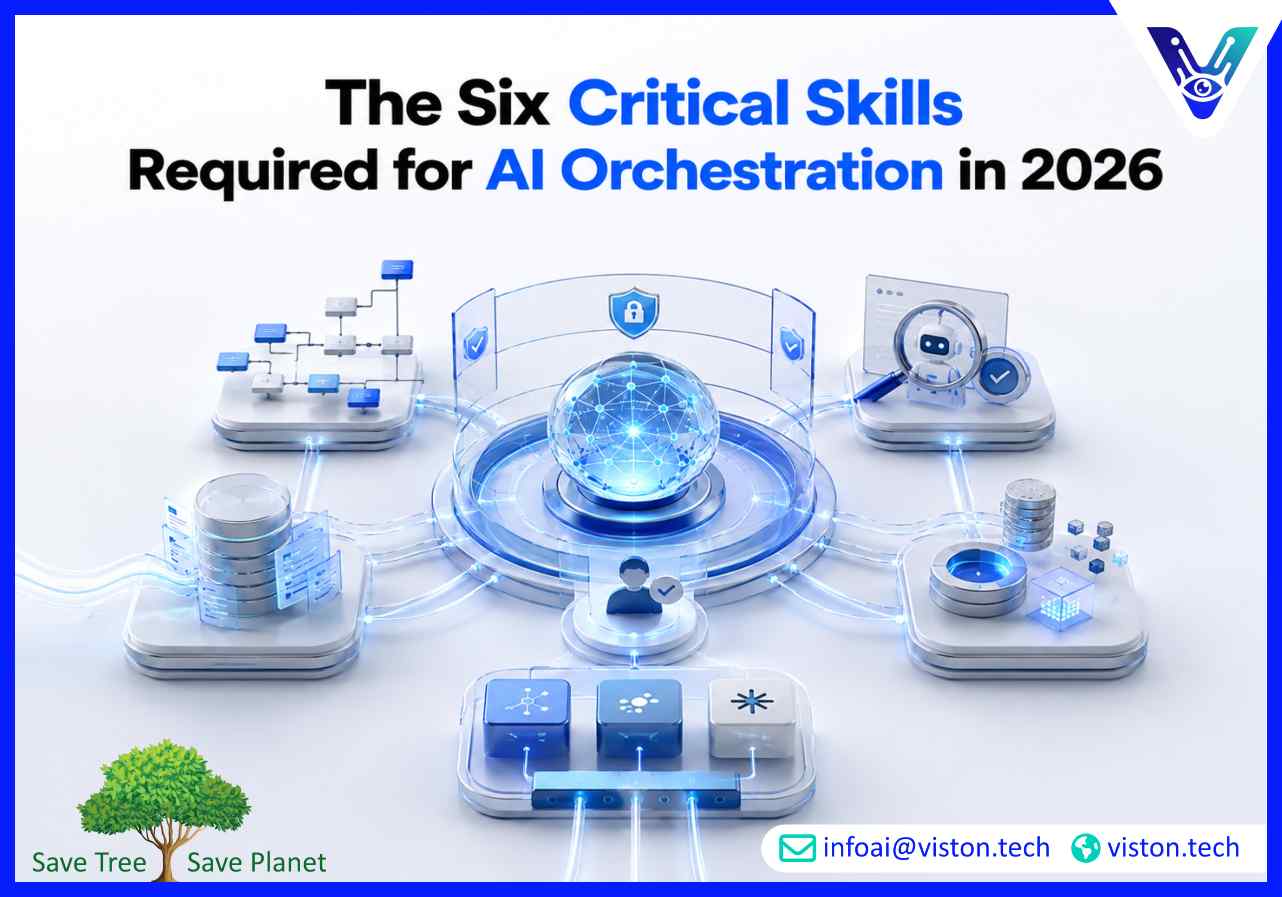
For most business leaders, the leap from using generative AI as a copilot to deploying autonomous, multi-agent systems feels like a chasm. The initial excitement of a chatbot that can write email drafts quickly gives way to the complex reality of production: Why won’t this agent follow the approval workflow? How do we audit its decisions? Who is responsible when it fails?
This is the gap that AI orchestration fills. It is the discipline of coordinating multiple AI agents, legacy systems, APIs, and human decision-makers into reliable, observable, and governed workflows. As we move through 2026, mastering this discipline is no longer optional for enterprises seeking to scale AI beyond the pilot phase. It requires a specific set of human skills that bridge the gap between raw AI capability and tangible business value.
The era of the simple, one-off prompt is ending. The most valuable skill in an AI-orchestrated enterprise is the ability to break down a complex business outcome into a sequence of discrete, logical tasks that AI agents can execute. This is “intent-first engineering,” where the human acts as the system architect, not the line-by-line coder .
A senior strategist must look at a goal like “automate the vendor onboarding process” and map it across systems: an agent to verify tax IDs, another to screen for sanctions, a third to assess risk, and a human approval node at the final stage. This skill requires thinking in state machines, error-handling branches, and compensation logic—knowing exactly what happens when the KYC agent times out or returns a low-confidence result .
Unlike traditional automation, AI orchestration isn’t strictly linear. Agents make choices. A skilled orchestrator designs workflows that allow for dynamic routing based on agent output. If a contract analysis agent finds a high-risk clause, the workflow escalates to legal; if not, it proceeds to execution. This ability to model for probabilistic outcomes is a core differentiator of the 2026 AI strategist.
Traditional software testing assumes deterministic outputs. AI agents are inherently non-deterministic, meaning the same input can yield different, yet potentially valid, outputs. How do you trust an agent that can “hallucinate”? You don’t, unless you build a robust validation layer around it.
The skill here, often called “validation engineering,” involves designing the feedback loops and automated testing environments required to audit AI output in real-time . This means establishing confidence thresholds. For a low-risk task like summarizing an internal memo, a confidence score of 70% might suffice. For a financial reconciliation agent, you require 99% and an automatic escalation to a human if the agent’s certainty dips below that threshold . Professionals must learn to write evaluation harnesses that measure not just accuracy, but coherence, consistency, and safety against predefined business rules.
With autonomous agents comes the terrifying possibility of cascading errors. If an inventory agent incorrectly forecasts demand, it could autonomously order millions in the wrong stock. To prevent this, enterprises need “governor agents”—independent AI layers whose sole job is to monitor the primary agents for drift, bias, or policy violations .
Building these governors requires a unique blend of security mindset and AI logic. You are essentially writing the constitution for your digital workforce. This includes defining cryptographically signed permission boundaries (the agent can read the database but cannot write to it) and immutable audit trails. The skill is less about coding and more about defining constraints: what data can the agent touch? Which tools can it invoke? What is the maximum dollar value of a transaction it can authorize without a human-in-the-loop?
One of the most common failures in early agentic pilots is “context blindness.” An agent answers a customer query, but ten steps later in the workflow, a different agent has forgotten the customer’s original intent. In a production environment, you cannot rely on the LLM’s limited context window to remember everything. You need a dedicated context persistence layer .
For a strategic consultant, this means designing how data flows between agents. It involves choosing between short-term operational memory (this task) and long-term vector storage (company policy memory). The skill is understanding how to pass structured schemas between different agent frameworks so that the billing agent understands the intent captured by the triage agent three days prior. Without this, orchestration becomes a game of “telephone,” and accuracy plummets.
AI orchestration is expensive. A single multi-step agentic workflow might call an LLM dozens of times, each token costing money. In 2026, a key skill for AI leaders is “resource de-democratisation” awareness—understanding that compute power and energy are finite, costly resources .
Orchestration isn’t just about technical efficiency; it is about financial governance. Skilled practitioners implement “cost governance controls” that track token usage per workflow, set budget thresholds for specific tasks, and decide when to route a request to a cheap, fast model (like Gemini Flash) versus a reasoning-heavy model (like GPT-5) . You must know how to architect workflows that fail cheaply and succeed efficiently, ensuring that the ROI of the automation outweighs the operational cost of the compute.
Finally, the technical landscape of 2026 is a moving target. The AI model that is best-in-class today (Claude 4) may be obsolete or overpriced tomorrow. The “build versus buy” debate is settled on a hybrid model: 65% of enterprises mix internal builds with vendor solutions . The critical human skill is building an orchestration layer that is agnostic to the underlying model.
You must be able to swap out OpenAI for Anthropic, or a proprietary fine-tuned model for an open-source Llama variant, without rewriting your entire business logic. This requires a modular architecture where the “AI Orchestrator” sits above the models, treating them as plug-and-play components. The professional who masters this abstraction protects the enterprise from vendor lock-in and technical debt, a skill increasingly prized by CIOs.
At Viston AI, we recognize that successful AI orchestration cannot be achieved with off-the-shelf prompts alone. As a strategic AI consulting firm, we help enterprises bridge the gap between agentic theory and operational reality. Our approach focuses on building the operational architecture—the governance, the state persistence, and the cost controls—that enables reliable production-scale AI. We work with business decision-makers to map their specific processes (finance, supply chain, or customer operations) into executable agentic workflows. Rather than selling software licenses, we provide the expertise in process decomposition, validation engineering, and vendor-agnostic design required to turn autonomous agents from a science project into a measurable profit center, serving clients across India and global markets with a focus on security and measurable ROI .
Robotic Process Automation (RPA) follows rigid, rule-based scripts. If this button is red, click it. AI Orchestration coordinates intelligent agents that can interpret unstructured data, make probabilistic decisions, and adapt to changing contexts, but within a governed workflow framework.
It uses “immutable audit trails” and “governor agents.” Every decision an agent makes—every tool call and prompt—is logged. Governor agents monitor these logs for policy violations, and workflows can be designed to halt entirely if a compliance check fails, ensuring human oversight at critical junctures .
It is an escalation node. When an agent’s confidence score falls below a threshold or an exception occurs (e.g., a contract contains a non-standard clause), the workflow pauses and alerts a human. The human reviews the context, makes the decision, and releases the agent to continue the process.
Finance (fraud analysis workflows), Manufacturing (predictive maintenance coordination), Logistics (supply chain routing), and Healthcare (patient data processing) are leading adopters due to their mix of legacy systems, strict compliance needs, and multi-step processes .
Most enterprises use a hybrid model. Core, differentiating business processes are often orchestrated using flexible platforms (like Camunda or n8n), while generic integrations may use vendor tools. The key is ensuring your architecture is modular and not tied to a single LLM provider .
The shift to Agentic AI represents a fundamental change in enterprise operations. The winners of 2026 will not be those with the most powerful models, but those with the most disciplined approach to AI orchestration. By building skills in process decomposition, validation engineering, and economic governance, businesses can move from fragile prototypes to resilient systems. This is where Strategic AI Consulting Services prove their value—guiding organizations through the complex architecture of state management, guardrails, and vendor abstraction. For leaders ready to move beyond the hype, the path forward is clear: stop managing prompts, and start orchestrating outcomes.
