
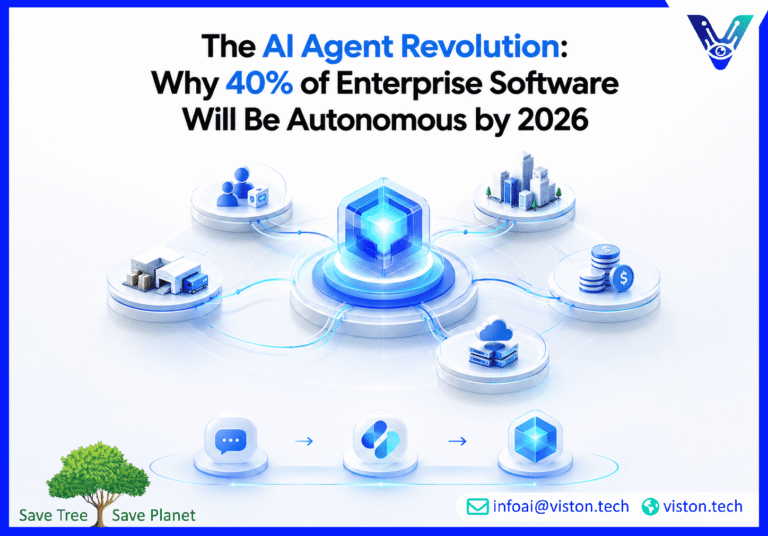
The Future of Enterprise Applications: Why 40% Will Feature AI Agents by 2026
The world of enterprise software is on the brink of a seismic shift. We are moving beyond simple automation and into an era of intelligent, autonomous systems. At the heart of this transformation are AI agents—digital workers poised to redefine how businesses operate. Gartner projects that by 2026, a staggering 40% of enterprise applications will feature these task-specific AI agents, a monumental leap from less than 5% in 2025. This isn’t just an incremental update; it’s a complete reimagining of enterprise technology.
This rapid evolution is backed by explosive market growth. The agentic AI market is forecasted to surge from approximately $7 billion in 2025 to between $88 billion and $199 billion by the early 2030s. In the U.S. alone, the market is expected to reach an impressive $65 billion. For C-suite executives, IT leaders, and product managers, this isn’t a trend to watch—it’s a critical business imperative to act on now.
The Evolution of AI in Enterprise Applications: From Chatbots to Agents
To understand the significance of AI agents, it’s helpful to look at the journey of AI in enterprise software. This has been a gradual evolution, with each phase building on the last to deliver more sophisticated capabilities.
Phase 1: The Rise of Chatbots
Our journey began with rule-based chatbots. These early applications of AI were designed to handle simple, repetitive queries. Think of the automated chat windows on websites that answer frequently asked questions. While revolutionary at the time for their ability to provide 24/7 support and reduce the burden on human agents, their capabilities were limited by predefined scripts.
Phase 2: The Emergence of Copilots
The next leap forward brought us AI copilots, powered by advancements in large language models (LLMs). These are the AI assistants embedded within our productivity suites, like Microsoft’s Copilot or Google’s Gemini. They act as intelligent partners, helping users draft emails, summarize documents, and analyze data. Copilots represent a significant step up, offering suggestions and automating parts of a workflow, but they still require human guidance to initiate and complete tasks.
Phase 3: The Dawn of AI Agents
Now, we are entering the age of AI agents. Unlike their predecessors, agents are autonomous. They don’t just suggest; they do. An AI agent can understand a complex goal, break it down into smaller tasks, interact with multiple applications, and execute the entire workflow from start to finish with minimal human intervention. This is the key difference: agents can take action and make decisions independently to achieve a desired outcome.
Where AI Agents Are Making Their Mark
The impact of AI agents will be felt across the entire suite of enterprise software. They are not a niche technology but a foundational layer that will enhance the core systems businesses rely on every day. Here’s a look at how they are transforming key areas:
- Enterprise Resource Planning (ERP): In ERP systems, AI agents are set to revolutionize everything from financial operations to supply chain management. Imagine an agent that can autonomously analyze financial data to identify cost-saving opportunities, automatically generate and send invoices, and even predict cash flow with greater accuracy. These agents can perform “touchless operations,” shifting the finance department from reactive oversight to proactive foresight.
- Customer Relationship Management (CRM): AI agents are transforming CRMs from static databases into proactive sales and service engines. An agent can qualify leads by engaging with them through personalized emails, scheduling meetings with sales representatives, and updating the CRM with every interaction. This frees up sales teams to focus on what they do best: building relationships and closing deals.
- IT Service Management (ITSM): For IT departments, AI agents promise a future of proactive and automated support. An agent can monitor systems for potential issues, diagnose problems, and even resolve them before an employee is aware of a disruption. This dramatically reduces ticket volumes and frees up IT staff for more strategic initiatives. Organizations using AI agents in ITSM have reported up to a 40% reduction in ticket resolution time.
- Supply Chain Management (SCM): AI agents are bringing a new level of intelligence and resilience to supply chains. An agent can monitor inventory levels in real-time, automatically place orders with suppliers when stock is low, and even adjust logistics in response to unforeseen disruptions like weather delays. This creates a more agile and efficient supply chain, capable of adapting to a constantly changing global landscape. By 2030, Gartner predicts that 50% of SCM solutions will utilize intelligent agents.
What Your Business Should Be Building Now
The rise of AI agents is not a future event; it is happening now. Businesses that fail to adapt risk being left behind. To stay competitive, leaders must focus on building AI-native apps—applications designed from the ground up with artificial intelligence at their core. This represents a fundamental shift away from simply adding AI features to existing software.
Key Principles of Building AI-Native Applications:
- Adopt an AI-First Mindset: Instead of asking how AI can improve an existing process, ask how a process would work if it were designed around AI from the beginning. This shift in perspective is crucial for true innovation.
- Focus on Data Strategy: High-quality, accessible data is the lifeblood of any AI system. Businesses must invest in robust data infrastructure and pipelines to ensure their AI agents have the information they need to make intelligent decisions.
- Start Small and Scale: Begin with a specific, high-impact use case. This allows you to demonstrate value quickly and learn valuable lessons before expanding to more complex workflows. For a deeper dive into scaling your AI initiatives, this Forbes article offers valuable insights.
- Prioritize Trust and Governance: As AI agents become more autonomous, it is essential to have clear governance frameworks in place. This includes ensuring transparency in how agents make decisions and establishing human oversight for critical processes.
Strategic Positioning for the Age of AI Agents
The integration of AI agents into enterprise software is more than a technological upgrade; it is a strategic imperative. The companies that will lead in this new era are those that view AI not as a tool, but as a core component of their business strategy. This requires a proactive approach and a willingness to rethink long-standing processes.
CIOs and technology leaders have a narrow window—Gartner suggests just three to six months—to define their agentic AI strategy. Those who hesitate will find themselves at a significant competitive disadvantage, facing higher costs, slower processes, and a diminished customer experience. For more on developing a robust AI strategy, consider the insights from McKinsey’s “The state of AI in 2024” report.
The transition to an enterprise landscape dominated by AI agents will be one of the fastest and most transformative shifts since the adoption of the cloud. The future belongs to the businesses that not only embrace this change but actively shape it. By starting today, you can position your organization to thrive in the intelligent, autonomous, and efficient world of tomorrow.
Take the Next Step with Viston AI
Navigating the transition to an AI-powered enterprise can be complex. To truly harness the power of AI agents and build a competitive advantage, you need a partner with deep expertise and a proven track record. Viston AI specializes in developing and deploying custom AI-powered solutions that drive real business outcomes. Whether you are just beginning your AI journey or looking to scale your existing capabilities, our team of experts can help you architect a strategy that is tailored to your unique needs.
Contact Viston AI today to discover how our AI-powered solutions can transform your enterprise.
Frequently Asked Questions (FAQs)
What is an AI agent in the context of enterprise software?
An AI agent is an autonomous software program that can perceive its environment, make decisions, and take actions to achieve a specific goal. Unlike chatbots or copilots, AI agents can execute multi-step tasks across different applications without continuous human guidance. For example, an agent could manage the entire procurement process, from identifying the need for a new product to placing the order and tracking its delivery.
How do AI agents differ from traditional automation like RPA?
Traditional automation, such as Robotic Process Automation (RPA), is rule-based and designed to mimic human actions for repetitive tasks within a structured workflow. AI agents, on the other hand, are far more intelligent and adaptable. They can handle unstructured data, learn from their interactions, and make decisions in dynamic environments. While RPA follows a script, an AI agent can write its own script to achieve a goal.
What are the biggest challenges to adopting AI agents in the enterprise?
The primary challenges include ensuring data quality and accessibility, integrating AI agents with legacy systems, and establishing robust governance and security protocols. There is also a cultural challenge in fostering trust in autonomous systems and reskilling the workforce to collaborate effectively with their new digital colleagues.
Which industries are expected to be most impacted by AI agents?
Virtually every industry will be impacted, but those with complex operational workflows stand to gain the most. This includes manufacturing, logistics, finance, healthcare, and retail. In these sectors, AI agents can optimize everything from supply chains and financial reporting to customer service and patient care.
What new job roles might emerge with the rise of AI agents?
While AI agents will automate many existing tasks, they will also create new roles. We will likely see the emergence of positions such as AI agent trainers, AI ethicists, and AI workflow orchestrators. These roles will focus on managing, governing, and optimizing the performance of AI agent ecosystems to ensure they align with business objectives and ethical standards.
How can a business measure the ROI of implementing AI agents?
The return on investment (ROI) can be measured through a variety of metrics, including increased productivity, reduced operational costs, faster decision-making, and improved customer satisfaction. For example, a business could track the reduction in manual hours for a specific process, the decrease in error rates, or the increase in sales conversions after deploying an AI agent.
What is the difference between an AI-native application and an application with AI features?
An application with AI features typically adds artificial intelligence capabilities to an existing software framework. In contrast, an AI-native application is designed from the ground up with AI as its core component. This means the entire architecture, user experience, and data strategy are built to leverage the full potential of AI, leading to more powerful and seamlessly integrated intelligent functionalities.
How will AI agents impact the customer experience?
AI agents will enable hyper-personalized and proactive customer experiences. They can anticipate customer needs, provide instant and accurate support 24/7, and resolve issues before they escalate. This leads to higher levels of customer satisfaction and loyalty by creating a more seamless and responsive customer journey.
