
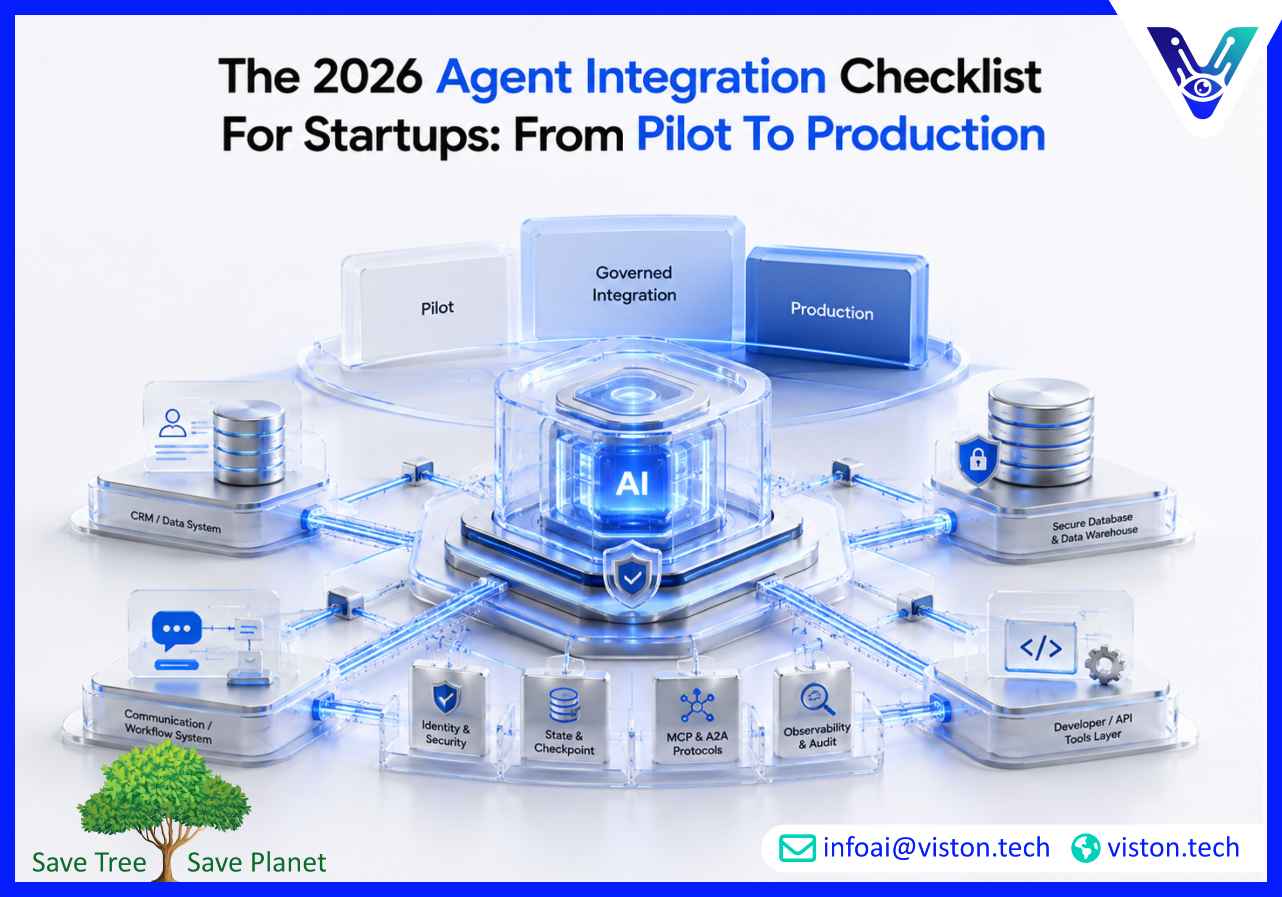
Building a functional AI agent prototype is no longer the hard part. The challenge—and the true value creation—lies in agent integration: connecting that agent securely to your CRM, your data warehouse, your communication channels, and your internal tools. For startups moving fast, a fragmented integration strategy leads to agentic chaos: hallucinations, broken workflows, and security blind spots. This checklist provides the technical and operational framework for startup founders and engineering leaders to integrate AI agents that are reliable, governed, and commercially valuable.
Startups face unique pressures when deploying AI agents: lean teams, evolving product architectures, and the urgent need to demonstrate ROI. The most common failure mode is treating integration as an afterthought. Teams build a capable agent using a framework like AutoGen or LangGraph, then attempt to “bolt on” connections to their existing stack.
This reactive approach leads to fragile systems. Without a deliberate integration strategy, agents struggle with authentication sprawl, inconsistent data access, and a lack of observability when things go wrong. In 2026, successful startups are treating integration as the core engineering challenge, not a deployment detail. The shift from monolithic AI features to multi-agent workflows requires a corresponding shift in infrastructure thinking .
This checklist moves beyond generic advice. It focuses on the specific technical and operational requirements for integrating AI agents into production startup environments. Each item addresses a point of failure observed across real-world deployments.
Agents interact with the world through tools: API calls, database queries, and internal functions. The single most important integration decision you will make is how you define and enforce these tool interfaces. Treat every tool as a deterministic contract.
Use strict JSON schemas (enums, required fields, type constraints) for every function your agent can call. Implement pre-call validation to reject malformed requests before they reach your systems, and post-call verification to ensure returned data matches expected shapes . This is not optional. Probabilistic LLMs calling loosely defined tools is a recipe for unpredictable production behavior. Reserve the LLM for reasoning and intent extraction; hand off validated parameters to deterministic, unit-tested code for execution .
A misconfigured SaaS tool leaks data passively; a misconfigured agent takes bad actions actively . For startups, the risk of “shadow agentic AI” is real—individual teams deploying agents without centralized oversight. Your integration layer must enforce governance from day one.
Assign every agent a unique identity with least-privilege credentials. Do not embed shared API keys or use a single service account. Implement an Agent Registry that catalogs what agents exist, what tools they can access, and who is accountable for their behavior . For sensitive actions—financial transactions, data deletion, external communications—implement human-in-the-loop (HITL) approval workflows within your integration logic .
When an agent makes an incorrect decision, you need to know why. Without comprehensive telemetry, debugging becomes guesswork. Instrument every LLM call, tool invocation, retrieval step, and key decision point .
Your integration layer must emit structured logs and traces to a centralized destination. This serves multiple purposes: debugging failures, building regression test datasets, and satisfying enterprise compliance reviews. An agent that emits no traces is invisible to your organization . Use OpenTelemetry-based instrumentation to ensure portability across observability backends. These traces become the foundation for continuous evaluation and iterative improvement.
Many valuable agent tasks are not single-turn exchanges. They involve multi-step planning, waiting for human input, or spanning days to complete an objective. Your integration architecture must support checkpoint-and-resume mechanisms for long-running agents .
Implement persistent state storage that captures the agent’s reasoning chain, intermediate results, and pending actions. This allows recovery from failures without starting over and enables delegation patterns where the agent pauses for human review while consuming zero compute resources. For startups building differentiated products, the ability to handle asynchronous, long-running workflows is a competitive advantage.
Writing custom integration code for every tool, API, and data source is not scalable. In 2026, the industry is coalescing around open standards. The Model Context Protocol (MCP) provides a universal bridge for connecting agents to databases, APIs, and enterprise systems . The Agent-to-Agent (A2A) protocol enables different agents, possibly built by different teams or organizations, to discover and collaborate securely .
Startups should adopt these protocols as the foundation of their integration layer. Use MCP servers to expose tools and data sources with minimal custom code. Use A2A to decompose complex problems into specialized sub-agents that communicate via standardized Agent Cards and JSON payloads. This approach future-proofs your architecture and dramatically reduces maintenance burden.
Integration is not a one-time event. Agent behavior degrades as underlying models change, data distributions shift, and new edge cases emerge. Your integration layer must support continuous evaluation: unsupervised evals running against live production traces to catch failures the moment they happen .
Implement guardrails at two points: pre-LLM (PII detection, prompt injection blocking, sensitive data filtering) and post-LLM (hallucination detection, output format compliance, tool validation) . Guardrails should be capable of driving self-correction loops where flagged issues are fed back to the LLM for revision before the user ever sees an error. For startups, automated quality enforcement scales where manual review does not.
Your integration approach must evolve. Establish regular reviews of agent performance, tool call accuracy, and failure patterns. Use production traces to build supervised evaluation datasets that validate integration changes before deployment . Maintain a clear owner for each agent integration point who is accountable for its reliability and security. Without ownership and iteration cycles, integration debt accumulates until the system becomes unmaintainable.
At Viston AI, we specialize in Agent Integration Services for startups navigating the transition from prototype to production. We understand that startups need integration solutions that are secure, scalable, and aligned with rapid iteration cycles—not rigid enterprise frameworks that slow development down.
Our approach focuses on the specific challenges startups face: establishing governance without bureaucracy, implementing observability on lean budgets, and designing integrations that evolve with your product. We help startups implement the technical foundations outlined in this checklist: identity-based access controls, MCP and A2A protocol adoption, continuous evaluation pipelines, and replayable audit systems. Our team brings production experience from deploying agents across CRM, knowledge management, and workflow automation contexts. We work alongside your engineering team to integrate agents that are reliable, auditable, and commercially valuable—without assuming we know your business better than you do.
Agent deployment refers to making an agent accessible to users. Agent integration refers to connecting that agent to your internal systems—databases, APIs, CRMs, communication tools—with proper security, observability, and governance. Integration is the harder and more critical discipline for production readiness.
For a focused use case with existing APIs, a basic integration can take 2-4 weeks. Production-grade integration with full observability, governance, and evaluation typically requires 8-12 weeks for a startup team. Working with specialized agent integration services can significantly accelerate this timeline by bringing reusable patterns and protocols.
Least-privilege credentials per agent, no hardcoded secrets, audit trails for every tool call, input sanitization, and human approval workflows for sensitive actions. If your integration lacks any of these, it is not production-ready for any business handling customer data.
Yes, you can write custom integration code. However, each custom integration becomes a maintenance liability. As your agent fleet grows, the overhead of bespoke connections becomes unsustainable. Adopting open protocols like MCP and A2A is a best practice for 2026 that future-proofs your architecture.
Start with observability and tracing. Before connecting your agent to any business system, instrument it to log every decision and tool call. You cannot improve or debug what you cannot see. Observability is the foundation upon which all other integration work depends .
Yes. Viston AI specifically focuses on startups and growth-stage companies. We offer engagement models tailored to lean teams, including advisory and implementation support that scales with your needs. Contact us to discuss your specific integration requirements.
AI agents are becoming the new user interface for software. For startups, the ability to integrate agents reliably and securely is no longer a differentiator—it is a requirement for remaining competitive. The 2026 integration checklist focuses on fundamentals: strict tool contracts, identity-based governance, comprehensive observability, stateful workflow support, open protocols, continuous evaluation, and iterative refinement. Start with observability, adopt MCP and A2A standards, and build integrations that treat agents as accountable actors in your system. For startups needing to accelerate their integration timeline or fill capability gaps, specialized Agent Integration Services from firms like Viston AI can provide the expertise and production patterns needed to move from pilot to production with confidence.
