
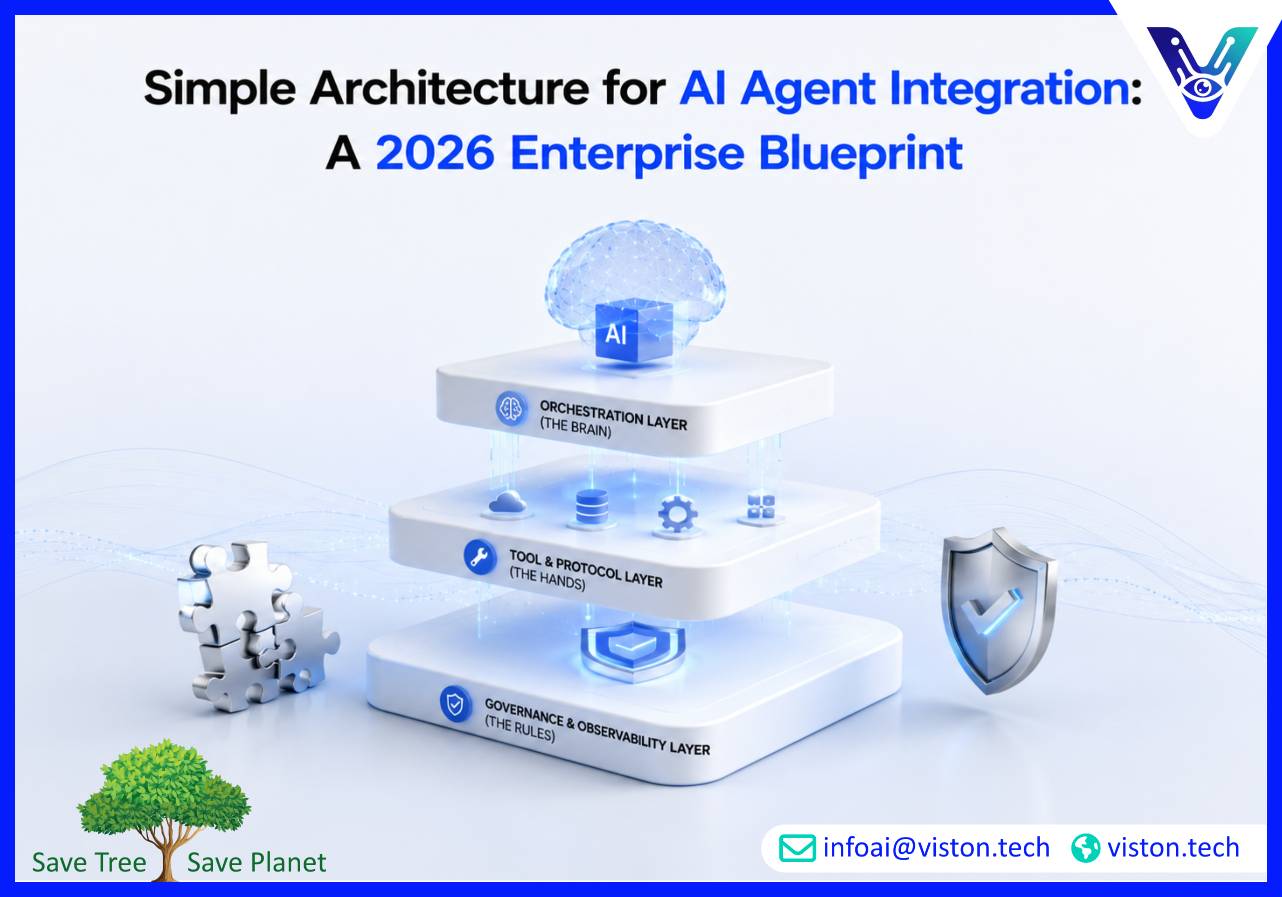
As organizations move beyond AI experimentation, the question is no longer if agents will be deployed, but how. In 2026, with 73% of Global Top 500 enterprises having initiated AI agent pilots but only 19% achieving cross-departmental scaling, the gap between ambition and reliable execution is clear . For business and technology leaders, the path forward requires moving past bespoke, monolithic builds toward a simple architecture for AI agent integration—one that prioritizes modularity, governance, and real-world commercial value.
This guide provides an expert-led blueprint for integrating autonomous agents into existing enterprise ecosystems without recreating the complexity that causes 95% of generative AI pilots to stall .
The honeymoon phase of simply prompting a single Large Language Model (LLM) is over. Production failures—hallucinations, latency spikes, and security gaps—almost always stem from architectural rigidity. The most successful deployments treat agents not as magical black boxes but as logical, replaceable microservices .
A simple architecture for AI agent integration relies on three core principles: separation of concerns, API-first connectivity, and deterministic guardrails. By decoupling the reasoning engine from business logic and data, enterprises avoid the “agent sprawl” that sees redundant bots proliferating across departments without centralized governance . This approach future-proofs investments, allowing organizations to swap out LLM providers or update specific skills without dismantling entire workflows.
To achieve sustainable autonomy, enterprises must construct a stack that separates what the agent thinks from what it does.
This control plane manages state, memory, and workflow logic. Instead of hard-coding sequences, modern frameworks utilize declarative YAML or graph-based workflows (like LangGraph) to map tasks . This layer handles the “plan-and-execute” loop, determining when to call tools and when to hand control back to a human for approval. For long-running processes lasting days, this layer maintains state via checkpointing, ensuring resilience without constant GPU burn .
Integration lives here. Rather than writing custom API wrappers for every internal system—a practice that creates brittle, unmanageable code—enterprises should adopt open standards. The Model Context Protocol (MCP) acts as a universal connector, allowing agents to dynamically discover and interact with databases and SaaS tools via standardized “Agent Cards” . For agent-to-agent communication across different platforms or business units, the Agent2Agent (A2A) protocol, governed by the Linux Foundation, provides a trusted bus for delegation and discovery .
Autonomy without accountability is a liability. A simple yet effective architecture integrates a governance stack at the edge. This includes assigning every agent a unique cryptographic identity (Agent Identity) to enforce least-privilege access and implementing deterministic code for financial calculations or writes, reserving the LLM strictly for intent extraction . Every action an agent takes—updating a CRM or initiating a refund—must generate a “receipt” logged in an immutable audit trail .
A simple architecture directly addresses the primary reasons enterprise integrations fail today.
Legacy systems are often cited as the primary barrier. By implementing an orchestration layer that communicates via APIs (rather than direct database scraping), agents interact with existing enterprise resource planning (ERP) and customer relationship management (CRM) systems without fragility. This API-first approach allows firms to utilize pre-built connectors for platforms like SAP or Oracle, drastically shortening deployment timelines from months to weeks .
Agentic workloads are computationally intense, often requiring 10 to 100 times more inference than simple chatbots . A modular architecture solves this via “token routing”—directing simple summarization tasks to small, cheap open-source models (like Gemma 4) while reserving expensive frontier models for complex reasoning. Furthermore, separating the “always-warm” control plane (orchestration on cheap CPU) from the “scale-to-zero” inference plane (GPU execution) ensures you pay only for active compute, slashing total cost of ownership .
In regulated industries, data sovereignty and compliance are non-negotiable. A simple architecture allows for hybrid deployment: running the inference plane on-premises or in a sovereign cloud while maintaining a managed control plane. This ensures sensitive financial or health data never leaves the secure perimeter, aligning with global compliance standards like GDPR or local data residency laws .
When evaluating partners for Agent Integration Services, business leaders should prioritize capabilities that ensure long-term value over short-term demos.
Navigating the shift from monolithic prototypes to modular production systems requires specialized engineering discipline. Viston AI delivers Agent Integration Services designed specifically for enterprises burdened by legacy complexity and governance concerns. We do not offer generic AI consulting; we architect and implement the three-layer blueprint—Orchestration, Tool/Protocol, and Governance—directly into your existing stack.
Viston AI bridges the gap between bleeding-edge model capability and enterprise reality. Our delivery approach focuses on commercial relevance: we build multi-agent workflows that connect securely to your SAP, Oracle, or Microsoft Dynamics instances using API-first MCP standards, ensuring data never requires risky migration to function. We prioritize deterministic outcomes by embedding strict JSON validation and human-in-the-loop approval gates, preventing the “hallucination risk” that keeps compliance officers awake at night. For organizations in regulated markets, we deploy hybrid architectures that respect data sovereignty while maximizing inference efficiency. With Viston AI, you gain a partner dedicated to making agentic systems scalable, auditable, and relentlessly business-focused.
The fastest method is implementing the Model Context Protocol (MCP), which allows agents to discover and read database schemas dynamically without pre-written connectors. Pair this with a containerized sandbox environment to test read-only queries against production snapshots safely.
Implement a “human-in-the-loop” (HiTL) middleware layer combined with deterministic guardrails. The agent can propose a journal entry, but the system pauses execution, logs the intent, and requires a signed API token from a supervisor before the write command executes.
Modular architecture typically has a higher initial setup cost but lowers operational expenditure (OpEx) by 40-65% at scale. By separating the control plane (cheap CPU) from inference (scale-to-zero GPU) and utilizing token routing, you avoid paying for expensive compute during idle listening or simple routing tasks .
Yes, through API facades. If the legacy system lacks modern REST APIs, an orchestration layer can wrap the system in an MCP server. This server translates agent tool calls into legacy protocols (like SOAP or even direct database queries), isolating the agent from the underlying complexity.
Viston AI deploys architectures that prioritize “bringing AI to the data” rather than moving data to the cloud. We utilize on-prem inference planes and strict Role-Based Access Control (RBAC) with Attribute-Based Access Control (ABAC) to ensure agents only access data explicitly scoped to their task, maintaining full compliance with data residency laws .
The era of brittle, monolithic AI scripts is ending. In 2026, competitive advantage belongs to enterprises that treat simple architecture for AI agent integration as a competitive discipline—one that values open protocols over custom code, deterministic execution over probabilistic hope, and governance as a core feature. By adopting a modular stack of Orchestration, Tool/Protocol, and Governance, businesses can escape the pilot trap, moving from 19% to 100% utilization of their AI investments. Whether modernizing financial reconciliation or automating supply chain logistics, the blueprint is clear: build for replacement, integrate via standards, and always require a receipt for autonomy. Viston AI stands ready to help organizations navigate this shift, offering the specialized Agent Integration Services necessary to turn complex architecture into measurable business outcomes.
