
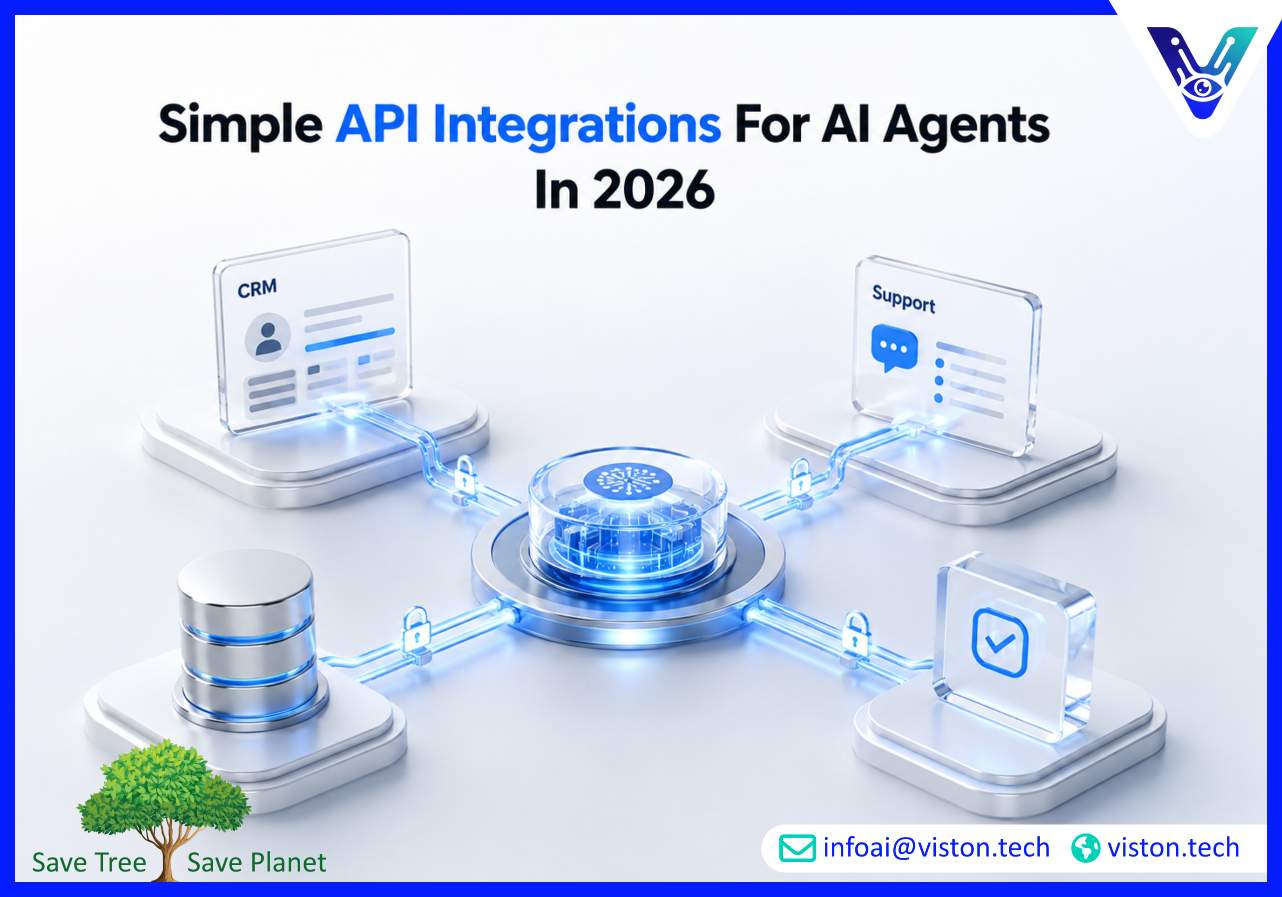
Simple API integrations for AI agents help businesses turn AI from a standalone assistant into a practical workflow tool that can read data, trigger actions, update systems, and support real operations with less manual effort.
Simple API integrations for AI agents connect an AI agent with external software systems through application programming interfaces. In practical terms, APIs allow the agent to interact with business tools such as CRMs, helpdesks, calendars, databases, payment platforms, project management tools, email systems, and internal applications.
Without integrations, an AI agent can usually answer questions or generate content based on available context. With API access, the same agent can become part of a workflow. It can retrieve customer records, check order status, create support tickets, update pipeline stages, send notifications, summarize account activity, or trigger follow-up tasks.
The word “simple” does not mean careless or basic. It means the integration is focused, well-scoped, secure, and designed around a clear business task. A simple API integration may connect one AI agent to one CRM action, one database lookup, or one support workflow. That narrow scope often makes it easier to test, govern, and scale later.
In 2026, businesses are moving beyond AI experimentation. The priority is no longer just asking AI to produce answers. Teams want AI agents that can work inside real business systems and complete useful tasks with proper controls.
API integrations are central to this shift because they give AI agents access to the systems where business work happens. For example, a sales agent needs CRM data. A support agent needs ticketing and knowledge base access. An operations agent may need ERP, inventory, spreadsheet, or database connections. A finance workflow may require invoice, approval, and reporting integrations.
The strongest AI agent integrations are usually not the most complicated ones. They solve a specific workflow problem, use reliable data, follow permission rules, and create a measurable operational improvement.
Simple API integrations are useful when an AI agent needs to move from conversation to action. The best use cases are repeatable, structured, and connected to a clear business outcome.
AI agents can connect with CRM systems to retrieve lead details, summarize account history, update deal stages, create follow-up tasks, or draft outreach based on customer context. This helps sales teams reduce administrative work and maintain cleaner pipeline data.
Support agents can use APIs to check ticket history, search knowledge bases, categorize issues, create new tickets, update ticket status, or escalate cases to the right team. This improves response consistency while keeping human teams involved where judgment is needed.
Operations teams can use AI agents to pull data from spreadsheets, databases, forms, project tools, or internal systems. Simple integrations can help with task creation, approvals, reporting, status checks, and exception alerts.
AI agents can connect with email platforms, campaign tools, analytics dashboards, and content systems to support research, segmentation, campaign summaries, reporting, and workflow notifications.
AI agents can retrieve information from business databases, generate summaries, flag missing data, prepare reports, or send alerts when certain conditions are met. This is especially useful for teams that regularly depend on updated information from multiple systems.
A successful integration starts with workflow clarity, not technology selection. Businesses should first define what the AI agent needs to do, which system it must access, what data it can use, and what action it is allowed to perform.
The safest way to begin is with a narrow use case. For example, instead of integrating an AI agent with an entire CRM, start with one action such as retrieving lead details or creating a follow-up task. This keeps the project easier to test and manage.
AI agents should not have unrestricted access to business systems. Access should be limited by role, task, data sensitivity, and approval requirements. Read-only access may be enough for many early integrations.
API integrations require proper authentication, token management, access control, and monitoring. Poor authentication handling can create security risks, especially when agents interact with customer records, financial data, or internal systems.
When an AI agent updates records or triggers workflows, validation is essential. The system should check required fields, confirm business rules, prevent duplicate actions, and escalate uncertain cases to a person.
Businesses should track API failures, incorrect outputs, incomplete tasks, latency, user feedback, and manual overrides. Monitoring helps improve reliability and prevents small integration issues from becoming operational problems.
A simple integration should be designed so it can expand later. Clean API design, structured logs, reusable connectors, clear documentation, and modular workflows make it easier to add more systems or agent capabilities over time.
Simple API integrations can deliver quick operational value, but they still require careful planning. Many failed AI integration projects are not caused by the AI model itself. They fail because the workflow, access rules, data quality, or system logic was not properly defined.
Trying to integrate multiple tools at once increases complexity. It becomes harder to test the agent, trace errors, manage permissions, and understand where failures happen. A focused first integration is usually more effective.
AI agents depend on the data they receive. If CRM fields are outdated, support categories are inconsistent, or internal documentation is unclear, the agent may produce unreliable actions or recommendations.
Some workflows should not be fully automated. Refunds, contract updates, financial approvals, legal responses, customer complaints, and sensitive communications may require human review before completion.
APIs can fail because of rate limits, authentication issues, missing fields, downtime, or malformed requests. Reliable integrations need fallback logic, alerts, retries, and clear escalation paths.
Businesses need visibility into what the agent accessed, what action it took, when it acted, and why. Logs, permissions, version control, and approval records are important for trust and accountability.
Viston AI is relevant to businesses exploring simple API integrations for AI agents because its service offering includes Agent Integration Services and broader AI agent development capabilities. This aligns directly with the practical need to connect AI agents with real business systems, workflows, and data sources.
For organizations that want AI agents to do more than answer questions, Viston AI can support integration planning, workflow analysis, API connection design, agent configuration, testing, and deployment. This may include connecting agents with CRMs, support tools, databases, automation systems, internal applications, or other business platforms where structured access is required.
The value of this approach is not simply technical connectivity. Good agent integration requires understanding the business process, defining safe permissions, setting up validation rules, handling errors, and ensuring the agent supports a real operational outcome. Viston AI’s focus on Agent Integration Services makes it suitable for companies that need practical implementation support rather than experimental AI features.
For businesses across industries and global markets, simple API integrations can create a controlled starting point for AI adoption. They allow teams to improve one workflow first, prove value, reduce risk, and then expand toward more advanced agentic automation when the foundation is reliable.
Simple API integrations for AI agents connect an AI agent to external business software so it can retrieve data, trigger actions, update records, or support workflow automation through controlled API access.
AI agents need API integrations to work with real business systems. APIs allow agents to access current data, interact with tools, and complete useful tasks instead of only generating responses.
AI agents can connect to CRMs, ERPs, helpdesks, databases, calendars, email platforms, project management tools, analytics dashboards, payment systems, and custom internal applications.
They can be secure when designed with proper authentication, limited permissions, access controls, monitoring, validation, audit logs, and human approval for sensitive actions.
The best first integration is usually a narrow, high-value workflow such as retrieving CRM details, creating support tickets, updating task status, generating reports, or sending internal notifications.
Yes. Viston AI’s Agent Integration Services align with connecting AI agents to business systems, designing practical workflows, and supporting reliable implementation for operational use cases.
Simple API integrations for AI agents are one of the most practical ways for businesses to move from AI experimentation to real workflow value. By connecting agents with business systems through secure, focused, and well-tested APIs, organizations can reduce manual effort, improve data access, speed up routine tasks, and create a stronger foundation for agentic automation. Agent Integration Services help businesses design these connections responsibly, with the right balance of automation, control, security, and scalability. Viston AI is a relevant specialist for organizations that want AI agents to operate inside real business workflows, not just isolated conversations.
