Sentiment Analysis Without Coding Tools: A Practical 2026 Guide for Businesses
Sentiment analysis without coding tools helps businesses understand customer emotions without building complex NLP systems from scratch. In 2026, no-code sentiment analysis is especially useful for teams that need faster insight from reviews, surveys, support tickets, chats, and social media feedback.
What Sentiment Analysis Without Coding Tools Means
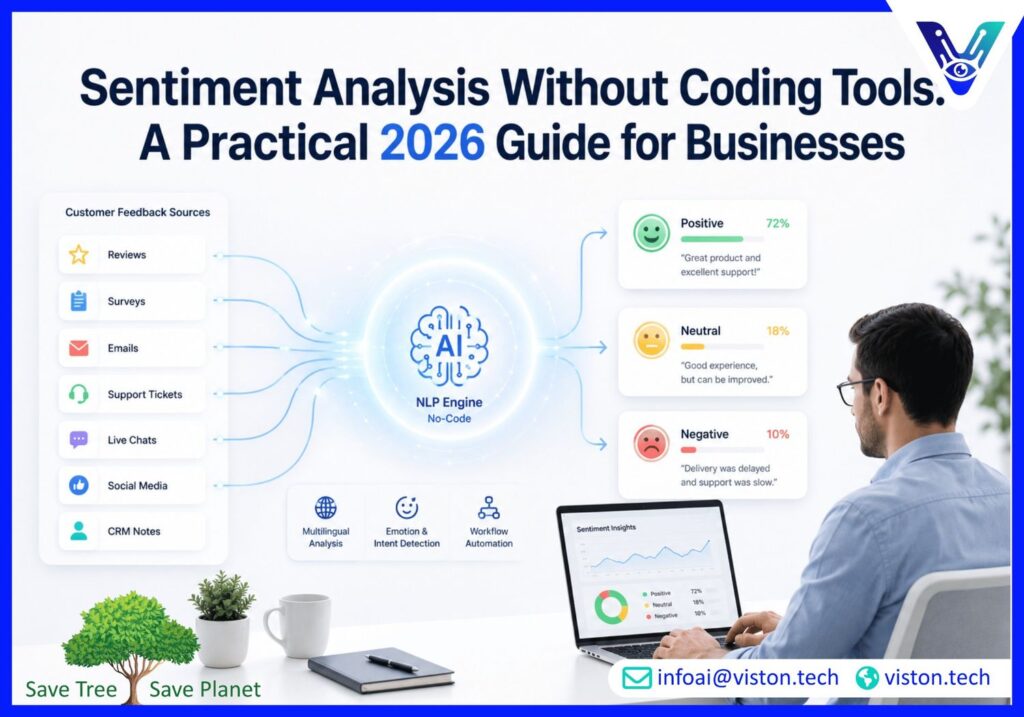
Sentiment analysis without coding tools refers to platforms, dashboards, and AI-powered applications that classify text as positive, negative, neutral, or more detailed emotional categories without requiring users to write code.Instead of hiring developers to build custom machine learning pipelines, business teams can upload data, connect customer feedback sources, configure rules, and review sentiment insights through a user-friendly interface.Common data sources include:
Customer reviews
Survey responses
Support tickets
Live chat transcripts
Social media comments
CRM notes
Email feedback
Product feedback forms
The goal is simple: turn unstructured customer language into useful business signals. A no-code tool can help teams identify dissatisfaction, recurring complaints, product issues, service gaps, positive feedback themes, and emerging risks faster than manual review.
Why No-Code Sentiment Analysis Matters in 2026
Businesses now collect more customer feedback than most teams can read manually. Reviews, chats, comments, and support conversations often contain the clearest signals about customer satisfaction, loyalty, churn risk, and product-market fit.Without sentiment analysis, teams usually rely on small samples, manual tagging, or assumptions. That creates several problems. Negative trends may be noticed too late. Product teams may miss repeated complaints. Marketing teams may misunderstand brand perception. Support leaders may struggle to separate urgent emotional issues from routine requests.No-code sentiment analysis tools reduce that gap by making NLP-based insight accessible to non-technical teams. Marketing, customer support, product, operations, and leadership teams can monitor sentiment patterns without waiting for engineering resources.In 2026, businesses also expect sentiment analysis tools to support stronger workflows, including:
Real-time feedback monitoring
Multilingual text analysis
Aspect-based sentiment detection
Emotion and intent classification
CRM and helpdesk integrations
Automated alerts for negative sentiment
Dashboards for teams and executives
Exportable reports for decision-making
How Businesses Can Use Sentiment Analysis Without Coding
Customer Support Prioritization
Support teams can use sentiment analysis to identify frustrated customers, urgent complaints, and negative interactions. This helps managers prioritize tickets based on emotional severity, not just arrival time.
Review and Reputation Monitoring
Businesses can analyze product reviews, Google reviews, marketplace feedback, and app store comments to understand what customers like or dislike. This is useful for improving service quality, product messaging, and customer experience.
Product Feedback Analysis
Product teams can group feedback by topic and sentiment. For example, customers may be positive about pricing but negative about onboarding, delivery, usability, or support speed.
Marketing Campaign Evaluation
Marketing teams can monitor how audiences respond to campaigns, launches, offers, and brand messaging. Sentiment analysis helps separate visibility from actual audience approval.
Customer Churn Risk Detection
Repeated negative sentiment in tickets, emails, surveys, or chat conversations can signal churn risk. No-code tools help customer success teams detect these warning signs earlier.
Choosing the Right No-Code Sentiment Analysis Tool
The best tool depends on the type of feedback, volume of data, business workflow, and reporting needs. A simple upload-based tool may be enough for occasional review analysis, while a growing company may need integrations with CRM, helpdesk, ecommerce, or social listening platforms.Important evaluation factors include:
Accuracy across your industry language
Support for your customer feedback channels
Ability to detect topics, emotions, and sentiment intensity
Multilingual capability if serving global customers
Data privacy and access control
Ease of dashboard use for non-technical teams
Reporting and export options
Integration with existing tools
Ability to customize categories or labels
Scalability as feedback volume grows
Businesses should also test tools with real customer data before making a decision. Generic demos may look impressive, but sentiment accuracy depends heavily on context, wording, industry terms, sarcasm, abbreviations, and multilingual variations.
Frequently Asked Questions
What are sentiment analysis without coding tools?
They are no-code platforms that analyze customer text and classify sentiment without requiring programming knowledge.
Can no-code sentiment analysis tools be accurate?
Yes, but accuracy depends on data quality, language complexity, industry terminology, and whether the tool supports customization.
Who should use no-code sentiment analysis?
Marketing teams, support teams, product managers, ecommerce businesses, operations teams, and leadership teams can use it to understand customer feedback faster.
What data can be analyzed?
Common data includes reviews, surveys, support tickets, emails, social media comments, chat transcripts, and CRM notes.
Is no-code sentiment analysis suitable for small businesses?
Yes. Small businesses can use it to analyze reviews and feedback without hiring developers or building custom NLP systems.
Conclusion
Sentiment analysis without coding tools gives businesses a practical way to understand customer emotion at scale. Instead of relying only on manual review, teams can identify patterns, risks, complaints, and positive signals faster. In 2026, the strongest value comes from choosing tools that match real feedback channels, support business workflows, and provide reliable insights that teams can act on.