
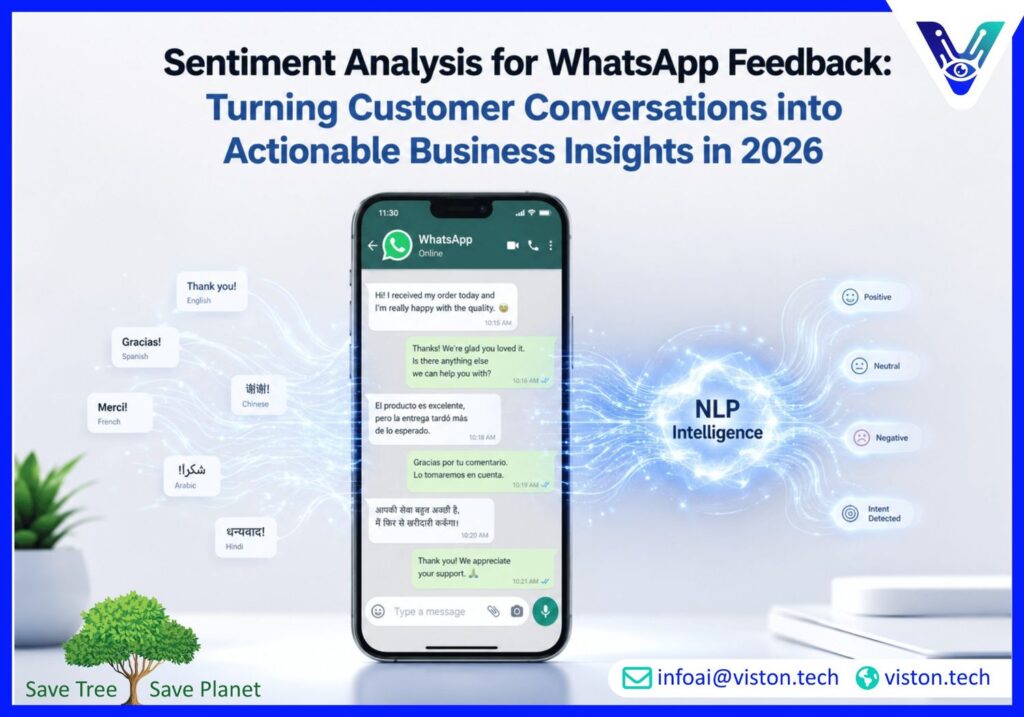
WhatsApp has become one of the most widely used communication channels between businesses and customers. From support interactions and service requests to product inquiries and post-purchase feedback, valuable customer opinions are shared every day through WhatsApp conversations. Sentiment analysis for WhatsApp feedback helps organizations transform these unstructured conversations into meaningful insights that improve customer experience, operational performance, and business decision-making.
Sentiment analysis for WhatsApp feedback is the process of using Natural Language Processing (NLP), machine learning, and artificial intelligence to identify the emotional tone behind customer messages. It helps businesses determine whether customer feedback is positive, negative, neutral, or mixed.
Unlike traditional surveys that often capture limited responses, WhatsApp conversations provide continuous and real-time customer feedback. Sentiment analysis enables organizations to automatically process large volumes of messages and identify customer attitudes without manual review.
Businesses can analyze WhatsApp feedback to understand:
As customer communication increasingly shifts toward messaging platforms, organizations are recognizing WhatsApp feedback as a valuable source of business intelligence.
Customer expectations continue to evolve rapidly. Many consumers now prefer messaging apps over emails, web forms, and phone calls for interacting with businesses. WhatsApp offers convenience, speed, and familiarity, making it a preferred communication channel across industries.
However, this shift creates new challenges for organizations. Large volumes of conversational data can quickly become difficult to monitor manually.
Without sentiment analysis, businesses may struggle to:
Organizations that implement sentiment analysis can proactively respond to customer concerns, improve retention rates, and make data-driven decisions based on real customer experiences.
Customer sentiment can change rapidly. Real-time sentiment analysis allows businesses to identify negative experiences immediately and take corrective action before issues escalate.
Support teams can receive alerts when customers express frustration, dissatisfaction, or urgency, enabling faster resolution and improved customer outcomes.
Negative feedback often serves as an early warning sign of customer churn. Sentiment analysis helps organizations identify at-risk customers and intervene proactively.
By addressing concerns before customers leave, businesses can strengthen relationships and reduce customer attrition.
As customer interactions grow, manually reviewing every WhatsApp conversation becomes impractical. Automated sentiment analysis enables organizations to process thousands of messages efficiently while maintaining consistency and accuracy.
This scalability is particularly valuable for enterprises handling large customer bases across multiple regions.
Customer opinions provide valuable input for product development, service improvements, marketing strategies, and operational planning.
Sentiment analysis converts conversational feedback into structured insights that decision-makers can use to guide business priorities.
Monitoring sentiment across WhatsApp interactions helps organizations understand how customers perceive their brand.
Businesses can identify recurring praise, complaints, and emerging issues that influence overall customer perception.
A modern sentiment analysis workflow typically involves multiple stages designed to transform raw conversational data into actionable insights.
WhatsApp feedback is collected from customer conversations, support chats, surveys, automated interactions, and service communications.
Customer messages often contain emojis, abbreviations, spelling variations, slang, and multilingual content. Preprocessing ensures that the data is prepared for accurate analysis.
NLP algorithms analyze message structure, context, keywords, and linguistic patterns to understand customer intent and emotional tone.
The system categorizes messages into sentiment categories such as:
More advanced systems may also identify emotions such as frustration, satisfaction, disappointment, excitement, or urgency.
The analyzed results are transformed into dashboards, reports, trend analysis, alerts, and actionable recommendations for business teams.
This allows organizations to move beyond raw feedback and focus on measurable improvements.
Sentiment analysis for WhatsApp feedback has applications across virtually every industry.
Retail businesses can monitor customer opinions regarding products, delivery experiences, pricing concerns, returns, and customer support interactions.
Healthcare providers can assess patient satisfaction, appointment experiences, communication effectiveness, and service quality feedback.
Banks and financial institutions can analyze customer sentiment regarding digital banking services, support interactions, onboarding processes, and transaction experiences.
Telecom providers can identify recurring customer concerns related to network quality, billing, technical support, and service availability.
Hotels, airlines, and travel providers can evaluate guest experiences, booking satisfaction, service quality, and operational performance.
Regardless of industry, organizations benefit from understanding customer sentiment at scale.
As organizations increasingly rely on conversational data to understand customer behavior, sentiment analysis solutions must deliver more than basic keyword detection. Businesses need scalable platforms capable of processing large volumes of customer feedback across multiple communication channels while maintaining accuracy and business relevance.
Viston AI focuses on advanced sentiment analysis solutions designed to help organizations extract meaningful insights from customer interactions. By leveraging Natural Language Processing, machine learning, and AI-driven analytics, businesses can gain deeper visibility into customer opinions, satisfaction trends, and emerging concerns.
For organizations using WhatsApp as a customer engagement channel, sentiment analysis can support multiple operational objectives, including customer experience monitoring, service quality improvement, complaint management, and customer retention initiatives.
Modern sentiment analysis implementations also require capabilities such as multilingual support, real-time monitoring, scalable processing, analytics dashboards, reporting automation, and integration with business systems. These capabilities help transform raw conversational data into actionable intelligence that supports strategic decision-making.
For global organizations operating across diverse customer segments, effective sentiment analysis enables teams to understand customer expectations more accurately while improving responsiveness and overall service performance.
Organizations should establish specific goals before implementing sentiment analysis. Objectives may include improving customer satisfaction, reducing churn, monitoring brand perception, or enhancing support performance.
Accurate sentiment analysis depends on clean, relevant, and representative customer data. Businesses should implement proper data collection and preprocessing practices.
Global organizations often receive feedback in multiple languages. Multilingual sentiment analysis capabilities are essential for maintaining consistent insight quality.
Sentiment scores alone may not provide complete business understanding. Combining sentiment analysis with customer journey data, support metrics, and operational insights improves decision-making.
Customer sentiment evolves over time. Continuous monitoring allows businesses to detect changes quickly and adapt strategies accordingly.
Sentiment analysis for WhatsApp feedback uses AI and Natural Language Processing to identify customer emotions, opinions, and attitudes from WhatsApp conversations.
WhatsApp conversations often contain valuable customer insights that reveal satisfaction levels, service issues, product concerns, and brand perceptions in real time.
Yes. Modern sentiment analysis systems can automatically analyze thousands of messages efficiently, making them suitable for both growing businesses and large enterprises.
For organizations operating across multiple markets, multilingual capabilities help ensure accurate sentiment detection regardless of language or regional communication patterns.
Viston AI provides sentiment analysis capabilities that help organizations transform customer conversations into actionable insights, enabling better customer experience management and informed business decisions.
Common outcomes include improved customer satisfaction, enhanced retention, faster issue resolution, stronger brand reputation monitoring, and more informed operational planning.
Sentiment analysis for WhatsApp feedback has become an essential capability for organizations seeking to understand customer experiences at scale in 2026. As customer communication increasingly moves toward messaging platforms, businesses need efficient ways to transform conversations into actionable insights. By combining advanced sentiment analysis with modern NLP technologies, organizations can identify customer concerns faster, improve service quality, strengthen retention efforts, and make more informed business decisions. For companies looking to unlock greater value from customer interactions, sentiment analysis provides a practical foundation for customer-centric growth and continuous improvement.
