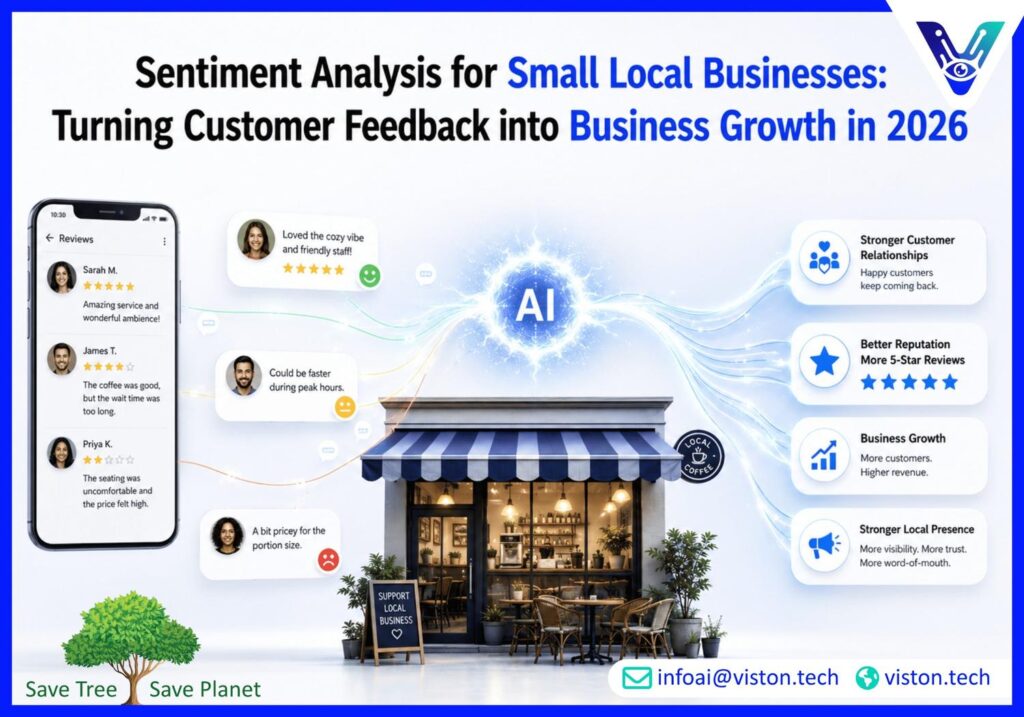
Sentiment Analysis for Small Local Businesses: Turning Customer Feedback into Business Growth in 2026
Customer opinions can make or break a local business. Whether feedback appears in online reviews, social media comments, surveys, emails, or messaging platforms, understanding customer sentiment has become essential for business growth. In 2026, sentiment analysis helps small local businesses transform large volumes of customer feedback into actionable insights that improve customer experience, reputation, and profitability.
What Sentiment Analysis Means for Small Local Businesses
Sentiment analysis is the process of using artificial intelligence and natural language processing to identify and categorize customer opinions as positive, negative, or neutral. Instead of manually reviewing hundreds of comments and reviews, businesses can automatically understand how customers feel about their products, services, staff, pricing, and overall experience.For small local businesses, this capability is particularly valuable because customer relationships directly impact revenue and reputation. Local businesses often rely heavily on word-of-mouth marketing, online reviews, and repeat customers.Common sources of customer sentiment include:
Google Business Profile reviews
Social media comments and mentions
Customer surveys
Email feedback
Live chat conversations
Support tickets
Online marketplace reviews
Community forums and local discussion groups
By analyzing these channels collectively, businesses gain a clearer understanding of customer expectations and emerging concerns.
Why Sentiment Analysis Matters More in 2026
Customer expectations continue to evolve rapidly. Consumers now expect faster responses, personalized experiences, and consistent service quality across all touchpoints. A single negative experience can quickly influence potential customers through online reviews and social media.Several factors have increased the importance of sentiment analysis for local businesses:
Growing Review Influence
Many customers research local businesses online before making purchasing decisions. Reviews often become a deciding factor when choosing between competitors.
Higher Customer Expectations
Modern consumers expect businesses to listen, respond, and adapt quickly to feedback. Companies that fail to understand customer concerns risk losing market share.
Increasing Feedback Volume
Even small businesses receive feedback across multiple digital channels. Manual review processes are becoming increasingly difficult to manage efficiently.
Competitive Local Markets
In crowded local markets, customer experience often becomes a key differentiator. Understanding customer sentiment helps businesses identify opportunities for improvement before competitors do.
Key Benefits of Sentiment Analysis for Small Local Businesses
Implementing sentiment analysis can deliver measurable business value beyond simply monitoring reviews.
Improved Customer Experience
Sentiment analysis helps identify recurring complaints and customer frustrations. Businesses can address issues proactively and improve service quality based on real customer feedback.
Better Reputation Management
Negative sentiment trends can be detected early before they become widespread reputation issues. This allows business owners to respond quickly and protect their brand image.
Stronger Customer Retention
Understanding why customers are satisfied or dissatisfied helps businesses improve loyalty and reduce customer churn.
More Informed Business Decisions
Customer sentiment data can reveal valuable insights about products, pricing, staff performance, service quality, and operational processes.
Marketing Optimization
Businesses can identify which products, services, or customer experiences generate the most positive sentiment and use those insights to strengthen marketing campaigns.
Competitive Intelligence
Monitoring sentiment around competitors can help local businesses understand market expectations and identify opportunities to differentiate themselves.
How Sentiment Analysis Works in Practice
Modern sentiment analysis solutions use advanced AI models to process customer feedback automatically.The typical process includes:
Collecting feedback from multiple channels
Cleaning and organizing customer data
Analyzing text using natural language processing models
Classifying sentiment categories
Identifying common themes and topics
Generating reports and actionable insights
Tracking sentiment trends over time
Advanced solutions can go beyond basic positive and negative classifications. They can detect emotions, urgency levels, customer intent, and specific topics generating praise or criticism.For example, a restaurant may discover that food quality receives highly positive feedback while delivery times consistently generate negative comments. This level of insight enables targeted operational improvements.
Common Use Cases for Local Businesses
Sentiment analysis can support various industries and business models within local markets.
Restaurants and Cafes
Monitor food quality feedback
Track service satisfaction
Identify menu preferences
Manage online review reputation
Retail Stores
Understand product satisfaction
Evaluate customer service experiences
Identify inventory-related concerns
Improve in-store experiences
Healthcare Clinics
Analyze patient feedback
Improve appointment experiences
Monitor service quality perceptions
Support patient satisfaction initiatives
Professional Service Providers
Track client satisfaction
Identify service improvement opportunities
Strengthen client relationships
Improve retention strategies
Regardless of industry, the goal remains the same: understanding customer opinions to make smarter business decisions.
How Viston AI Supports Sentiment Analysis Initiatives
For organizations looking to implement sentiment analysis effectively, specialized expertise in artificial intelligence and natural language processing can significantly improve outcomes. Viston AI focuses on sentiment analysis solutions designed to help businesses extract meaningful insights from customer conversations, reviews, surveys, and other feedback channels.Rather than simply classifying feedback as positive or negative, effective sentiment analysis requires accurate language processing, contextual understanding, scalable data handling, reporting capabilities, and integration with existing business systems. Businesses often need solutions that can process feedback from multiple sources while delivering insights that support operational and strategic decision-making.Viston AI’s sentiment analysis capabilities help organizations transform unstructured customer feedback into actionable intelligence. This can support customer experience improvement initiatives, reputation management efforts, service optimization programs, and customer retention strategies.As customer feedback volumes continue to grow across digital channels, businesses increasingly require scalable sentiment analysis frameworks capable of delivering consistent and reliable insights. By focusing on practical business outcomes and data-driven decision-making, sentiment analysis solutions can help organizations better understand customer expectations and respond more effectively to changing market demands.
Implementation Considerations Before Choosing a Sentiment Analysis Solution
Not all sentiment analysis platforms offer the same capabilities. Small businesses should evaluate solutions carefully before implementation.
Data Source Coverage
The platform should support the communication channels most relevant to your business.
Accuracy and Context Understanding
Industry-specific terminology, sarcasm, and customer intent can impact accuracy. Advanced AI models generally provide better results.
Reporting and Dashboards
Insights should be easy to understand and actionable for business decision-makers.
Scalability
The solution should accommodate business growth and increasing feedback volumes.
Integration Capabilities
Compatibility with CRM systems, customer support platforms, survey tools, and marketing systems can improve efficiency.
Privacy and Security
Customer feedback data should be processed using appropriate security and compliance practices.
Frequently Asked Questions
What is sentiment analysis for small local businesses?
Sentiment analysis uses AI and natural language processing to evaluate customer opinions from reviews, surveys, social media, and other feedback channels, helping businesses understand customer satisfaction and identify improvement opportunities.
Can sentiment analysis help improve online reviews?
Yes. Sentiment analysis helps businesses identify recurring issues that contribute to negative reviews, enabling corrective actions that improve customer experiences and future ratings.
Is sentiment analysis affordable for small businesses?
Many modern sentiment analysis solutions offer scalable pricing models, making them accessible to small and medium-sized businesses without requiring enterprise-level budgets.
What data sources can be analyzed?
Common sources include online reviews, surveys, social media posts, customer support tickets, emails, chat conversations, and feedback forms.
How accurate are modern sentiment analysis systems?
Advanced AI-powered platforms can achieve high levels of accuracy, particularly when trained to understand industry-specific language and customer communication patterns.
How can Viston AI help with sentiment analysis?
Viston AI provides sentiment analysis solutions that help businesses analyze customer feedback, identify trends, improve customer experience, and support data-driven decision-making through AI-powered insights.
Conclusion
Sentiment analysis for small local businesses has evolved from a competitive advantage into a practical business necessity. As customer interactions continue to expand across digital channels, understanding customer opinions quickly and accurately becomes increasingly important. By leveraging sentiment analysis, businesses can strengthen customer relationships, improve operational performance, protect their reputation, and make more informed decisions. For organizations seeking to transform customer feedback into measurable business value, sentiment analysis solutions provide a structured and scalable approach to understanding what customers truly think and expect.