
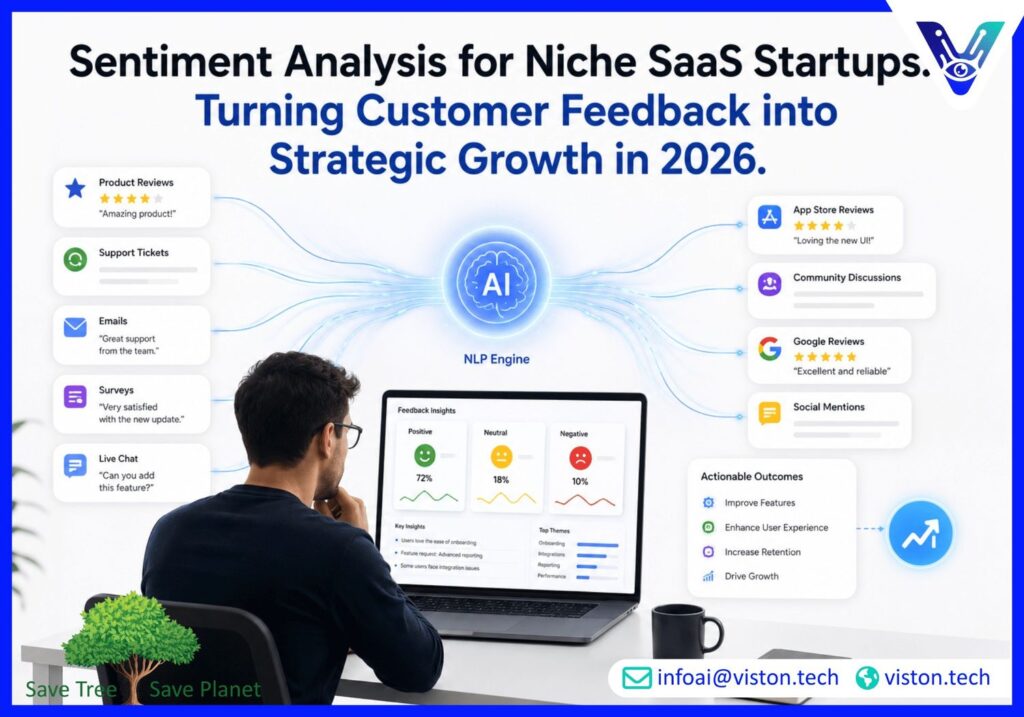
For niche SaaS startups, customer perception can significantly influence growth, retention, product adoption, and market positioning. As competition increases across specialized software markets, understanding what users think, feel, and expect has become a business necessity. Sentiment analysis helps SaaS companies transform customer feedback into actionable insights that support better product decisions and stronger customer experiences.
Sentiment analysis is the process of using natural language processing (NLP) and artificial intelligence to evaluate customer opinions, emotions, and attitudes expressed through text-based interactions.
For niche SaaS startups, sentiment analysis can process large volumes of feedback from sources such as:
Rather than manually reviewing thousands of comments, startups can automatically identify whether feedback is positive, negative, or neutral while uncovering recurring themes and concerns.
This enables leadership teams to make faster, data-driven decisions that align with customer expectations.
SaaS buyers today expect rapid improvements, personalized experiences, and responsive support. For startups operating in highly specialized markets, customer feedback often contains valuable signals that directly affect growth.
Acquiring customers continues to be expensive for SaaS companies. Retaining existing customers often delivers significantly greater long-term value.
Sentiment analysis helps identify early warning signs of dissatisfaction before customers cancel subscriptions or reduce usage.
Many niche SaaS startups rely on product-led growth models where customer satisfaction drives referrals, reviews, and expansion revenue.
Understanding user sentiment helps product teams prioritize improvements that have the greatest impact on adoption and retention.
Whether serving healthcare, fintech, logistics, legal technology, education, or manufacturing sectors, niche SaaS providers face growing competition.
Companies that understand customer sentiment can respond more effectively to market expectations and changing customer needs.
Customers often express dissatisfaction long before they submit formal complaints.
Sentiment analysis can uncover recurring concerns related to:
These insights allow teams to address issues proactively.
Product teams frequently receive more feature requests than they can implement.
Sentiment analysis helps determine which requests generate the strongest emotional responses from customers, enabling smarter roadmap prioritization.
Negative sentiment patterns often emerge before customers leave.
By monitoring customer interactions continuously, startups can identify at-risk accounts and intervene before churn occurs.
Customer conversations reveal how users perceive a product compared to alternatives.
This information helps marketing and leadership teams refine messaging, positioning, and differentiation strategies.
Modern sentiment analysis platforms combine machine learning, NLP models, and business intelligence capabilities to process customer feedback at scale.
The first step involves gathering feedback from multiple customer touchpoints.
The system analyzes customer comments and categorizes sentiment into positive, negative, or neutral classifications.
Advanced solutions can also detect emotions such as:
Beyond sentiment scoring, modern platforms identify recurring themes across customer conversations.
This helps businesses understand what specific issues are driving customer opinions.
Dashboards provide leadership teams with measurable insights into customer satisfaction trends, feature feedback, support performance, and overall sentiment changes.
Customer feedback becomes easier to analyze and prioritize, allowing development teams to focus on high-impact improvements.
Understanding user sentiment helps businesses address pain points that affect customer satisfaction.
Customer success teams can identify unhappy users earlier and take corrective actions before relationships deteriorate.
Leadership teams gain visibility into customer expectations and market sentiment, improving planning and investment decisions.
Monitoring customer sentiment helps organizations respond quickly to negative feedback and strengthen positive customer relationships.
For niche SaaS startups seeking deeper customer intelligence, sentiment analysis requires more than simple positive or negative scoring. Businesses need solutions capable of analyzing customer feedback across multiple channels while providing actionable insights that support product development, customer success, and growth initiatives.
Viston AI specializes in sentiment analysis solutions designed to help organizations transform unstructured customer feedback into meaningful business intelligence. By leveraging advanced natural language processing technologies, machine learning models, and scalable analytics capabilities, the platform can process customer conversations from diverse data sources.
For SaaS companies, this enables teams to identify emerging customer concerns, understand user expectations, monitor satisfaction trends, and uncover opportunities for product enhancement. The ability to analyze large volumes of customer feedback in real time helps organizations make informed decisions without relying solely on manual review processes.
As customer expectations continue to evolve in 2026, businesses increasingly require sentiment analysis solutions that integrate with existing workflows, support scalable growth, and deliver measurable insights. Organizations operating in specialized SaaS markets can benefit from a structured approach to understanding customer sentiment and improving business outcomes through data-driven decision-making.
Sentiment analysis uses AI and natural language processing to evaluate customer opinions, emotions, and feedback across various communication channels, helping SaaS businesses understand customer satisfaction and concerns.
Niche SaaS startups often serve specialized audiences where customer feedback directly influences product development, retention, and growth. Sentiment analysis helps identify opportunities and risks more efficiently.
Yes. By detecting negative sentiment patterns early, businesses can proactively engage customers, address concerns, and improve retention outcomes.
Sentiment analysis can process reviews, support tickets, emails, surveys, social media comments, and listings from directories.
Modern AI-powered sentiment analysis platforms achieve strong accuracy levels when properly trained and configured, especially when combined with industry-specific language models and continuous optimization.
Viston AI provides sentiment analysis capabilities that help SaaS businesses monitor customer feedback, identify trends, understand user sentiment, and generate actionable insights that support growth and customer experience initiatives.
Sentiment analysis for niche SaaS startups has evolved into a strategic capability that supports customer retention, product innovation, and business growth. As customer expectations continue to rise in 2026, organizations that effectively understand and act on customer feedback gain a meaningful competitive advantage. By combining advanced sentiment analysis technologies with a structured customer intelligence strategy, SaaS companies can make better decisions, improve user experiences, and build stronger long-term customer relationships. For businesses seeking scalable sentiment analysis expertise, Viston AI offers solutions aligned with modern customer insight and growth objectives.
