
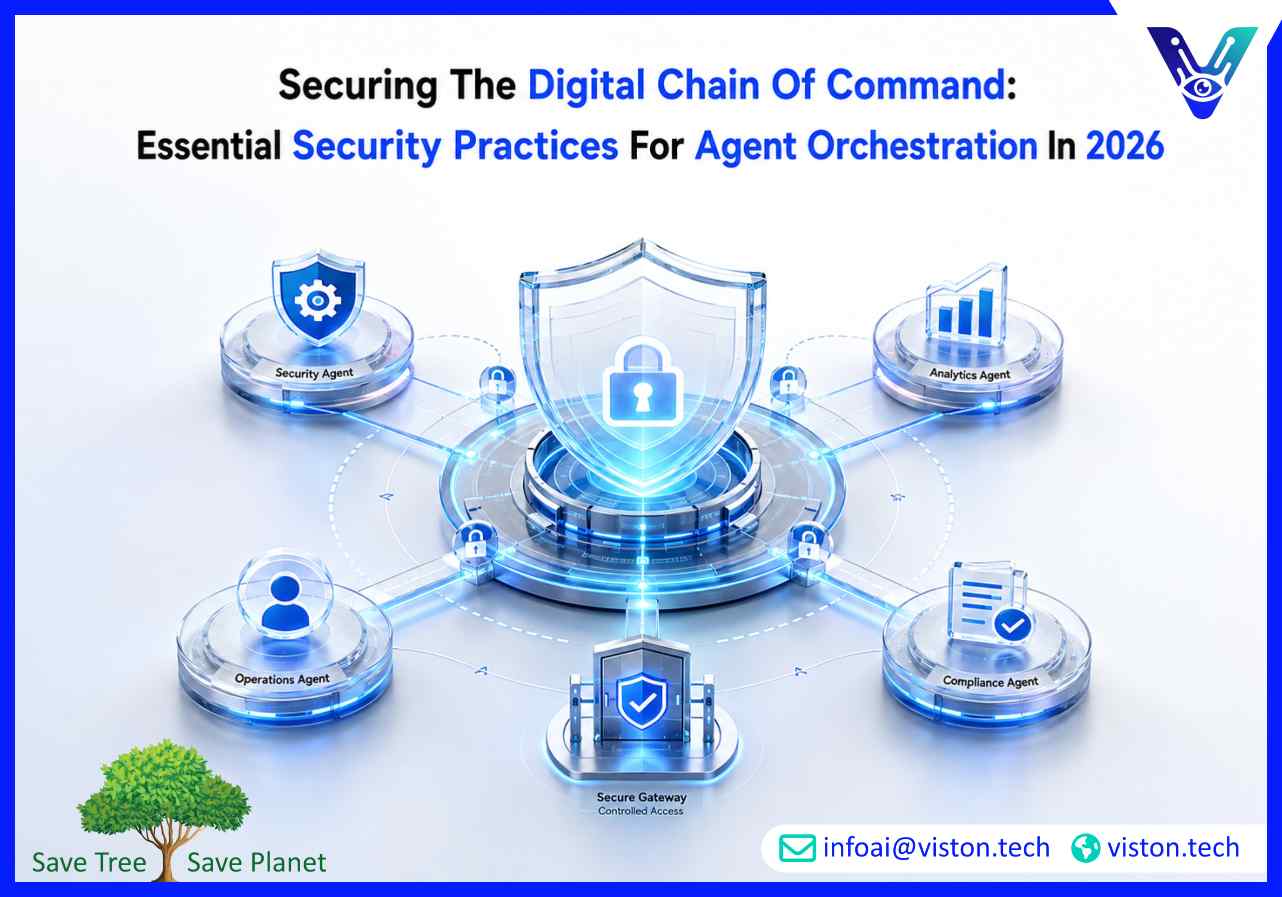
Agentic AI is moving from experimental pilot to production reality. Unlike traditional automation, these systems don’t simply execute pre-written scripts; they reason, plan, and take autonomous action. At the heart of this capability lies a new, often overlooked attack surface: agent orchestration. This process—how agents are directed, how they communicate, and how they access tools and data—has become the digital “chain of command.” For organizations developing and deploying AI agents, securing orchestration is no longer optional. It is the difference between controlled automation and operational catastrophe.
In 2025 and 2026, the security industry has reached a clear consensus: the prompt is not a perimeter. While early AI safety focused on filtering inputs and outputs, agentic systems demand a different approach. An agent doesn’t just generate text; it calls APIs, modifies databases, sends emails, and provisions cloud resources. The orchestration layer governs these actions. As the Cloud Security Alliance notes, we are moving from software that executes instructions to systems that initiate actions, creating a need for an “Agentic Control Plane” to manage identity, authorization, and runtime behavior . If an attacker compromises the orchestration logic or the communication channel between agents, they effectively control the entire autonomous workforce. This is the shift from protecting what the model says to governing what the agent does
To secure orchestration, organizations must first understand the unique risks that arise when multiple autonomous systems interact. These go far beyond traditional application security concerns and are specific to the agentic paradigm.
The most critical risk occurs when an agent has access to a suite of tools but lacks sufficient context to validate the intent behind a request. This creates the “confused deputy” vulnerability, where an agent is tricked into performing a malicious action (e.g., exfiltrating data or deleting a file) because it believes the request is legitimate . An attacker doesn’t need to break the agent’s security; they simply need to provide a poisoned instruction or indirect prompt injection hidden in a document or web page the agent reads. Effective security must therefore constrain not just what tools an agent can use, but under what circumstances and with what specific parameters.
In a multi-agent system, agents often delegate subtasks to specialized peers. This introduces risk at every handoff. If a high-privilege orchestrator agent can delegate a sensitive task to a lower-privilege worker agent without re-authentication, the integrity of the action is compromised. Furthermore, early agentic systems often rely on long-lived static API keys or shared service accounts. These credentials represent a catastrophic single point of failure. OWASP’s guidance on securing agentic apps emphasizes treating every agent as a distinct, manageable non-human identity (NHI) with its own short-lived credentials, just as you would a human employee . Long-lived secrets are a breach waiting to happen.
Many advanced agents utilize long-term memory or retrieval-augmented generation (RAG) to maintain context across sessions. This creates a new attack vector: memory poisoning. An attacker could interact with an agent in one session to embed a malicious bias or hidden instruction into its long-term memory store. In a future session, that agent would unknowingly act on the poisoned data, potentially violating policies without any visible trigger . Securing orchestration, therefore, requires validating and sanitizing any external data before it is committed to an agent’s memory, treating all external content as hostile until proven otherwise.
Based on the emerging threats of 2026, organizations must implement a set of non-negotiable security controls at the orchestration level. These practices move beyond reactive guardrails to proactive, systemic governance.
Forget the perimeter. Security for agentic systems starts with identity. Each agent, whether a top-level orchestrator or a specialized worker, must have a unique, verifiable identity. Instead of static credentials, orchestration should leverage just-in-time (JIT) authorization. Before an agent executes any action, the orchestration layer should request a narrowly-scoped, short-lived token (e.g., using OAuth or SPIFFE) that is valid only for that specific task and expires immediately after completion . This ensures that even if an agent is compromised, the attacker’s window of opportunity and blast radius are minimal.
Traditional “least privilege” defines what resources an identity can access. “Least agency” goes further, defining what actions an agent can take, when, and under what conditions . This is best enforced via policy-as-code, integrated directly into the orchestration control plane. For every action request, a policy engine (like Open Policy Agent) should evaluate not just the identity but also the context: Is this action within the agent’s defined scope? Does it exceed a cost or time ceiling? Is it an approved tool chain? This runtime policy enforcement is the only way to block the “confused deputy” from chaining together several benign actions into a malicious workflow .
A central tenet of secure orchestration is eliminating direct, untrusted communication between agents and tools. The emerging best practice is to enforce a gateway pattern. All traffic from agents to external servers, databases, or even other agents should pass through a dedicated orchestration gateway . This gateway becomes the single point for enforcing authentication, logging all requests and responses, applying rate limiting, and even transforming or validating data. It provides the visibility necessary to detect anomalies, such as an agent suddenly attempting to access a database it has never used before, and block the request instantly.
Finally, security requires accountability. Organizations must maintain a living inventory (an AI SBOM) of every agent in production, including its version, the models it uses, the tools it has permission to call, and its designated owner . The orchestration layer must log an immutable, tamper-proof audit trail of every significant event: every agent action, every tool call, every human approval, and every data access. This is not just for compliance; it is essential for forensic analysis and for answering the CEO-level question: “Can we reconstruct exactly why our agent made that specific decision?” .
As a specialist in AI Agent Development & Deployment, Viston AI understands that effective orchestration is the foundation of reliable, production-grade autonomy. We design and deploy agentic systems with security embedded at every layer of the orchestration workflow. Our approach focuses on implementing the principles of zero-trust for non-human identities, building custom gateways that govern tool access, and coding policies that enforce “least agency” by default. We help organizations move from fragile, prompt-based controls to a robust, identity-first security architecture. Whether you are deploying a single customer support agent or a complex multi-agent system for financial analysis, Viston AI builds the orchestration logic to be transparent, auditable, and resilient. We focus on ensuring your agents act precisely as intended—no more, no less—providing the confidence needed to scale your autonomous operations securely.
Agent orchestration refers to the systems and logic that govern how AI agents are directed, how they communicate with each other, and how they access tools and data. From a security perspective, it is the control plane for autonomous action. Securing orchestration means ensuring that every agent action is authorized, auditable, and aligned with its intended purpose.
Traditional applications execute a deterministic, pre-defined set of instructions. AI agents are non-deterministic; they make contextual decisions and can chain actions in unforeseen ways. This means you cannot simply secure the code. You must secure the runtime context, the communication channels between agents, and the tools they can access. The primary risk shifts from a code vulnerability to a logic or prompt-based manipulation that leads to unintended, autonomous action.
“Least agency” is an evolution of “least privilege.” While least privilege limits which resources an account can access, least agency limits what actions an agent can perform, under what specific conditions, and with what frequency or cost threshold. For example, a support agent might have read access to a customer database (“least privilege”), but “least agency” would restrict it from executing that read action more than 10 times per minute or after 6 PM, unless a human approves.
A gateway acts as a centralized intermediary between agents and the backend services (APIs, MCP servers, databases) they need to use. It enforces all security policies, authenticates every request, logs all traffic for observability, and can block malicious or anomalous activity. It prevents agents from communicating directly with external resources, ensuring you have a single point of control and visibility for all agent-orchestrated actions .
No. Long-lived static API keys are a major liability in agentic systems. They are easily leaked, difficult to rotate automatically, and provide no context about the agent’s intent. Best practices for 2026 require moving to short-lived, just-in-time credentials tied to a specific, verifiable agent identity. This approach minimizes the blast radius if a credential is stolen and allows for granular, per-action authorization.
As agentic AI reshapes enterprise operations, the orchestration layer has become the central battleground for security. The question is no longer if your models are safe, but whether your agents can be trusted to act autonomously within defined boundaries. By shifting from reactive guardrails to proactive governance—implementing identity-first authorization, enforcing least agency, and mandating a gateway architecture—businesses can harness the power of autonomous systems while containing their inherent risks. For organizations serious about AI Agent Development & Deployment, security cannot be an afterthought; it must be the foundation of the orchestration strategy. The expertise of a specialist like Viston AI lies in building this foundation, ensuring that your autonomous workforce is not only powerful but provably trustworthy.
