
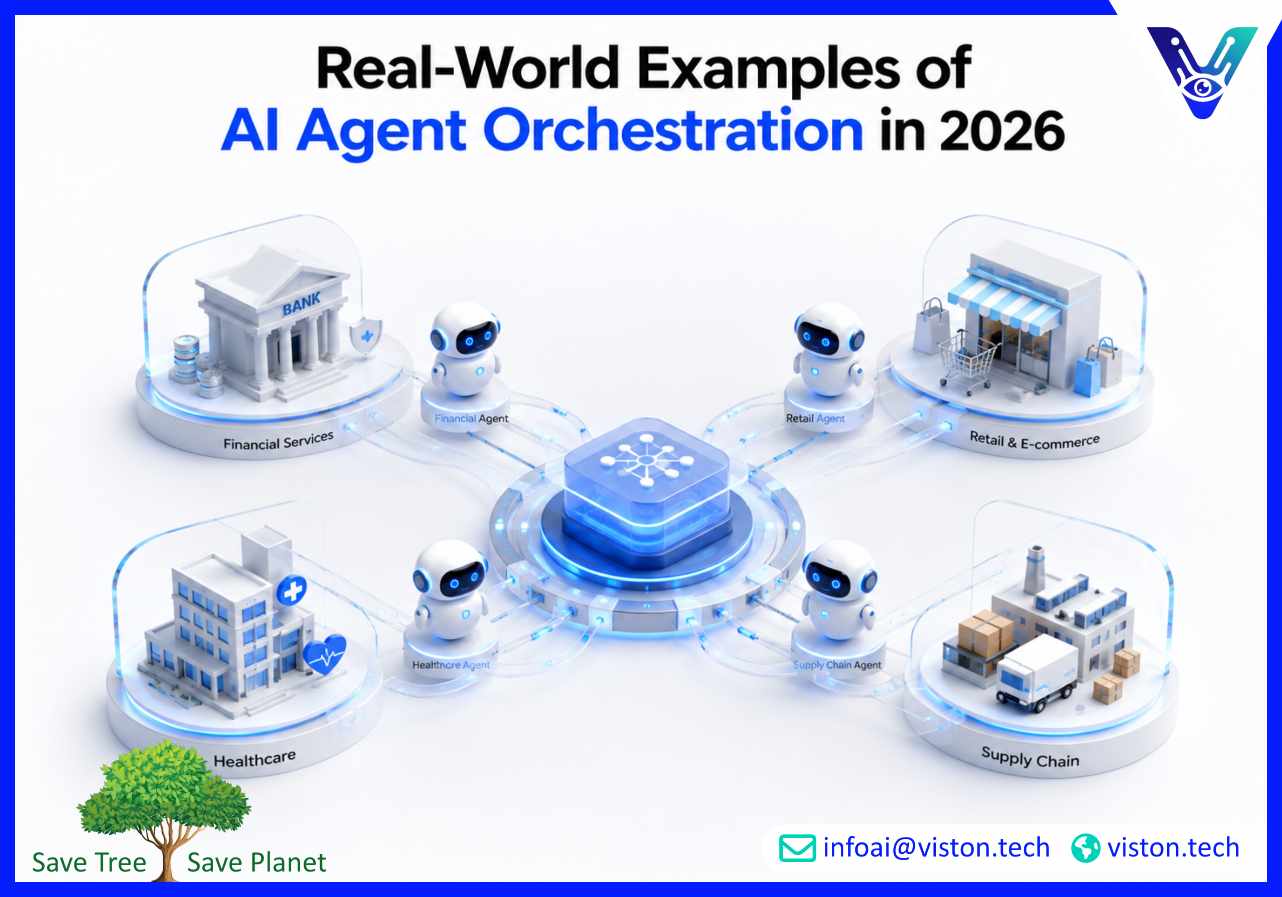
AI agent orchestration has moved firmly from research labs into live enterprise operations. Across finance, retail, healthcare, and supply chain, businesses are deploying coordinated systems of AI agents that plan, act, and adapt across complex workflows — and the results are measurable. For decision-makers evaluating Custom AI Agent Solutions, understanding what orchestration actually looks like in production is the most practical starting point.
A single AI agent handles a narrow, well-defined task. Orchestration is what happens when multiple agents need to work together — sharing context, passing outputs, coordinating decisions, and completing multi-step workflows that no individual agent could manage alone.
In a production environment, an orchestration layer manages which agents activate, in what sequence, with what data, and under what governance rules. It handles memory, routing, error recovery, and escalation to human reviewers where required. Without this coordination layer, agents either duplicate work, miss handoffs, or take actions outside their intended scope.
In 2026, orchestration architecture has become the primary differentiator between AI deployments that scale and those that stall. The question enterprises are asking is no longer whether to deploy agents — it is how to coordinate them reliably across departments, data systems, and compliance requirements.
Financial institutions have been among the earliest and most aggressive adopters of orchestrated agent systems. The process-heavy, rule-driven nature of financial operations creates natural leverage points for coordinated automation.
In investment banking, orchestrated agents now handle document generation tasks that previously required hours of analyst time. A supervisor agent receives a brief, routes research tasks to a data-retrieval agent, passes structured findings to a synthesis agent, and delivers a formatted output — all within a controlled, auditable workflow. The speed improvement is significant, but the governance layer matters just as much: in regulated environments, every agent action must be logged, permissioned, and traceable.
In financial compliance, multi-agent systems monitor transactions, flag anomalies, cross-reference regulatory databases, and escalate borderline cases to human compliance officers. The orchestration layer ensures agents operate within defined authority boundaries and that no autonomous decision bypasses required oversight checkpoints.
Fraud detection is another well-deployed use case. A primary analysis agent assesses transaction patterns; if confidence falls below a threshold, the orchestration layer automatically reroutes the decision to a conservative fallback model or a human reviewer — maintaining reliability without slowing down legitimate transaction processing.
Retail is where the commercial impact of agent orchestration becomes most visible because the feedback loops are fast and the metrics are clear.
A major deployment pattern in retail involves connecting customer service agents, recommendation agents, inventory agents, and order-processing agents through a unified orchestration layer. When a customer contacts support, the orchestration system routes the inquiry to the appropriate specialist agent based on intent. If the query involves an out-of-stock item, the inventory agent provides real-time availability data. If a return is involved, the resolution agent processes the request within defined policy parameters — without requiring human intervention for straightforward cases.
Dynamic pricing is another strong use case. Agents monitor demand signals, competitor pricing data, and inventory levels in near real time and adjust prices accordingly. The orchestration layer coordinates these inputs across merchandising, pricing, and operations agents simultaneously, enabling decisions that would take human teams hours to compute and execute.
For large retail chains managing thousands of store locations, inventory forecasting agents process continuous data inputs — sell-through rates, seasonal patterns, supplier lead times — and make autonomous replenishment decisions at scale. This removes the per-decision bottleneck that previously slowed planning cycles.
Healthcare represents one of the most complex environments for agent orchestration because of strict data governance requirements, patient safety stakes, and the volume of administrative burden that falls on clinical teams.
Patient intake orchestration is a high-impact deployment area. An intake agent collects and structures patient information, a records agent retrieves relevant clinical history, a triage agent surfaces key flags and clinical guidelines, and a documentation agent prepares pre-consultation notes — all before a clinician enters the room. The result is that clinicians spend less time on data retrieval and documentation and more time on actual care decisions.
Claims processing and compliance auditing represent another strong orchestration use case. Agents coordinate across payer systems, patient records, and regulatory databases to process claims, flag discrepancies, and route exceptions for review. Human-in-the-loop checkpoints are embedded at high-risk decision nodes — this is not optional in healthcare; it is a compliance requirement.
Supply chain management involves a large number of interdependent variables — supplier performance, logistics costs, inventory levels, demand patterns, and regulatory requirements across multiple geographies. Multi-agent orchestration is particularly well-suited to this environment because it allows agents to process these factors simultaneously rather than sequentially.
A representative deployment involves a consumer goods enterprise where procurement agents, logistics agents, demand forecasting agents, and customer service agents are connected through a central orchestration layer. When a supplier disruption is detected, the exception-handling agent assesses impact, the logistics agent identifies alternative routing options, the inventory agent evaluates buffer stock positions, and the customer service agent prepares updated delivery communications — all within a coordinated, automated workflow.
Demand forecasting agents that integrate internal sales data with external market signals can generate product-level forecasts with significantly higher granularity than traditional statistical models. When these agents are properly orchestrated with inventory and procurement systems, the forecast output drives automatic replenishment actions rather than sitting in a report waiting for human review.
The gap between a successful orchestration deployment and a failed one is rarely about the underlying model capability. It is almost always about architecture, governance, and integration quality.
Several factors consistently differentiate production-grade orchestration from pilot-stage experiments:
As of mid-2026, a relatively small share of enterprise AI agent pilots have reached full production at scale. The organizations that have crossed that threshold share a common trait: they treated orchestration architecture as the primary engineering challenge, not an afterthought to model selection.
Viston AI specializes in building and deploying Custom AI Agent Solutions for enterprise clients across the USA, Europe, and Australia. Its work spans industries where complex, multi-step workflows benefit most from coordinated agent deployment — financial services, retail, supply chain, and operations-heavy sectors.
Viston builds task-focused autonomous agents using established orchestration frameworks including AutoGen Studio, CrewAI, and Vertex AI Agent Builder, selecting the architecture most appropriate to the workflow complexity and governance requirements of each engagement. Its LLMOps in a Box approach addresses the full deployment lifecycle — from agent design and integration through to monitoring, governance, and ongoing optimization — rather than delivering a standalone model with no operational infrastructure around it.
For enterprise clients, Viston integrates agents with existing tech stacks including CRMs, ERP platforms, data warehouses, and communication systems, ensuring orchestration delivers value through the systems businesses already rely on. Responsible AI and compliance guardrails are embedded into its delivery approach, which is particularly relevant for clients in regulated industries where audit trails and human oversight are non-negotiable requirements.
Organizations working with Chief AI Officers, Heads of Data Science, or VP-level digital transformation leaders will find Viston’s end-to-end capability relevant — particularly where the goal is moving beyond isolated automation experiments toward scalable, production-grade agent infrastructure.
A single AI agent handles one task or a narrow set of related tasks. An orchestrated multi-agent system coordinates multiple specialized agents through a central layer that manages task routing, data sharing, sequencing, error handling, and governance. Orchestration is what makes AI practical for complex, multi-step enterprise workflows that cross departmental boundaries.
Financial services, retail and e-commerce, healthcare, and supply chain are the sectors with the most mature and widely deployed orchestrated agent systems. These industries share high transaction volumes, structured and repeatable workflows, and clear metrics — which creates strong conditions for measurable ROI from agent automation.
The most common failure points are poorly defined authority boundaries, insufficient observability and logging, weak integration with existing enterprise systems, and the absence of human-in-the-loop controls at high-stakes decision points. Governance gaps — not model capability limitations — are the primary reason most pilots do not scale.
A focused pilot in a well-defined process can be operational in four to eight weeks. Production-grade deployment with full integration, governance controls, testing, and monitoring typically takes three to six months, depending on workflow complexity and the number of systems involved.
Viston embeds responsible AI and compliance guardrails directly into its agent architecture through its LLMOps in a Box approach. This includes permissioned agent access, comprehensive audit logging, and human-in-the-loop controls at defined checkpoints — particularly relevant for clients in regulated industries such as financial services and healthcare.
The most widely used frameworks for enterprise orchestration in 2026 include LangGraph, CrewAI, AutoGen Studio, and Vertex AI Agent Builder. Framework selection depends on workflow complexity, integration requirements, existing infrastructure, and the governance and observability capabilities each framework supports in production environments.
AI agent orchestration is no longer an emerging concept — it is an operational reality in financial services, retail, healthcare, and supply chain, with measurable outcomes in each sector. For businesses evaluating Custom AI Agent Solutions, the practical lesson from 2026 deployments is clear: successful orchestration is an architectural and governance challenge as much as a technology one. Organizations that invest in well-designed, production-grade multi-agent infrastructure — with the right integration, observability, and oversight frameworks in place — are the ones seeing durable returns. Viston AI’s end-to-end capability in custom agent development and deployment positions it as a practical partner for enterprises ready to move beyond experimentation.
