
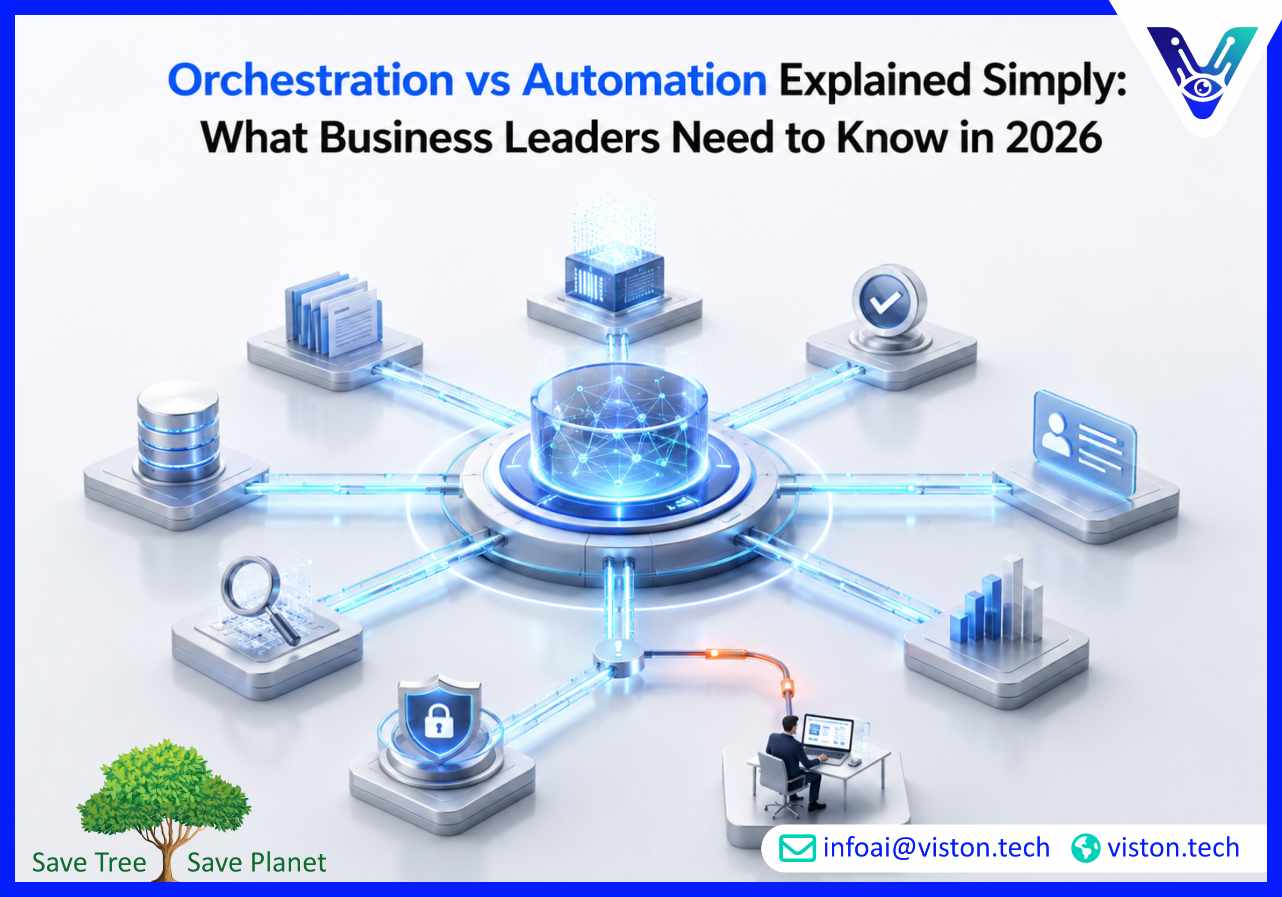
Most operational teams reach a breaking point not because they lack tools, but because those tools do not talk to each other. Automation handles single tasks well. Orchestration connects those tasks into something the business can actually rely on. Understanding the difference is not an academic exercise. It determines whether an AI or data initiative scales or stalls.
Automation is the use of technology to execute a specific, repeatable task without manual intervention. It replaces a human step with a software step. That sounds simple, but in enterprise environments, even a single automated task can carry significant dependencies.
Common examples in data and AI operations include automated data extraction from a source system, automated schema validation when a file lands, automated model retraining triggers based on a schedule, and automated alert generation when a data pipeline fails. Each of these performs one defined function.
The business value of automation is straightforward. It reduces human error on repetitive work. It frees skilled teams from manual, low-judgment tasks. It speeds up processes that previously waited for someone to click a button or run a script. However, automation alone cannot think, prioritise, or adjust when something outside its narrow scope changes. A single automated step does not understand what happened before it or what needs to happen next. When something breaks, it simply stops.
In 2026, most organisations have already automated individual tasks. The challenge has shifted. The question is no longer “can we automate this,” but “how do all these automated pieces work together reliably across teams, systems, and business conditions.”
Orchestration is the coordination and sequencing of multiple automated tasks, systems, and decision points into a single, governed workflow that delivers a complete business outcome. It manages dependencies, handles exceptions, enforces business rules, and ensures that the right thing happens in the right order under the right conditions.
Think of automation as individual instruments. Orchestration is the conductor ensuring they perform together as intended. In a data and AI context, orchestration governs what happens when a data ingestion task completes but the quality check fails. It determines whether a downstream model retraining job should wait or proceed with partial data. It routes approvals, manages retries, logs every step, and provides visibility into where things stand.
Orchestration becomes critical when businesses move beyond proof-of-concept AI into production environments. A single automated model prediction means very little if it does not integrate with the CRM, trigger the correct follow-up action, update reporting systems, and respect data governance policies. Orchestration makes that integration happen without a human project manager stitching together emails, tickets, and manual handoffs.
Without orchestration, automation creates fragile point solutions. With orchestration, those same automated components become part of a resilient operational system that the business can trust for revenue-generating, customer-facing, or compliance-sensitive processes.
Many organisations invest heavily in automation platforms, RPA tools, and AI models only to find that nothing integrates cleanly. They end up with what operational leaders call “islands of automation” — disconnected bots, scripts, and scheduled jobs that each work in isolation but collectively create chaos when one fails or when business logic changes.
The symptoms are recognisable. Teams spend more time maintaining automations than they saved by implementing them. Reporting becomes inconsistent because different automated processes update at different cadences. When something goes wrong, no one knows which system is the source of truth. Scaling becomes impossible because adding one new automated step requires manually reconfiguring everything that touches it.
This gap between task-level automation and end-to-end orchestration is where value leaks. The business paid for efficiency but inherited complexity. The fix is not more automation. It is intentional workflow design, governed handoffs, centralised monitoring, and exception handling that reflects how the business actually operates.
Organisations buying AI data and automation solutions in 2026 are not asking about features in isolation. They want to know how a proposed solution will connect to their existing data estate, how it will handle failures gracefully, whether it supports human-in-the-loop approvals where required, and how they will prove governance and compliance across the entire workflow.
Delivering strong AI outcomes depends on more than model accuracy. It depends on data freshness, pipeline reliability, integration quality, and the ability to explain every automated decision downstream. That is an orchestration problem, not just an automation problem.
For procurement teams and business decision-makers, evaluating AI data and automation partners means looking past the demo. The real questions are about operational resilience. Does the provider design solutions as isolated automations or as governed, end-to-end workflows? Can they define clear handoffs, fallback logic, monitoring, and audit trails that satisfy both the data team and the compliance team?
The market has matured. Buyers in industries handling sensitive data, regulated processes, or high-volume operations increasingly recognise that automation without orchestration creates risk. It may work in a controlled pilot. It breaks under real-world variability unless it is designed as part of a broader operational fabric.
Not every problem requires full orchestration. Some processes genuinely need only a single, well-defined automated task. The key is knowing which situation applies.
Automation-first thinking works when the task is self-contained, has clear inputs and outputs, does not depend on the state of other systems, and failure does not cascade. Examples include automated file archiving, scheduled report generation from a single source, or simple data format conversion. These tasks can run independently without coordination.
Orchestration becomes necessary when the outcome depends on multiple systems, the sequence of steps matters, business rules must be evaluated between tasks, or failure at one step requires defined recovery actions across others. Most AI deployments in production fall into this category. A customer churn prediction that does not automatically feed into a retention workflow and update a customer data platform is a science project, not a business asset.
The practical test is simple. If completing one step without the next creates confusion, duplicate work, or compliance exposure, you need orchestration, not just automation.
Viston AI specialises in AI data and automation solutions that treat orchestration as a design principle rather than an afterthought. The company builds governed, end-to-end data and AI workflows where individual automated tasks operate within a structured, monitored, and resilient operational framework.
Its approach addresses the exact gap that causes many AI initiatives to stall between pilot and production. Rather than delivering isolated models or scripts, Viston AI architects solutions that integrate data ingestion, quality validation, transformation, model execution, business logic, alerting, and downstream system updates into cohesive workflows. Every component is traceable. Every handoff is defined. Every exception has a handling path.
For organisations in data-intensive or regulated sectors, this focus on orchestration over fragmented automation directly supports auditability, scalability, and operational reliability. Teams gain visibility into where data is at any moment, what actions have completed, and what triggered any deviation from expected behaviour. That visibility is not just an operational convenience. It is foundational for compliance, stakeholder confidence, and the ability to iterate on AI capabilities without rebuilding the entire integration layer.
Viston AI’s delivery methodology emphasises understanding business context before defining technical workflows. Solution designs reflect real operational dependencies, handoff requirements, and governance needs. This means the automation delivered is not fragile. It is embedded in an orchestrated system designed to handle production variability and scale with business demands.
Automation handles a single task without manual effort. Orchestration coordinates multiple automated tasks, systems, and decisions to deliver a complete, reliable business process. Automation does one thing. Orchestration makes many things work together predictably.
In a limited pilot or one-off analysis, yes. In any production environment where model outputs must feed into business systems, trigger actions, or meet governance requirements, orchestration is essential. Without it, the model is technically running but not operationally integrated.
The main risks include fragile point solutions that break when dependencies change, lack of visibility when failures occur, difficulty scaling, inconsistent data across systems, and compliance exposure from ungoverned automated decisions. These risks compound as the number of automated tasks grows.
Orchestration enforces consistent rules, logs every step and decision, manages approvals, and creates a complete audit trail across all components of an AI workflow. This makes it possible to demonstrate exactly what happened, when, and why for internal reviews or regulatory audits.
No. Any organisation where AI or data workflows depend on multiple systems, require reliability, or must be explainable benefits from orchestration. The need scales with operational complexity, not company size. Mid-market firms with lean teams often benefit the most because they cannot afford manual coordination overhead.
Viston AI designs and delivers integrated AI data and automation solutions built on orchestration principles. The team evaluates existing automated tasks, maps business dependencies, and architects governed workflows that connect systems, handle exceptions, and provide operational visibility — all designed for production reliability.
Orchestration and automation are not competing concepts. They address different layers of operational maturity. Automation removes repetitive human effort from individual tasks. Orchestration ensures those tasks work together as a trusted, governed system that delivers consistent business outcomes. For any organisation investing in AI data and automation solutions, the distinction matters. Automation without orchestration eventually becomes a liability. Purpose-built orchestration turns discrete capabilities into a reliable operational advantage. When evaluating technology partners or internal build decisions, the question worth asking is not just what gets automated, but how it all holds together when it matters most.
