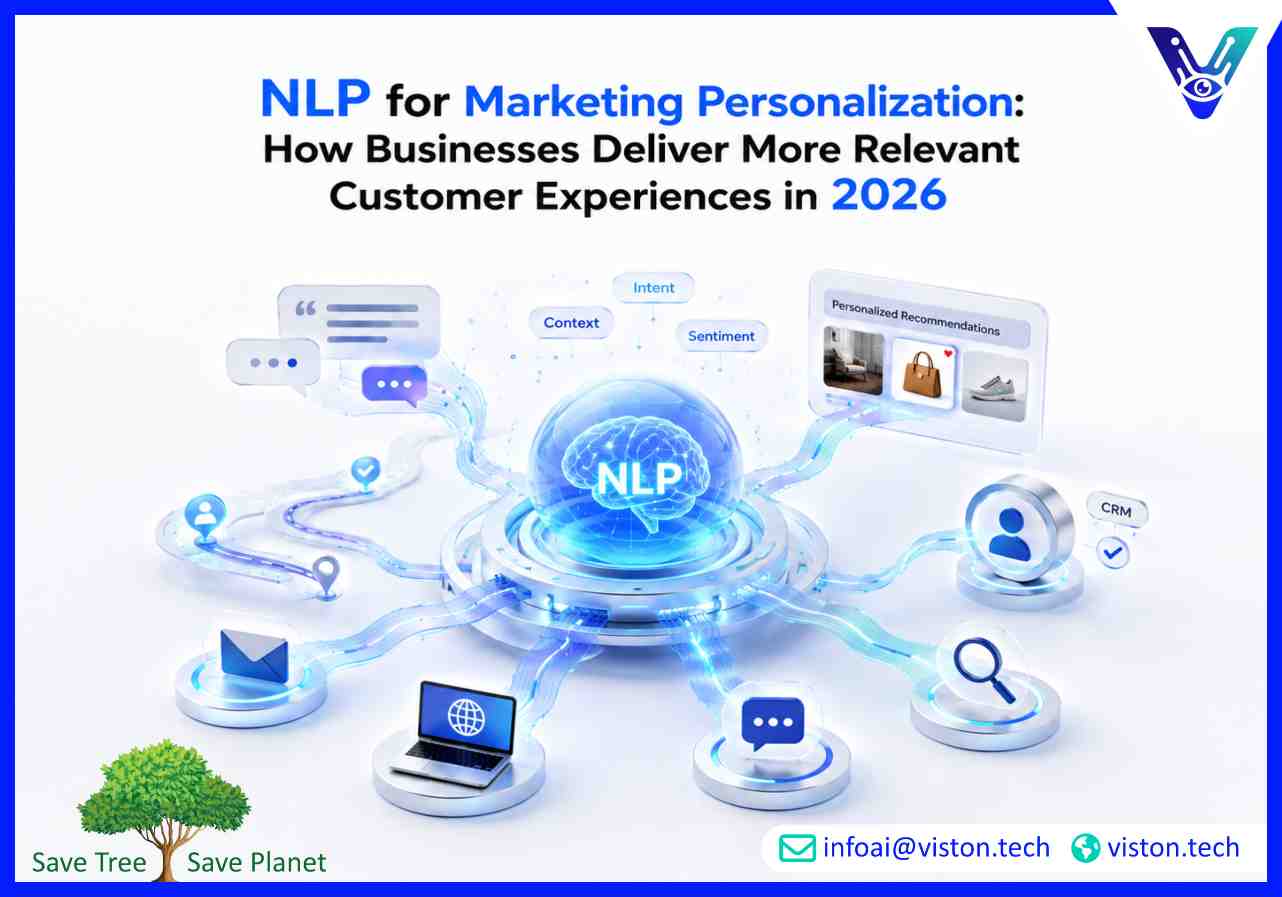
NLP for Marketing Personalization: How Businesses Deliver More Relevant Customer Experiences in 2026
Marketing personalization has evolved far beyond using a customer’s first name in an email. In 2026, businesses are expected to understand customer intent, preferences, behaviors, and communication patterns in real time. Natural Language Processing (NLP) has become a critical technology that enables organizations to analyze language-based data and create highly personalized marketing experiences at scale. For businesses seeking stronger engagement, improved conversions, and better customer retention, NLP-driven personalization is increasingly becoming a competitive advantage.
What NLP for Marketing Personalization Means for Businesses
Natural Language Processing is a branch of artificial intelligence that enables systems to understand, interpret, analyze, and generate human language. In marketing, NLP helps businesses process large volumes of customer-generated and business-generated text data to identify patterns, preferences, intent, sentiment, and behavioral signals.Unlike traditional personalization methods that rely heavily on demographic data or historical purchases, NLP enables businesses to understand what customers are actually communicating through various channels.Common sources of language data used for personalization include:
Customer support conversations
Email interactions
Website searches
Product reviews
Survey responses
Social media engagement
Chatbot interactions
Online forms and inquiries
By analyzing these interactions, businesses can create more relevant content, recommendations, messaging, and customer journeys.
How NLP Improves Personalization Accuracy
Traditional segmentation often groups customers into broad categories. NLP allows organizations to move toward intent-driven personalization by identifying:
Customer interests
Purchase intent
Pain points
Product preferences
Sentiment trends
Communication styles
Frequently discussed topics
Emerging customer needs
This deeper understanding helps marketers create experiences that feel more relevant and timely.
Why NLP-Powered Marketing Personalization Matters in 2026
Customers increasingly expect brands to deliver relevant interactions across every digital touchpoint. Generic campaigns often struggle to capture attention, while personalized experiences are more likely to generate engagement and conversions.Several factors are driving the adoption of NLP-powered personalization:
Growing customer expectations
Increasing competition across digital channels
Rising volumes of unstructured customer data
Demand for real-time engagement
Expansion of AI-driven marketing technologies
Need for scalable personalization strategies
Businesses that effectively use NLP can transform customer communication from reactive messaging into proactive, context-aware engagement.
Business Benefits of NLP for Marketing Personalization
Higher customer engagement rates
Improved content relevance
More accurate audience segmentation
Enhanced customer retention
Better lead nurturing
Increased conversion opportunities
More efficient marketing automation
Improved customer satisfaction
These outcomes make NLP an important component of modern marketing technology strategies.
Key Applications of NLP in Marketing Personalization
Natural Language Processing can support personalization across multiple marketing functions and customer touchpoints.
Personalized Content Recommendations
NLP systems analyze customer interests and content consumption patterns to recommend relevant articles, products, services, videos, or resources.This helps businesses increase engagement while improving customer experience.
Email Marketing Optimization
NLP can help marketers personalize:
Subject lines
Email content
Product recommendations
Offers and promotions
Send-time optimization
Customer journey sequences
By understanding customer language and intent signals, businesses can create more meaningful email interactions.
Customer Sentiment Analysis
Understanding customer sentiment allows marketers to adapt messaging based on audience perception.NLP-driven sentiment analysis can identify:
Positive experiences
Negative feedback
Brand perception trends
Customer satisfaction levels
Emerging concerns
This information supports more targeted and responsive marketing campaigns.
Conversational Marketing and Chatbots
AI-powered chatbots use NLP to personalize conversations based on user intent, previous interactions, and customer needs.These systems can:
Provide tailored recommendations
Qualify leads
Guide customers through buying journeys
Deliver contextual support
Improve engagement across digital channels
As conversational experiences become more sophisticated, NLP plays a central role in maintaining relevance and usability.
Search Personalization
NLP helps businesses understand the meaning behind search queries rather than relying solely on keyword matching.This enables more accurate search results, better content discovery, and improved customer experiences on websites, ecommerce platforms, and knowledge bases.
Implementation Considerations for NLP Marketing Personalization
While NLP offers significant opportunities, successful implementation requires careful planning and execution.
Data Quality and Accessibility
Personalization effectiveness depends heavily on the quality of customer data available for analysis.Organizations should ensure that relevant customer interactions are captured, organized, and accessible for NLP systems.
System Integration Requirements
NLP solutions often need integration with:
CRM platforms
Marketing automation systems
Customer support tools
Content management systems
Analytics platforms
Customer data platforms
Integrated environments help create consistent personalization experiences across channels.
Privacy and Compliance
Businesses implementing personalization strategies must consider privacy requirements, data governance policies, consent management, and responsible AI practices.Transparent use of customer data is increasingly important for maintaining trust and regulatory compliance.
Continuous Optimization
Customer behavior evolves over time. NLP models and personalization strategies require ongoing monitoring, testing, and refinement to maintain effectiveness.Organizations that continuously optimize personalization workflows often achieve stronger long-term results.
How Viston AI Supports NLP-Driven Marketing Personalization
As businesses increasingly seek more intelligent and scalable customer engagement strategies, Viston AI provides Natural Language Processing Solutions that help organizations transform language data into actionable marketing insights.Marketing personalization today requires more than traditional segmentation methods. Businesses need the ability to understand customer intent, analyze communication patterns, process unstructured data, and deliver relevant experiences across multiple channels. Viston AI supports these objectives through NLP-powered solutions that enable conversational AI, customer sentiment analysis, intelligent content recommendations, semantic search, and language-driven automation.Its approach focuses on connecting NLP capabilities with practical business workflows, existing technology ecosystems, and measurable marketing outcomes. By integrating NLP technologies with CRM platforms, customer engagement systems, analytics tools, and automation environments, organizations can create more responsive and personalized customer experiences.For businesses pursuing modern personalization strategies, scalable NLP implementation, reliable integrations, data governance, and ongoing optimization are critical success factors. Viston AI helps organizations address these requirements while supporting sustainable growth and long-term customer engagement objectives.
Frequently Asked Questions
What is NLP in marketing personalization?
NLP in marketing personalization refers to the use of Natural Language Processing technologies to analyze customer language, identify intent and preferences, and deliver more relevant marketing experiences across digital channels.
How does NLP improve customer personalization?
NLP helps businesses understand customer communication patterns, sentiment, interests, and behaviors, enabling more accurate recommendations, content delivery, and engagement strategies.
Can NLP improve email marketing performance?
Yes. NLP can support personalized subject lines, content recommendations, audience segmentation, and customer journey optimization, helping improve engagement and conversion opportunities.
What types of businesses benefit from NLP-powered personalization?
Organizations across ecommerce, SaaS, financial services, healthcare, education, retail, and professional services can use NLP to improve customer engagement and marketing effectiveness.
Can Viston AI help businesses implement NLP marketing personalization solutions?
Yes. Viston AI provides Natural Language Processing Solutions that support customer insights, conversational AI, personalization workflows, sentiment analysis, and language-driven marketing automation initiatives.
Conclusion
NLP for marketing personalization is helping businesses move beyond generic customer engagement and toward more intelligent, context-aware interactions. By understanding customer language, intent, sentiment, and preferences, organizations can deliver more relevant experiences across marketing channels while improving engagement, retention, and conversion outcomes. As personalization expectations continue to rise in 2026, Natural Language Processing Solutions provide a scalable foundation for building stronger customer relationships. Businesses looking to implement advanced personalization strategies can benefit from working with experienced specialists such as Viston AI to connect NLP technologies with meaningful business objectives and customer experience goals.