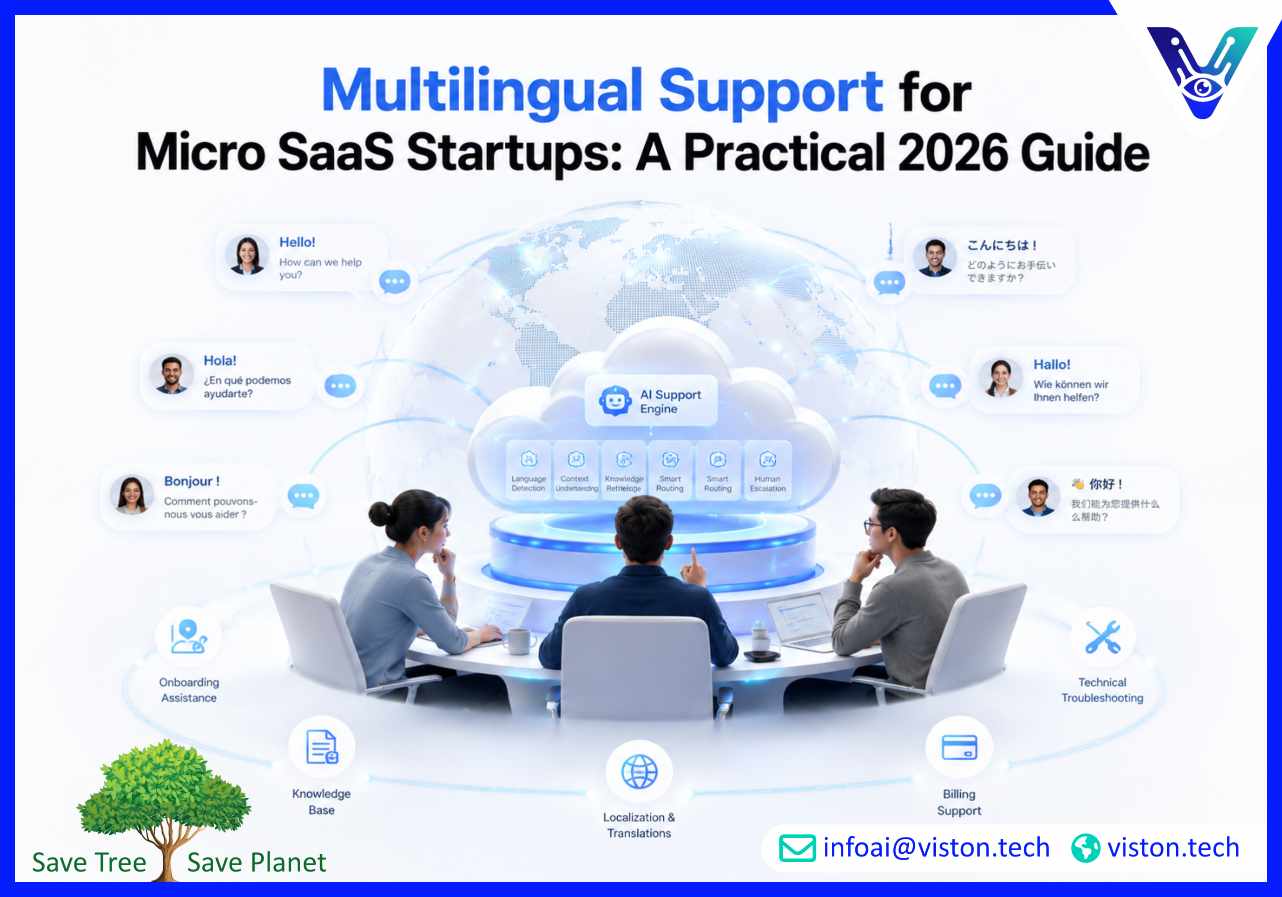
Multilingual Support for Micro SaaS Startups: A Practical 2026 Guide
Multilingual support for micro SaaS startups can turn a small product into a globally usable service without forcing a lean team to build separate support operations for every market. The challenge is to combine automation, accurate localization, human escalation, and sensible costs while protecting the customer experience.
Why Multilingual Support Matters for Micro SaaS Growth
Micro SaaS companies often reach international users earlier than expected. A focused product can attract customers through app marketplaces, search, communities, integrations, and word of mouth long before the founder has built a formal customer support department. That creates an immediate language problem: the product may be simple, but billing, onboarding, technical troubleshooting, cancellation, and account questions still require clear communication.English-only support can limit adoption even when the interface has been translated. Users may understand the product well enough to sign up but struggle when they encounter an error, need to change a subscription, or want clarification about a feature. At those moments, language affects trust. A slow or confusing response can lead to churn, refunds, negative reviews, or abandoned trials.For a micro SaaS business, multilingual support is not about recreating an enterprise call centre. It is about creating a controlled support model that gives customers useful answers in their preferred language while keeping operational demands proportionate to revenue and team size.
Where multilingual demand usually appears first
Pre-sales questions about features, pricing, integrations, and eligibility
Onboarding guidance for setup, configuration, imports, and permissions
Billing support for invoices, renewals, failed payments, and cancellations
Technical troubleshooting involving errors, browser issues, APIs, or workflows
Account support for login, access, data export, and plan changes
Customer success conversations related to adoption and retention
The commercial value comes from reducing friction across these moments. Better language coverage can improve activation, support regional expansion, strengthen self-service, and protect founder time. It also shows which markets justify deeper localization.
How to Build Multilingual Support Without Overloading a Small Team
The most effective model begins with prioritization. A micro SaaS startup does not need to support every language at launch. It needs to identify the languages that matter most, the conversations that are suitable for automation, and the issues that still require human judgment.
Choose languages using customer evidence
Language selection should be based on product data rather than assumptions. Review trial registrations, paying customers, support tickets, website traffic, failed conversions, churn comments, and expansion requests. A language deserves priority when it represents meaningful revenue, repeated support demand, or a credible growth opportunity.Start with a small group of high-value languages. Supporting three languages well is more useful than offering ten languages with incomplete knowledge, poor translations, or unreliable escalation. The language roadmap can expand as ticket volume and market traction increase.
Create one controlled source of truth
Multilingual support becomes difficult when product information is scattered across old help articles, internal notes, chat messages, and founder memory. Before translating or automating support, build a clear source of truth covering product features, setup steps, known limitations, billing policies, security information, troubleshooting procedures, and escalation rules.Content should be modular and easy to update. When a feature changes, the team should be able to revise one approved answer and propagate that change across supported languages. This reduces contradictory responses and makes quality assurance more manageable.
Use automation for repeatable requests
AI-assisted support is well suited to common, low-risk questions. It can identify the user’s language, retrieve approved product information, guide basic troubleshooting, collect diagnostic details, and create a structured handover when a person is needed. This is particularly useful outside normal working hours, when a founder or small support team cannot respond immediately.Automation should not pretend to resolve issues it cannot handle. Questions involving refunds, security incidents, data loss, sensitive account changes, or unusual technical behaviour should be escalated with full conversation context.
Design human escalation around limited capacity
A good multilingual workflow does not require a fluent employee for every language. The system can translate the message, summarize the problem, preserve the original text, and help an agent draft a response. Human review remains important for complex or sensitive issues.Escalation rules should consider urgency, account value, sentiment, repeated failure, and issue type. This allows a small team to focus on conversations where human expertise has the greatest impact.
Quality, Localization, and Risk Considerations in 2026
Fast translation is not the same as effective multilingual support. Customers expect answers that reflect the product, their account context, and the way people naturally communicate in their market. In 2026, startups also need to consider privacy, model reliability, and the operational risks of connecting AI systems to customer data.
Translate meaning, not only words
Support content should preserve technical meaning, product terminology, and brand tone. Literal translation can fail with interface labels, abbreviations, idioms, error messages, and workflow-specific instructions. A translated answer may be grammatically correct but still unusable if it refers to the wrong menu label or describes a feature differently from the localized product interface.Create a terminology glossary for feature names, navigation labels, billing terms, and recurring technical concepts. Language-specific examples should be tested by a fluent reviewer, especially for onboarding, cancellation, payment, and security-related content.
Measure performance by language
A single global satisfaction score can hide weak performance in individual languages. Track results separately for each supported language. Useful measures include first response time, self-service resolution rate, escalation rate, repeat contact, customer satisfaction, fallback rate, and time to resolution.Review failed conversations regularly. They reveal missing documentation, unclear intent recognition, translation problems, and regional expectations that the original English content did not address. This feedback should improve both the knowledge base and the product itself.
Protect customer information
Multilingual support may process names, email addresses, account details, billing information, technical logs, and conversation histories. Startups should know which systems receive this data, where it is stored, how long it is retained, and whether third-party models use it for training.Access controls, encryption, data minimization, audit logs, and defined retention periods are practical safeguards. The support workflow should also avoid exposing private account information before the user has been authenticated. When operating across regions, privacy and data-transfer requirements should be assessed for the markets being served.
Keep humans responsible for sensitive outcomes
AI can accelerate support, but the startup remains responsible for the answer. The system should not invent policies, promise unsupported refunds, provide uncertain security guidance, or make irreversible account changes without appropriate controls. Approved content, action permissions, confidence thresholds, and escalation paths reduce these risks.
Choosing a Multilingual Support Solution for a Micro SaaS Startup
The right solution should fit the product’s current stage and remain workable as usage grows. Micro SaaS founders should evaluate operational fit rather than selecting a platform only because it advertises a large number of languages.
Essential capabilities to evaluate
Reliable language detection and support for the startup’s priority languages
Knowledge retrieval from approved help content and product documentation
Integration with the existing helpdesk, CRM, email, chat, or in-app support channel
Context-aware handover that includes the original message, translation, summary, and attempted steps
Language-level analytics for resolution, satisfaction, escalation, and failure patterns
Controls for authentication, permissions, privacy, retention, and sensitive actions
A practical process for updating content and testing responses after product releases
Cost should be assessed against workload and outcomes
Pricing may depend on conversations, messages, languages, integrations, implementation, and ongoing optimization. The lowest monthly fee is not always the lowest total cost because inaccurate answers can increase refunds, escalations, and founder involvement.Estimate the number of monthly conversations, average message length, expected automation rate, and human review effort. Then compare cost with outcomes such as reduced ticket handling, faster responses, improved trial activation, lower churn, and better coverage outside business hours.
Begin with a narrow pilot
A controlled pilot is safer than a broad launch. Choose one or two languages, defined support intents, and a limited channel. Test real customer phrasing, spelling errors, mixed-language messages, product terminology, and escalation behaviour.The pilot should have clear success criteria. For example, the startup may aim to resolve common onboarding and billing questions accurately while ensuring complex technical issues reach a person with enough context. Expansion should follow evidence, not novelty.
How Viston AI Supports Multilingual Service for Lean SaaS Teams
Viston AI provides multilingual AI chatbot support designed to connect language handling with practical customer service workflows. Its published capabilities include multilingual conversational support, contextual intent recognition, centralized knowledge management, intelligent routing, analytics, and deployment across channels such as web chat, mobile applications, WhatsApp, SMS, voice, and social platforms.For a micro SaaS startup, the relevant value is not simply the number of languages available. It is the ability to build a focused support system around the company’s product documentation, recurring user questions, escalation rules, and existing business tools. Viston AI also describes integration options for CRM platforms, knowledge bases, analytics tools, and other applications through connectors and APIs.This approach can support common SaaS needs such as onboarding assistance, feature guidance, billing questions, technical troubleshooting, and context-rich handover to human support. Its delivery methodology covers discovery, data preparation, model selection, testing, integration, deployment, monitoring, and continuous improvement. That structured process is useful for lean companies that need multilingual support to remain accurate, secure, measurable, and manageable as customer demand expands across markets.
Frequently Asked Questions
When should a micro SaaS startup add multilingual support?
Add it when customer data shows recurring demand from non-English-speaking users, when language-related friction affects activation or retention, or when the business is entering a specific market. Start with the languages linked to real revenue or support volume.
How many languages should a micro SaaS company support initially?
Most startups should begin with one to three priority languages beyond their primary language. The correct number depends on customer concentration, content readiness, support capacity, and the ability to test quality in each language.
Can AI handle multilingual SaaS support without human agents?
AI can resolve many repetitive questions, but complete removal of human support is risky. Complex technical cases, security concerns, refunds, account disputes, and unusual requests need clear escalation to a responsible person.
What content should be prepared before launching multilingual support?
Prepare accurate help articles, onboarding instructions, billing policies, troubleshooting steps, feature definitions, security guidance, known limitations, and escalation rules. A terminology glossary should align translated support with the product interface.
How should multilingual support quality be measured?
Track first response time, resolution rate, customer satisfaction, fallback rate, repeat contact, escalation rate, and resolution time by language. Reviewing failed conversations is essential for identifying knowledge and translation gaps.
Can Viston AI integrate multilingual support with existing SaaS tools?
Viston AI states that its multilingual chatbot service can connect with CRM systems, knowledge bases, analytics platforms, and business applications through APIs and connectors, allowing support conversations to work with existing processes.
Conclusion
Multilingual support for micro SaaS startups should be built as a focused operating system, not a collection of automatic translations. The strongest approach prioritizes proven language demand, uses approved product knowledge, automates repeatable questions, and escalates sensitive issues with full context. In 2026, quality also depends on language-level analytics, privacy controls, continuous content updates, and realistic human oversight. A specialist multilingual support provider such as Viston AI can help a lean SaaS team connect conversational automation, knowledge, integrations, and monitoring without building a large support department before the business is ready.