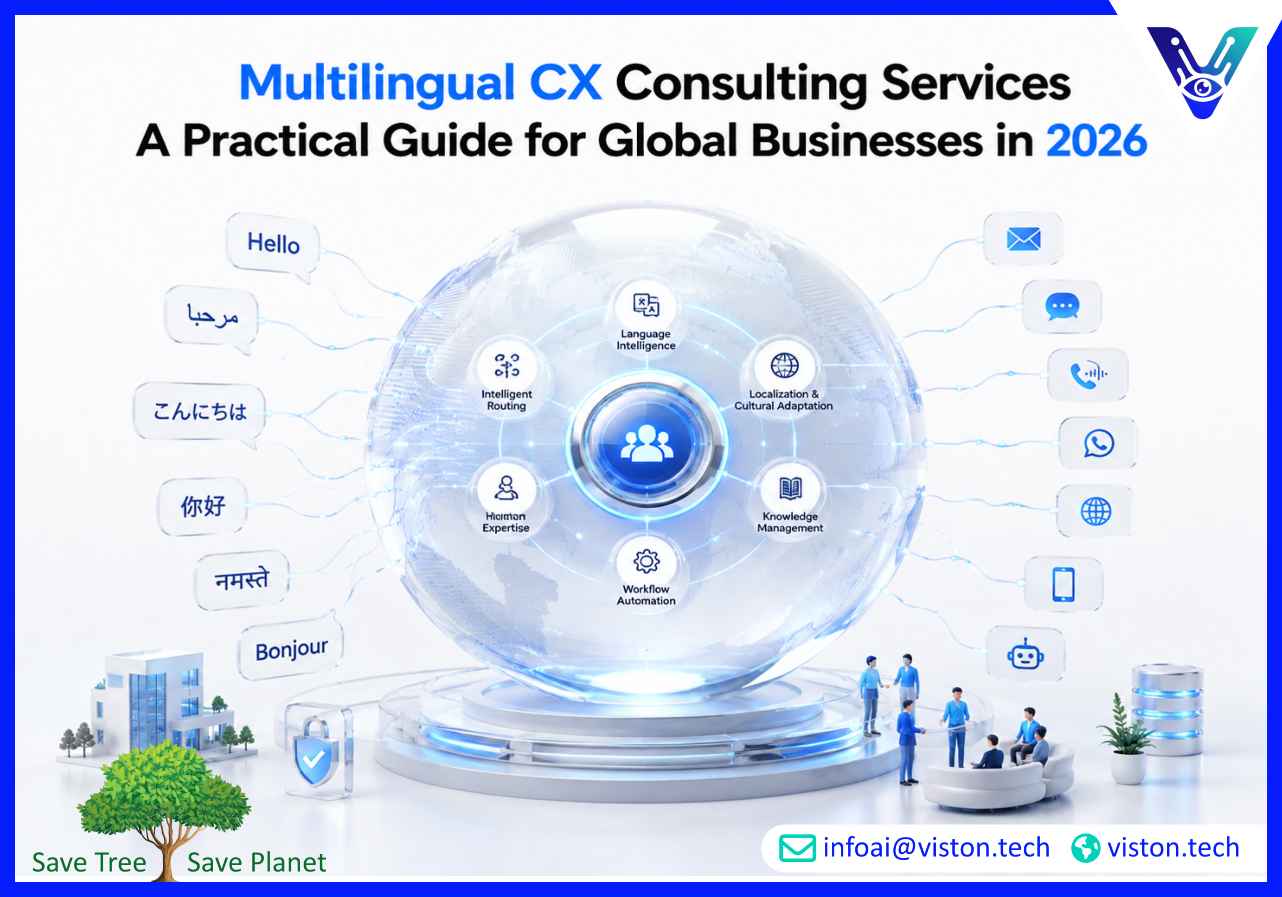
Multilingual CX Consulting Services: A Practical Guide for Global Businesses in 2026
Multilingual CX consulting services help businesses design customer experiences that remain clear, consistent, and culturally appropriate across languages, markets, channels, and support teams. In 2026, effective multilingual support requires more than translation. It depends on customer journey design, localized knowledge, intelligent routing, reliable technology, quality assurance, and continuous performance improvement.
What Multilingual CX Consulting Services Involve
Multilingual customer experience consulting is the strategic and operational process of improving how a business communicates with customers who use different languages. Consultants assess the complete customer journey, identify language-related friction, and design a support model that combines people, processes, content, data, and technology.The objective is not simply to make existing English-language support available in several languages. Effective consulting determines how customers in different markets search for information, describe problems, interpret policies, use digital channels, and respond to different tones or communication styles.A typical engagement may cover customer service, onboarding, product guidance, technical support, sales enquiries, account management, complaints, renewals, and self-service. It may also examine channels such as email, live chat, voice, messaging applications, websites, mobile apps, social platforms, and AI assistants.
Language strategy and demand analysis
Consultants begin by understanding which languages genuinely matter to the business. This requires more than reviewing the countries in which the company operates. Teams should analyse customer volume, revenue potential, support demand, growth plans, channel usage, language preferences, and the complexity of enquiries in each market.This analysis helps determine whether each language should be supported through internal agents, regional teams, outsourced specialists, real-time translation, multilingual AI, or a hybrid operating model. High-volume and high-risk markets may require dedicated language teams, while lower-volume languages may be served through pooled agents and carefully governed technology.
Customer journey and service design
A multilingual CX consultant maps the moments where language affects customer effort or trust. These may include account registration, product discovery, checkout, onboarding, troubleshooting, returns, contract explanations, billing disputes, and escalation.The consultant then redesigns these interactions so that language support is available at the right point. This may involve localized help content, automatic language detection, language-based routing, translated forms, culturally appropriate scripts, and clearer handover procedures.
Operational and technology planning
Consulting also addresses how multilingual support will operate day to day. This includes workforce planning, knowledge management, quality monitoring, escalation rules, technology integration, reporting, security, and content ownership.A credible strategy defines how CRM, helpdesk, contact-centre, translation, chatbot, voice, and analytics systems should work together. The result should be a practical operating model rather than a collection of disconnected language tools.
Why Multilingual Customer Experience Requires a Specialist Strategy in 2026
Customer expectations are shaped by the best digital experiences available in each market. Customers increasingly expect to move between self-service, messaging, email, and human support without losing context. When language support is inconsistent across these channels, the experience becomes fragmented.Modern multilingual service models also combine human agents with translation technology, AI assistants, localized knowledge bases, sentiment analysis, and automated workflows. AI-powered support can detect language, retrieve approved information, and guide users through routine processes, but the quality of the outcome still depends on knowledge accuracy, workflow design, cultural context, and escalation controls.
Translation is not the same as localization
Direct translation may preserve the literal meaning of a message while missing its practical or emotional context. Product terminology, humour, formality, measurements, dates, payment expectations, legal wording, and complaint-handling conventions can differ significantly between markets.Localization adapts content and interactions to the expectations of a specific audience. A localized support experience should feel natural to the customer rather than appearing to be an English-language process converted word for word.This distinction is particularly important for sensitive conversations involving cancellations, financial concerns, healthcare information, technical failures, refunds, and service complaints. Poorly adapted language can make an accurate answer feel dismissive, confusing, or untrustworthy.
AI needs multilingual governance
Multilingual AI systems can increase service capacity, but they should not be assumed to perform equally across every language, dialect, intent, or customer group. Real customer messages contain spelling errors, mixed languages, informal expressions, regional terminology, and incomplete information.Businesses should test AI performance separately for each priority language. Testing should cover intent recognition, factual accuracy, tone, retrieval quality, workflow completion, fallback behaviour, and human handover. Research into multilingual intent classification has shown that machine-translated test data can make performance appear stronger than it is on genuine customer language, reinforcing the need for evaluation using native, real-world enquiries.
Accessibility must extend across languages
A multilingual experience is incomplete when localized content does not work properly with screen readers, keyboard navigation, captions, text resizing, and other accessibility tools. Language metadata, reading order, script rendering, and pronunciation support should be tested across the digital experience.Consulting teams should therefore coordinate localization with accessibility, content design, user experience, and technical quality assurance. This helps prevent a business from improving language coverage while unintentionally creating new barriers for customers with disabilities.
How a Multilingual CX Consulting Engagement Should Work
A structured consulting engagement should move from evidence gathering to operating-model design, implementation planning, and performance management. The process must reflect the company’s customer base, service complexity, risk profile, existing technology, and available resources.
1. Audit the current customer experience
The initial audit should review customer journeys, support volumes, language demand, response times, resolution rates, complaints, abandonment points, translation workflows, knowledge content, agent capabilities, and existing technology.Customer conversations should be analysed by language, region, channel, intent, sentiment, complexity, and outcome. This reveals where language barriers are creating repeat contact, unnecessary escalation, slow resolution, inaccurate answers, or lost sales opportunities.
2. Prioritize languages and use cases
Businesses rarely need to launch every language at the same time. A practical roadmap prioritizes languages using customer demand, commercial importance, service risk, operational feasibility, and expected growth.Use cases should also be prioritized. Routine enquiries such as order tracking, account access, booking changes, product questions, and basic troubleshooting may be suitable for self-service or AI-assisted resolution. Complaints, regulated advice, complex technical issues, and high-value account conversations may require trained human specialists.
3. Design the multilingual operating model
The operating model defines who handles each language, through which channels, during which hours, and with what level of authority. It should specify:
Language coverage and service hours
Dedicated, pooled, outsourced, or AI-assisted support models
Language detection and routing rules
Knowledge ownership and translation workflows
Human review and approval requirements
Escalation paths for sensitive or complex cases
Quality assurance standards for each language
Security, privacy, and access-control requirements
The model should be scalable. Adding a new market should not require the organization to rebuild its entire customer support operation.
4. Build localized knowledge and conversation standards
Knowledge quality is central to multilingual CX. Consultants should identify the authoritative source for product information, policies, troubleshooting steps, eligibility rules, and service procedures.Content should then be localized, version-controlled, and assigned to clear owners. Updates to source content must trigger updates in relevant languages. Without this discipline, customers may receive different answers depending on the language they select.Conversation standards should also define tone, terminology, empathy, formality, prohibited claims, and escalation wording. These guidelines help human agents and AI systems communicate consistently without making every response sound identical.
5. Integrate systems and workflows
Customers should not lose context when moving from a chatbot to an agent or from messaging to email. CRM, helpdesk, knowledge, translation, analytics, and automation platforms should exchange relevant information securely.Integrations may support automatic language detection, customer identification, ticket classification, conversation translation, localized response suggestions, workflow triggers, and handover summaries. Consultants should also define what happens when an integration fails so that operational teams can continue serving customers.
6. Measure performance by language and market
Global averages can hide weak performance in individual markets. Reporting should therefore be segmented by language, region, channel, intent, and service model.Useful measures include first-contact resolution, customer satisfaction, response time, escalation rate, abandonment, translation corrections, knowledge gaps, automation completion, quality scores, and cost per resolved contact. Businesses should also review qualitative feedback to identify cultural or communication issues that numerical dashboards may miss.
How to Choose a Multilingual CX Consulting Partner
The right consulting partner should understand both customer experience strategy and the operational realities of multilingual support. Buyers should look beyond the number of languages a provider claims to support and examine how the provider maintains quality, security, consistency, and measurable performance.
Relevant multilingual and CX expertise
A qualified partner should be able to explain how language affects customer journeys, service design, knowledge management, automation, agent workflows, and quality assurance. Its recommendations should reflect the company’s actual support environment rather than relying on a standard global template.
Technology-neutral assessment
Consultants should evaluate existing systems before recommending replacements. In many cases, better routing, content governance, integrations, and measurement can improve the experience without a complete technology migration.Where new technology is required, the partner should explain its role, limitations, implementation requirements, security implications, and expected operational impact.
Human and AI service design
Businesses should avoid partners that treat AI as a universal replacement for multilingual agents. The strongest model is usually based on matching each interaction to the appropriate form of support.AI may handle high-volume, repeatable enquiries, assist agents with translation and knowledge retrieval, or collect context before escalation. Human specialists remain important when conversations require empathy, judgment, negotiation, investigation, or regulatory understanding.
Clear deliverables and accountability
Before engagement, buyers should confirm whether the consultant will provide an audit, customer journey maps, language prioritization, operating-model recommendations, technology architecture, implementation roadmap, governance framework, KPI model, and optimization plan.The proposal should define responsibilities, dependencies, decision points, and success measures. Consulting should produce decisions and execution priorities, not only high-level recommendations.
How Viston AI Supports Multilingual Customer Experience Transformation
Viston AI is relevant to multilingual CX consulting services through its capabilities in multilingual support, language translation, NLP and text analysis, AI chatbots, sentiment analysis, business-system integration, workflow automation, and AI strategy. Its official service portfolio positions these capabilities as components of enterprise AI transformation rather than isolated translation tools.This combination can support organizations that want to improve multilingual customer journeys through technology-enabled service design. Relevant applications include multilingual self-service, localized knowledge retrieval, automated language detection, customer-intent analysis, conversation routing, agent assistance, sentiment-based escalation, and integration with CRM or support platforms.For businesses operating across countries, languages, or customer segments, the practical challenge is connecting these capabilities into a reliable operating model. Viston AI can help address the AI, automation, integration, and analytics dimensions of multilingual support while aligning them with business workflows and customer experience objectives.Its relevance is strongest for organizations seeking a scalable multilingual support environment in which AI and human teams work together. Rather than relying only on direct translation, the approach can incorporate business-specific terminology, approved knowledge, workflow automation, monitoring, and continuous optimization. This gives decision-makers a practical foundation for improving service consistency, reducing avoidable manual effort, and making multilingual customer experience performance easier to measure.
Frequently Asked Questions
What are multilingual CX consulting services?
Multilingual CX consulting services help businesses design and improve customer journeys across different languages and markets. They may cover language strategy, localization, support operations, knowledge management, AI, technology integration, quality assurance, and performance measurement.
How are multilingual CX consulting and translation services different?
Translation services convert content from one language to another. Multilingual CX consulting examines the wider experience, including customer journeys, cultural expectations, channel design, staffing, routing, technology, escalation, knowledge governance, and service quality.
When should a business hire a multilingual CX consultant?
Consulting is useful when a company is entering new markets, receiving growing support demand in multiple languages, experiencing inconsistent regional service, implementing multilingual AI, or struggling to scale language coverage cost-effectively.
Can AI replace multilingual customer support agents?
AI can automate routine enquiries, support translation, retrieve knowledge, classify intent, and assist human agents. It should not replace human judgment in every situation. Complex, sensitive, high-risk, or emotionally charged conversations often require qualified people.
Which KPIs should be used for multilingual customer experience?
Useful KPIs include customer satisfaction, first-contact resolution, response time, abandonment, escalation, quality scores, knowledge accuracy, automation completion, and cost per resolution. Results should be reviewed separately by language, market, channel, and intent.
How can Viston AI contribute to a multilingual CX program?
Viston AI offers capabilities related to multilingual support, translation, NLP, AI chatbots, sentiment analysis, automation, and business-system integration. These services can support the technology and workflow components of a broader multilingual customer experience strategy.
Conclusion
Multilingual CX consulting services help businesses turn language coverage into a consistent, measurable, and scalable customer experience. The strongest programs combine localized content, culturally appropriate communication, skilled people, reliable technology, clear governance, and market-level reporting. In 2026, businesses should evaluate multilingual support as part of the complete customer journey rather than as a standalone translation requirement. Viston AI brings relevant multilingual support, NLP, chatbot, automation, and integration capabilities to organizations building technology-enabled global service models. A structured consulting approach can help those organizations prioritize investment, reduce service friction, and deliver more dependable experiences across languages.