
Multi-Agent Orchestration Solutions Australia: Architecting Coherent Enterprise AI in 2026
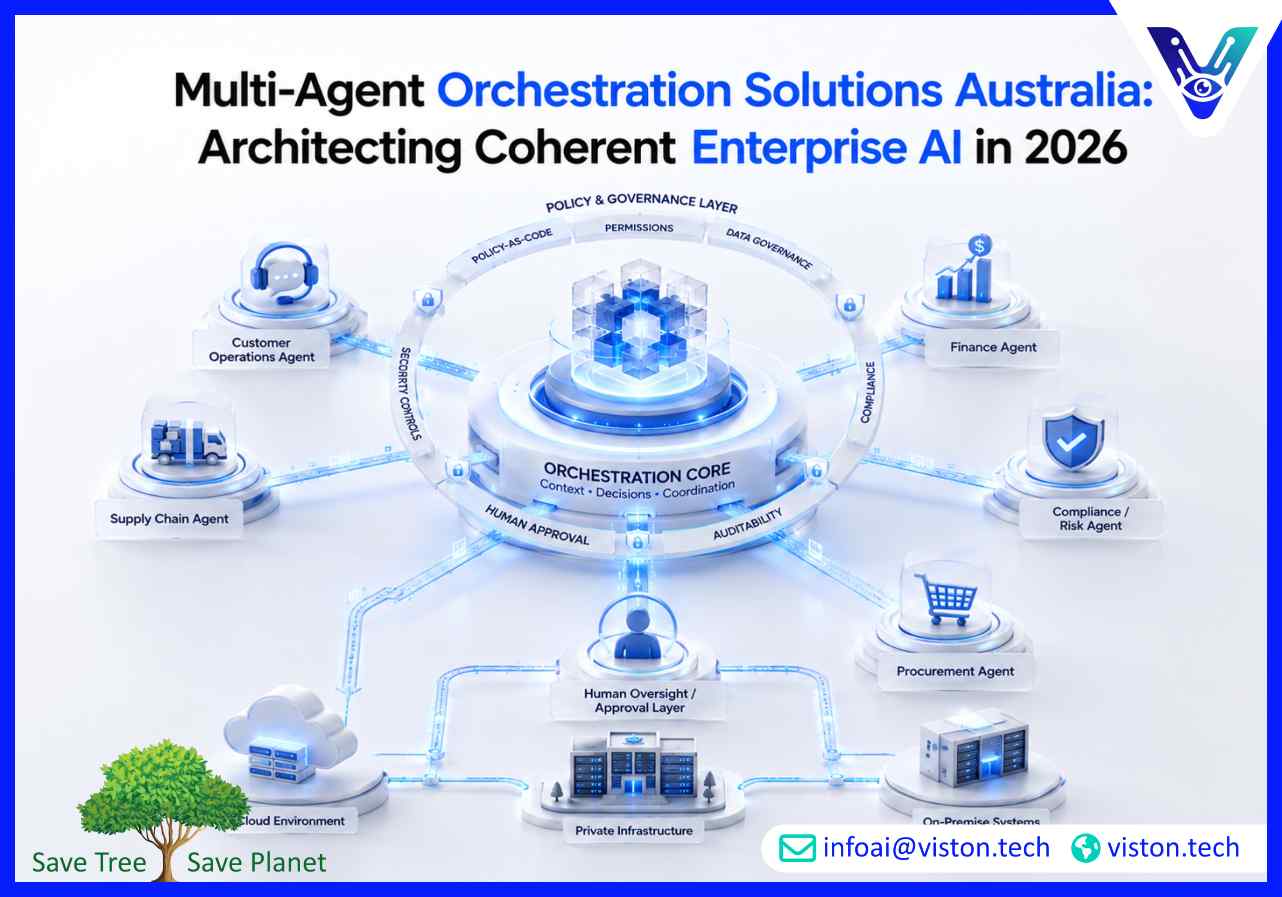
Running a single AI agent is straightforward. Managing fifty or five hundred autonomous agents that negotiate with each other, access sensitive data, and execute interdependent tasks is an entirely different discipline. For Australian enterprises moving beyond proof-of-concept AI, multi-agent orchestration has become the critical control layer that separates reliable business outcomes from expensive experimentation.
What Multi-Agent Orchestration Means for Australian Enterprises
Multi-agent orchestration is the systematic coordination of multiple autonomous AI agents so they operate as a coherent, governed system rather than isolated tools. Each agent may handle a specialized function — one qualifies sales leads, another checks inventory across distribution centres, a third drafts supplier communications — but their individual outputs only create business value when they work together under consistent rules.
In the Australian context, this requirement has matured rapidly. Businesses that began with single-purpose chatbots or retrieval-augmented generation pipelines in 2023 and 2024 now face a common pattern: useful pilots that do not connect. Customer service agents cannot hand over context to fulfilment agents. Procurement agents lack visibility of contract obligations known to legal review agents. The gaps between agents become the operational risk.
Orchestration addresses these gaps by introducing an intentional architecture. It defines how agents discover each other, how tasks are assigned and prioritised, how conflicts are resolved, and how outputs are validated before they reach downstream systems or human decision-makers. For Australian organisations subject to privacy obligations under the Privacy Act 1988, critical infrastructure regulation, or APRA operational risk standards, orchestration also provides the governance scaffolding that standalone agent deployments typically lack.
Why 2026 Marks a Turning Point for Orchestration Strategy
The Australian market has crossed several thresholds simultaneously that make multi-agent orchestration a boardroom topic rather than a back-office engineering concern. Three shifts define the current moment.
Agent Proliferation Has Outpaced Coordination
Through 2025, the default approach was to deploy agents departmentally. Marketing ran its own content generation agents. Supply chain experimented with demand forecasting agents. Legal trialled contract review agents. Each initiative operated on its own infrastructure, with its own prompt libraries, its own data access patterns, and its own definition of success. By early 2026, the accumulated technical debt of uncoordinated agent deployments has become visible on balance sheets — duplicated licences, conflicting outputs, and integration costs that scale faster than the value delivered.
Sovereign Infrastructure Requirements Are Clearer
Australian government agencies, financial services institutions, defence suppliers, and healthcare organisations increasingly require AI workloads to run on sovereign infrastructure with verifiable data residency. Orchestration layers must now operate across distributed hosting environments — some agents on Australian soil, others in secure offshore instances — while maintaining policy consistency. This is not a hypothetical requirement. Procurement frameworks referencing the Hosting Certification Framework and IRAP assessments now routinely ask organisations to explain how multi-agent systems maintain governance across hosting boundaries.
Agent-to-Agent Protocols Are Standardising
The Model Context Protocol and Google’s Agent2Agent protocol have matured sufficiently through 2025 that 2026 is the year enterprises can realistically build orchestrators that communicate with agents from multiple vendors. Interoperability is no longer a theoretical advantage. It is a procurement requirement. Australian enterprises increasingly specify that orchestration solutions must support agent discovery, capability advertising, and secure task handoff using open protocols rather than proprietary APIs that create vendor lock-in.
How Orchestration Changes Enterprise Risk and Reward
Without orchestration, multi-agent environments carry specific risks that compound as agent counts increase. Orchestration directly addresses these, turning them from liabilities into managed operational parameters.
Task collision and resource contention. Two agents attempting to update the same ERP record simultaneously creates data inconsistency that is difficult to trace. Orchestration layers queue, prioritise, and sequence agent actions so that conflicting instructions never reach production systems simultaneously. In industries like logistics or energy trading where milliseconds matter, this sequencing is business-critical.
Context fragmentation. When a customer enquiry passes through a triage agent, a classification agent, a response agent, and a handoff agent, each transition risks losing context. Orchestration maintains a shared context ledger that preserves the full interaction history, intent classifications, and decision rationale as stateful objects available to every agent in the workflow. For Australian businesses subject to the Notifiable Data Breaches scheme, this audit trail also serves as a compliance asset.
Policy enforcement at scale. Individual agents configured by different teams will inevitably interpret instructions differently. An agent built by a Melbourne engineering team may handle PII differently from one built by a Sydney operations team. Orchestration centralises policy enforcement — access controls, data handling rules, escalation thresholds — so that every agent operates within the same governance framework regardless of its origin.
Observability and attribution. When a multi-agent system produces an incorrect output — a mispriced quote, an erroneous compliance report, a flawed supply chain recommendation — organisations need to trace which agent made which decision and why. Orchestration platforms instrument agent interactions with distributed tracing, decision logging, and explainability outputs that turn opaque multi-agent behaviour into auditable records.
What Australian Buyers Should Evaluate in Orchestration Solutions
Procurement teams and technology leaders evaluating multi-agent orchestration solutions in 2026 face a market with genuine capability differentiation. The following evaluation dimensions reflect the specific requirements of the Australian enterprise environment.
Sovereign Deployment Flexibility
Solutions must support orchestration control planes deployable within Australian data centres, with the ability to manage agents running across AWS Sydney, Azure Australia Central, Google Cloud Sydney, and on-premises environments simultaneously. Buyers should verify that the orchestrator itself — not just the agents — can operate under Australian data residency constraints, and that its configuration state, agent credentials, and context stores do not transit through jurisdictions that conflict with organisational data sovereignty policies.
Protocol-Agnostic Agent Integration
An effective orchestrator connects to agents built on LangChain, CrewAI, AutoGen, Microsoft Semantic Kernel, and custom frameworks without requiring agent rewrites. It supports Model Context Protocol for agent discovery, Agent2Agent for inter-agent task delegation, and provides SDKs that allow existing agent teams to register capabilities with minimal code changes. Protocol agnosticism protects the investment organisations have already made in agent development while enabling future flexibility.
Policy-as-Code Governance
Orchestration governance should be expressed as version-controlled policies, not configured through admin consoles by individual operators. Policy-as-code allows enterprises to define rules — “agents in the finance domain may not access customer PII,” “agent outputs above $50,000 confidence threshold require human approval” — that are automatically enforced across all orchestrated workflows. For Australian financial services licensees, this capability maps directly to operational risk management obligations.
Human-in-the-Loop by Design
The orchestration layer should treat human approval as a first-class workflow step, not an afterthought. When agent confidence scores fall below defined thresholds, when agents encounter edge cases, or when decisions exceed materiality limits, the orchestrator should route outputs to appropriate human reviewers with full context, decision rationale, and recommended actions. In heavily regulated Australian sectors, this capability determines whether multi-agent systems can be deployed in production at all.
Observability and Continuous Improvement
Enterprise orchestration platforms instrument every agent interaction, log every decision, and surface performance metrics that allow operations teams to identify degrading agent performance, increasing latency, or policy violations before they become incidents. The best solutions feed these observability signals back into agent selection and routing decisions, so the orchestrator learns which agents perform best for which task types under which conditions.
Viston AI and Multi-Agent Orchestration for Australian Business
Viston AI specialises in multi-agent orchestration solutions designed for Australian enterprises that need production-grade coordination across diverse agent ecosystems. The company’s approach addresses the specific architectural, governance, and sovereignty requirements that characterise the Australian market.
Viston AI’s orchestration platform provides a control layer that connects agents regardless of their underlying frameworks or hosting environments. It supports agent registration through standard protocols, enabling organisations to bring agents built on LangChain, CrewAI, AutoGen, or custom stacks into a unified orchestration environment without redevelopment. Policy-as-code governance runs as a centralised engine, enforcing access controls, data handling rules, and approval workflows across every orchestrated interaction.
For businesses operating under Australian regulatory obligations, the platform’s deployment flexibility allows the orchestration control plane and context stores to reside entirely within Australian data centres, with configurable agent placement depending on specific workload requirements. The built-in observability framework provides distributed tracing and decision audit trails that support compliance reporting and operational monitoring.
Viston AI works with enterprises across financial services, logistics, healthcare, and government-adjacent sectors where multi-agent coordination must balance automation ambition with governance rigour. By focusing on protocol-agnostic integration, human-in-the-loop workflows, and sovereign infrastructure compatibility, the company helps organisations move from disconnected agent pilots to coherent, auditable, and scalable multi-agent operations.
Frequently Asked Questions
What is the difference between agent orchestration and traditional workflow automation?
Traditional workflow automation follows predefined paths with deterministic rules. Multi-agent orchestration coordinates autonomous agents that make independent decisions, negotiate with each other, and handle ambiguity. The orchestrator manages agent interactions, resolves conflicts, enforces policies, and ensures coherent outcomes without requiring every possible path to be predefined.
Do we need orchestration if we only run three or four agents?
At small scale, manual coordination through API integrations may work temporarily. However, even small agent teams create governance gaps around context consistency, error handling, and policy enforcement. Orchestration typically becomes necessary when agents share data, when outputs from one agent feed another, or when agent decisions affect regulated business processes — regardless of agent count.
Can multi-agent orchestration solutions operate on Australian sovereign infrastructure?
Yes, but not all solutions support this equally. Enterprises should verify that the orchestration control plane — not just individual agents — can be deployed within Australian data centres, and that configuration data, agent credentials, and context stores remain within Australian jurisdiction. Sovereign deployment capability varies significantly across vendors.
How does orchestration affect existing agent investments?
Effective orchestration layers connect to existing agents through standard protocols and SDKs, so organisations typically do not need to rebuild agents they have already developed. The orchestrator discovers agent capabilities, manages task assignment, and enforces governance without requiring changes to agent internals. This preserves the investment in existing agent development while adding coordination capabilities.
What role does human approval play in orchestrated multi-agent systems?
Human-in-the-loop should be a native workflow step within the orchestration layer, not an external process. Orchestrators route decisions to human reviewers when agent confidence falls below defined thresholds, when materiality limits are exceeded, or when edge cases are detected. This capability is essential for regulated Australian industries where fully autonomous decision-making may carry unacceptable compliance risk.
How does Viston AI approach multi-agent orchestration differently?
Viston AI focuses on protocol-agnostic integration, sovereign deployment flexibility, and policy-as-code governance specifically for the Australian enterprise market. The platform supports Model Context Protocol and Agent2Agent for interoperability, operates its orchestration control plane within Australian data centres, and treats governance as version-controlled policy rather than console configuration.
Conclusion
Multi-agent orchestration has moved from architectural curiosity to operational necessity for Australian organisations running more than a handful of AI agents. The coordination challenges, governance requirements, and interoperability demands that emerge as agent counts increase are not solvable with ad hoc integrations or departmental workarounds. They require deliberate orchestration architecture.
For procurement teams and technology leaders evaluating multi-agent orchestration solutions in Australia during 2026, the priorities are clear: sovereign deployment capability, protocol-agnostic agent integration, policy-as-code governance, human-in-the-loop workflows, and enterprise-grade observability. Organisations that invest in orchestration now position themselves to scale agent operations coherently while managing the regulatory and operational risks inherent in autonomous multi-agent systems. Viston AI provides orchestration solutions purpose-built for these Australian enterprise requirements, helping businesses coordinate diverse agent ecosystems under unified governance and reliable operational control.
